

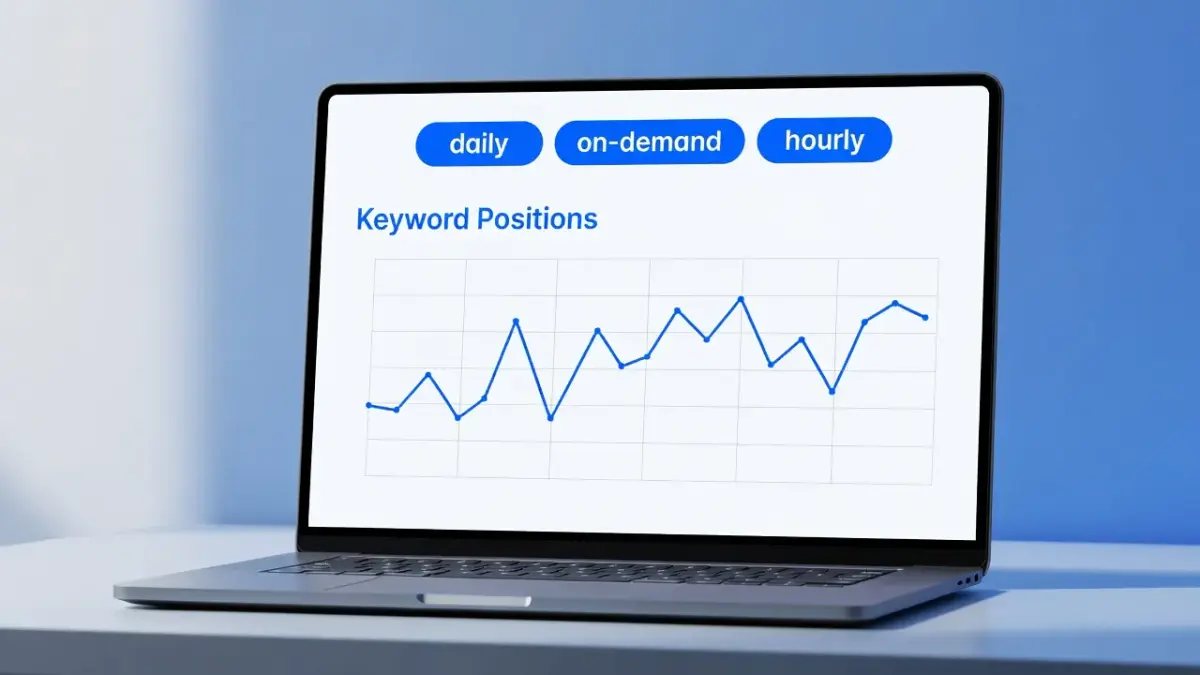
No rank tracker is truly real time. The fastest you can get is an on-demand refresh (AccuRanker, SE Ranking, ProRankTracker) or hourly checks (ProRankTracker), while Semrush, Ahrefs and STAT lean on scheduled daily or weekly updates. "Real time SERP tracking" in practice means you click refresh and wait a minute or two for a fresh crawl. For most small businesses, that's plenty.
A faster refresh still leaves you with the question of what to do about a position change. PulseRank handles the content side of that: it publishes one article a day and shows, through built-in Search Console reporting, what each article ranks for and where it's under-earning its position.
From what I've seen in forums and in my own use, the most common complaint isn't "my tracker is too slow." It's "my tracker says position 4 and Google says position 9." That gap comes from location, device and personalization, not refresh speed, and it's worth knowing before you pay extra for freshness.
What does "real time" actually mean in rank tracking?
"Real time" in rank tracking means a keyword's position on the search engine results page is re-checked on demand or within the hour, rather than on a nightly or weekly schedule. Nobody streams SERP changes live. Every tool sends a query, parses the results and stores a snapshot.
Three levels exist, and vendors blur them:
- Scheduled checks: daily or weekly, set by your plan.
- On-demand refresh: you hit a button and get a fresh snapshot for chosen keywords.
- Hourly or custom-interval checks: the tool re-runs keywords automatically many times a day.
If a vendor says "live" or "instant," ask which of the three they mean. I've covered the hourly end in more depth in this guide to rank tracking software that does hourly updates.
Does AccuRanker offer real-time rank tracking?
Yes, as close as the category gets: AccuRanker is built around on-demand keyword refreshes rather than waiting for a nightly crawl. It's a rank tracker first and an all-in-one SEO suite barely at all, which is exactly why it made this list. The AccuRanker site leads with fast, large-scale tracking.
- Pick it if: you manage many keywords or clients and want to force a refresh right after a content push or a ranking drop.
- Trade-off: it tracks and reports, but it doesn't help you decide what to write next, so you'll pay for other tools too.
Does Semrush Position Tracking update in real time?
No. Semrush's Position Tracking is built around daily updates, not a live feed. That's fine for trend lines, and it's what most agencies need.
You get tracking tucked inside a large suite, so one login covers keyword research, site audits and competitor data. In my opinion, that's the actual reason to use it. Don't buy Semrush because you expect real-time SERP tracking.
- Pick it if: you already use Semrush for other work and daily movement is enough.
- Trade-off: keyword caps are tied to your plan, and Semrush's pricing page is where you check the current limits before assuming your list fits.
Does Ahrefs Rank Tracker update in real time?
Not as a live feed: Ahrefs Rank Tracker works on scheduled updates, with manual refresh options layered on top. The update frequency depends on your plan, so check Ahrefs' pricing page as of November 2026 before counting on daily checks.
I like Ahrefs for the data it connects, since rankings sit next to backlink and traffic estimates. I wouldn't pick it purely for fast refresh.
- Pick it if: you want rank data alongside link and content research in a tool you already pay for.
- Trade-off: faster or more frequent checking costs more, and that gets expensive once your keyword list grows.
If you want a deeper look at how Ahrefs estimates traffic from those positions, I wrote about Ahrefs organic traffic value and its accuracy.
Is STAT Search Analytics good for real-time rank tracking?
STAT is excellent for large-scale, enterprise-grade SERP data, but I wouldn't call it a real-time tool. STAT is Moz's enterprise product, built for big keyword sets and SERP-feature analysis rather than checking one phrase every hour.
Pricing is quote-based as far as I can see, so a small business can't just sign up and test it. That alone rules it out for most readers here.
- Pick it if: you run thousands of keywords across markets and need SERP-feature depth with reporting for stakeholders.
- Trade-off: it's overbuilt and out of reach for a small site with a few hundred keywords.
Does ProRankTracker offer real-time rank tracking?
ProRankTracker comes closest on the hourly side: it advertises frequent update intervals, including hourly, on top of manual refresh. The ProRankTracker site pitches it as a pure rank checker with a lot of engines and locations.
- Pick it if: you want the most frequent automatic checks and don't need a content suite attached.
- Trade-off: it's a narrow tool, so research, writing and publishing all happen somewhere else.
My view: hourly tracking is a nice-to-have unless you're running a launch, a migration or a competitive fight over one keyword.
Does SE Ranking offer a real-time rank tracker?
SE Ranking offers daily tracking plus an on-demand check, so it's near-real-time rather than live. The SE Ranking rank tracker sits inside a broader toolkit that also covers audits and keyword research.
That mix is why it's a common pick for small agencies. It gives you the refresh button without forcing you into enterprise pricing.
- Pick it if: you want a mid-priced all-rounder with on-demand refresh.
- Trade-off: the all-in-one breadth means you pay for modules you may never open.

Real time rank tracking tools compared
The table below lays out how each option refreshes and who it suits, as of November 2026. Vendors change plans often, so confirm the current update frequency on their pricing pages before buying.
| Tool | Update style | Pick it if |
|---|---|---|
| PulseRank | Search Console reporting on each published article, plus AI citation tracking | You want to see what your published articles rank for and where they under-earn, without a separate rank checker |
| AccuRanker | On-demand refresh | You handle large keyword sets or many clients |
| ProRankTracker | Frequent automatic checks, including hourly options | You want the fastest scheduled cadence |
| SE Ranking | Daily plus on-demand check | You want a mid-priced all-rounder |
| Semrush Position Tracking | Daily updates | You already live in Semrush |
| Ahrefs Rank Tracker | Scheduled updates, manual refresh extras | You want rank data next to backlink research |
| STAT Search Analytics | Enterprise-scale scheduled tracking | You track thousands of keywords across markets |
Do you actually need real-time rank tracking?
For most small and medium businesses, no: daily data answers almost every question you'll have. Rankings wobble for hours after Google tests changes, so reacting to each wobble just makes you busy.
Real-time checking earns its keep in three cases:
- Launches: you shipped a page and want to confirm it's indexed and placed.
- Migrations: you moved a domain or restructured URLs and need to catch drops fast.
- Head-to-head fights: one money keyword where a competitor is closing in.
The bigger bottleneck for a growing business is usually publishing enough good content, not checking positions faster. That's the gap PulseRank fills. It researches your keyword pool, builds a 30-day content plan, then writes and publishes one citation-ready article a day straight to your WordPress, Shopify, Wix or Git site.
The reporting side pairs Google Search Console data with AI citation tracking, so you see both what your articles rank for and whether answer engines cite you. It's one flat plan at $499 per month with a 7-day free trial, and you can see how it works here. If AI citations are part of your goal, AI optimization for generative search explains the approach.
I'd pick PulseRank over stacking a rank tracker, a writing tool, an image tool and a publishing plugin. The tradeoff is spending your budget on output instead of refresh rate, and for a business trying to grow, that's where I'd spend it.
How to set up real time SERP tracking without wasting your keyword budget
You can get useful near-real-time tracking in about 30 minutes by refreshing only the keywords that matter. Refreshing everything hourly burns your limits for no gain.
- Pick a short watch list: 10 to 30 keywords tied to revenue or a recent launch.
- Set the right location and device: a tracker showing national desktop results will disagree with your customers' mobile local results, so mobile rank tracking matters here.
- Keep everything else on daily: let the rest of your list update on schedule.
- Cross-check with Google: Google's Performance report documentation describes clicks, impressions and average position. That's an average, not a live spot.
- Act on trends, not blips: wait for several days of movement before rewriting a page.
For the broader workflow, see how to monitor search engine rankings and the roundup of daily rank tracking tools.
Frequently Asked Questions
Is real time SERP tracking the same as real time rank tracking?
Yes, they describe the same thing. Both mean re-checking where your pages appear in search results on demand or very frequently, rather than on a long schedule.
Does Google Search Console show real-time rankings?
No, it shows average position over a period, not a live rank. Its data is useful for trends and for seeing which queries earn clicks, but it won't mirror a tracker's snapshot of one exact spot.
Why does my rank tracker disagree with what I see in Google?
Location, device, language and personalization change what each searcher sees. A tracker reports one defined configuration, so set the city and device to match your customers.
Is hourly rank tracking worth paying for?
Only if you're in a launch, migration or tight competitive fight. Otherwise daily data is enough, and the extra checks mostly eat into your keyword limits.
Can I track AI answer engine citations in real time?
Not reliably with classic rank trackers, which measure search result positions. Citation tracking is a separate measurement, and PulseRank includes it alongside its Search Console reporting.
Is there a free way to monitor rankings?
Google Search Console is free and shows queries, clicks and average position for your own site. It won't track competitors or give you an on-demand snapshot, so it complements a paid tracker.
How many keywords should I refresh on demand?
Start with 10 to 30 revenue-linked or recently updated keywords. Expand only if daily data keeps leaving you with unanswered questions.
Do agencies need a different tool than small businesses?
Often yes, because client volume and reporting needs raise the stakes. The agency rank tracking software comparison covers that case.