

The best agency rank tracking software for modern SEO firms prioritizes client isolation, multi-device search engine tracking, automated reporting, and AI answer engine visibility. Managing rank tracking across dozens of client domains requires dedicated multi-tenant workspaces, white-label PDF generation, and real-time rank updates rather than legacy weekly scrapes. As of September 2026, traditional rank tracking alone is no longer enough. Agencies must also track organic visibility inside AI Overviews and conversational search engines to prove true return on investment to stakeholders.
What rank tracking tools do SEO agencies actually use?
SEO agencies primarily use dedicated rank tracking tools such as AccuRanker, Advanced Web Ranking, Semrush, Ahrefs, BrightLocal, and integrated platforms like PulseRank to monitor keyword rankings across diverse client accounts. The choice depends on portfolio volume, localized tracking needs, and reporting workflows.
Smaller boutique agencies often start with all-in-one platforms like Ahrefs or Semrush because they bundle keyword research, backlink analysis, and rank tracking into one subscription. However, as an agency grows past 20 active retainer clients, dedicated rank trackers or execution platforms become essential. Dedicated tools prevent data caps from throttling daily updates and provide granular permission settings for client logins.
Agencies handling local accounts rely heavily on geo-grid rank trackers to measure map pack positions across specific zip codes. Enterprise agencies managing thousands of URL paths opt for API-first rank trackers that stream position data straight into custom Data Studio dashboards or internal analytics warehouses.
How well do rank trackers handle multiple clients for agencies?
Modern rank trackers handle multiple clients by using isolated client profiles, dedicated permission tiers, custom tag structures, and automated white-label reporting schedules. Without these features, managing 50 client accounts in a single workspace leads to misallocated keyword budgets and reporting errors.
Here is how specialized agency rank tracking software keeps client accounts organized:
- Account Partitioning: Organizes keywords into isolated client folders so client teams only see their own dashboard.
- Granular Permission Controls: Allows account managers to grant read-only access to external stakeholders while restricting access to billing and project configurations.
- Custom Tagging and Categorization: Groups keywords by page type (e.g., product pages vs blog posts), campaign phase, or search intent across multiple client domains.
- Automated White-Label Reports: Schedules recurring PDF or live web reports featuring the agency's logo, brand colors, and custom domain URL.
- Search Volume and Share of Voice Filtering: Isolates mobile vs desktop positions across local zip codes without blending global search context into localized campaigns.
When evaluating how to monitor search engine rankings for a broad client base, multi-tenant workspace architecture is the single most important operational requirement.
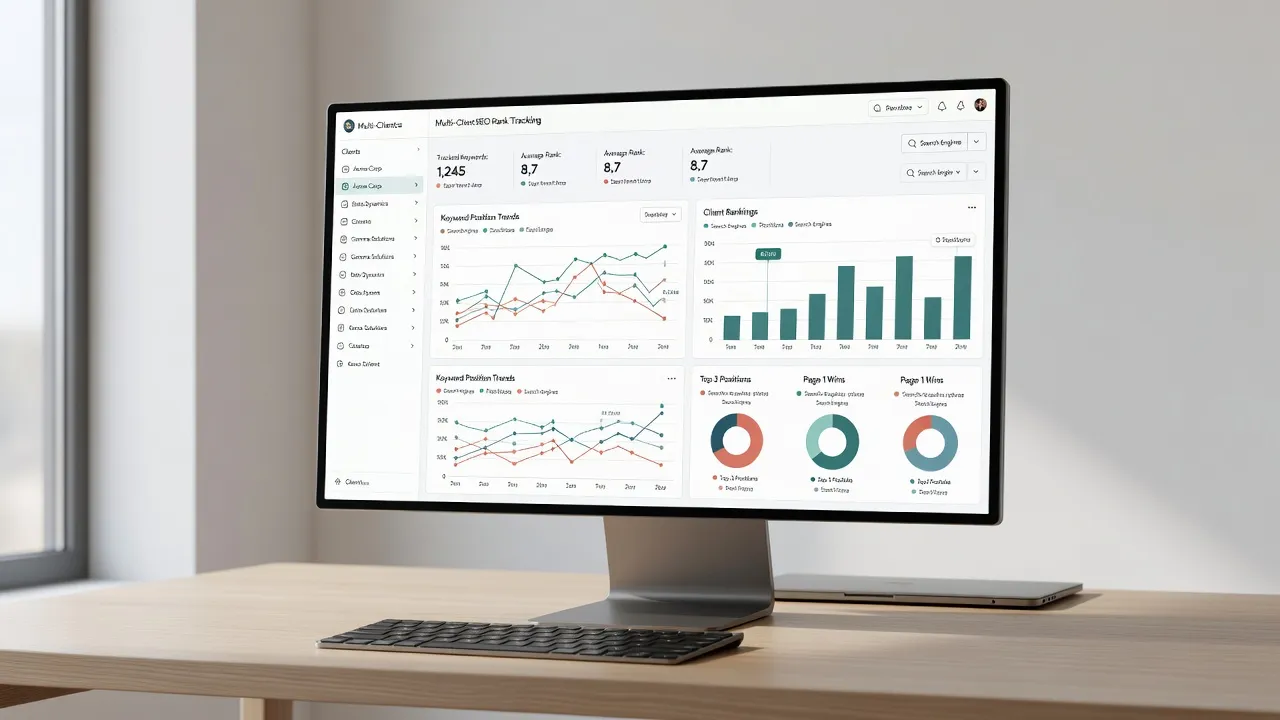
Best agency rank tracking platforms compared
The table below breaks down the top agency rank tracking platforms based on client management features, reporting capabilities, primary constraints removed, and base pricing checked in September 2026.
| Platform | Target Use Case | Client Management & Reporting | Primary Constraint Removed | Starting Price |
|---|---|---|---|---|
| PulseRank | Content execution & AI citation tracking | Single dashboard with integrated Search Console & AI citation tracking | Eliminates manual content production and separate rank tracking tool stacks | $499/month (flat plan) |
| AccuRanker | Real-time, high-volume rank tracking | Unlimited domains, custom tags, automated white-label reports | Eliminates rank update delays with on-demand refresh buttons | $129/month |
| Semrush | All-in-one SEO suite & competitive analysis | Client Portal add-on, multi-project management | Removes the need for fragmented third-party audit and backlink tools | $139.95/month |
| Ahrefs | Backlink-focused rank monitoring | Project-based tracking, client sharing permissions | Eliminates guesswork around competitor link velocity and share of voice | $129/month |
| BrightLocal | Local SEO & multi-location rank tracking | Local Search Grid, client-facing dashboards | Removes geo-location manual work for map pack tracking | $39/month |
| Advanced Web Ranking | Enterprise custom ranking & white-label reporting | Dynamic client permissions, unlimited sub-accounts | Eliminates strict project capping for high-volume agency portfolios | $99/month |
1. PulseRank: Automated content execution and AI citation tracking
PulseRank is an integrated SEO and generative engine optimization (GEO) platform that pairs rank tracking with automated daily content publishing. Instead of forcing agencies to check ranks in one tool and execute content fixes in another, it manages the full content lifecycle in a single workflow.
For agencies managing organic growth campaigns, PulseRank removes the manual overhead of writing, formatting, and tracking performance across multiple tools. The platform generates a 30-day content plan from targeted keyword pools, then writes and publishes citation-ready articles directly to WordPress, Shopify, Wix, or Git repositories.
Key features for agencies
- Search Console Reporting: Built-in performance dashboards aggregate real Google Search Console data alongside traditional positions, flagging pages that are under-earning their target rankings.
- AI Citation Tracking: Monitors whether client content gets cited inside AI answer engines alongside standard search engine result pages.
- End-to-End Content Pipeline: Automatically formats articles with markdown tables, structured data, sourced external links, and inline images before publishing daily.
Trade-offs
PulseRank is designed specifically for organic content execution and rank tracking. Agencies seeking standalone technical site audit tools or backlink link-building packages will still use specialized secondary tools alongside it.
Pricing
PulseRank costs $499 per month for one flat plan. It includes keyword research, content strategy, 30 published articles per 30-day cycle, image generation, direct publishing, and reporting dashboards with no credit metering or per-seat charges.
2. Ahrefs vs SEMrush rank tracking for agencies: how do they compare?
Semrush offers more flexible client reporting options and faster daily rank updates, while Ahrefs provides superior backlink context alongside its keyword tracking metrics. Choosing between them comes down to whether your agency prioritizes client reporting portals or backlink link building insights.
Agency Rank Tracker Selection
Divide your selection between two categories:
All-in-One Suites
- Ahrefs (Link Focus)
- Semrush (Reporting)
- PulseRank (GEO Content Execution)
Specialized Trackers
- AccuRanker (Speed)
- BrightLocal (Local Maps)
- AWR (Custom Enterprise)
Semrush position tracking
Semrush stands out for agency workflows due to its dedicated Client Portal add-on and versatile reporting builder. According to the official Semrush position tracking features documentation, the tool updates rankings daily and allows agencies to track keywords down to specific zip codes and device types.
- Strengths: Excellent multi-location tracking, automated client PDF builder, strong competitive keyword discovery.
- Trade-off: High-volume rank tracking gets expensive quickly. Tracking thousands of keywords across multiple client projects requires higher subscription tiers or add-on units.
Ahrefs rank tracker
Ahrefs integrates rank tracking directly into its site audit and backlink database. As outlined in the official Ahrefs rank tracker documentation, it automatically calculates Share of Voice (SoV) and tracks competitor movement across tracked keyword lists.
- Strengths: Deep integration with domain authority and backlink profiles, intuitive mobile vs desktop rank toggles.
- Trade-off: Rank updating frequency depends on your plan level, and client sharing options are restricted compared to dedicated white-label tools.
3. What AccuRanker features suit agencies, like client management and API integrations?
AccuRanker suits high-volume SEO agencies by offering instant on-demand rank updates, custom client tagging, unlimited domain profiles, and robust API access. It focuses purely on rank tracking, making it one of the fastest search engine position trackers on the market.
For an agency managing enterprise accounts, waiting 24 to 48 hours to confirm rank changes after a major algorithm update is unacceptable. As detailed on the AccuRanker agency features page, users can manually refresh keyword rankings every 2 hours when real-time validation is needed.
Key agency capabilities
- Unlimited Domains and Users: AccuRanker does not charge extra for adding client organizations or team member logins.
- REST API Access: Agencies can export raw rank data directly into custom client dashboards or internal business intelligence platforms.
- Tagging and Dynamic Segmentation: Group keywords by search intent, target landing page, or custom client parameters to filter large datasets instantly.
Trade-offs
AccuRanker does not include site auditing, backlink analysis, or content creation features. It acts strictly as a specialized rank tracking engine.

4. How does BrightLocal Rank Tracking work for local SEO agencies?
BrightLocal Rank Tracking works by pin-pointing local map pack positions and organic local search results across custom zip codes, neighborhoods, and geo-coordinates. Standard rank trackers often fail for local businesses because search results change dramatically based on the searcher's exact physical location.
Local service businesses and multi-location franchises require specialized local rank tracking software to measure true local visibility.
How local rank tracking functions
- Local Search Grid: BrightLocal uses a visual grid overlaid on Google Maps to display map pack positions across a 3x3 or 5x5 mile radius.
- Geo-Targeted Keyword Tracking: Tracks search queries with specific local parameters (e.g., "plumber near me" or "dentist Austin TX") without requiring manual IP proxy setups.
- Citation and Reputation Monitoring: According to the official BrightLocal rank tracker page, the suite cross-references search ranks with local review counts and citation consistency.
Trade-offs
BrightLocal is built specifically for local SEO. It is not designed for national e-commerce campaigns, global SaaS brands, or non-localized organic content tracking.
5. How does Advanced Web Ranking compare as an agency rank tracker?
Advanced Web Ranking (AWR) compares as a highly customizable enterprise rank tracker designed for agencies that require white-label reporting and unlimited sub-account structures. It has been a staple in the agency market for over two decades due to its flexible data collection settings.
As documented on the official Advanced Web Ranking reporting documentation site, AWR allows agencies to customize search engine user agents, tracking frequencies, and geo-locations down to the city level.
Key agency advantages
- Custom White-Label Permalinks: Deliver live interactive dashboards to clients hosted on your agency's custom domain name.
- Flexible Tracking Frequencies: Save budget by setting low-priority client keywords to update weekly while tracking critical head terms daily.
- Developer API: Full JSON API access allows seamless integration with enterprise reporting pipelines.
Trade-offs
The user interface feels technical and less modern than newer cloud platforms. Setting up advanced reporting templates requires a steep learning curve for new account managers.
Why traditional agency rank tracking is out of date in 2026
Traditional agency rank tracking is out of date because monitoring desktop blue links on Google ignores the growing share of search traffic answered directly by AI models. In 2026, searchers rely heavily on AI Overviews, ChatGPT, Perplexity, and conversational search interfaces.
Tracking position #2 on standard Google SERPs means little if an AI answer engine generates a zero-click summary above the organic results that excludes your client's brand.
2026 Search Engine Reality
| Search Result Type | Tracking Method Required |
|---|---|
| AI Answer Engine / AI Overview (Top Citation Area) | GEO & Citation Tracking |
| Traditional Organic Blue Links (Positions #1–10) | Standard Rank Tracking |
The AI Answer Engine / AI Overview appears above traditional organic blue links in search results.
What modern rank tracking software must include
Agencies upgrading their stack in 2026 look for three essential capabilities:
- Generative Engine Visibility: Tracking whether client content gets cited in AI-generated answers. Agencies offering generative engine optimization agency services must prove citation placement to retain clients.
- First-Party Performance Integration: Combining position tracking with Google Search Console data to spot pages that hold top positions but fail to generate expected click-through rates.
- Execution-Linked Tracking: Linking rank monitoring directly to content publishing workflows so agencies can measure how fast new articles gain search visibility.
Platforms like PulseRank address this shift directly by pairing daily rank metrics and Search Console analysis with an automated content generation engine. This allows agencies to scale client campaigns without adding headcount.
How to choose the right rank tracker for your agency
Selecting the right software depends on your agency's size, client retainers, and primary service offerings.
- For local SEO agencies: Choose BrightLocal for map grid visibility and local review integration.
- For enterprise technical SEO: Choose AccuRanker or Advanced Web Ranking for API access, instant updates, and dynamic client tagging.
- For all-in-one research suites: Choose Semrush or Ahrefs if you want backlink data and competitive auditing in one place.
- For scalable organic content operations: Choose PulseRank if you need enterprise rank tracking combined with end-to-end keyword research, content creation, direct publishing, and AI citation tracking.
Evaluating your reporting bottlenecks and keyword volume today ensures you pick a tool that scales alongside your agency's growth.
Frequently Asked Questions
What is agency rank tracking software?
Agency rank tracking software is specialized SEO software designed to monitor search engine positions across multiple client domains, offering multi-tenant client organization, white-label reporting, and localized keyword tracking.
How much does agency rank tracking software cost?
Agency rank tracking costs range from $39 per month for small local setups up to $499 per month for integrated enterprise execution platforms, depending on keyword volume, update frequency, and client reporting features.
Can rank tracking tools track AI search engine answers?
Yes, modern rank trackers and GEO platforms track brand mentions and content citations inside AI Overviews, ChatGPT, and conversational search engines alongside traditional organic rankings.
What is the difference between daily and on-demand rank tracking?
Daily rank tracking automatically updates search positions once every 24 hours, while on-demand rank tracking allows account managers to manually trigger instant position refreshes during major campaigns or algorithm updates.
Why do agencies need white-label rank tracking reports?
White-label reports allow agencies to send clean rank performance PDFs or live dashboards styled with their own branding, logo, and domain URL, building trust and professional credibility with clients.
Is Google Search Console enough for agency rank tracking?
Google Search Console is essential for tracking real impression and click data, but it lacks localized zip-code tracking, competitor position comparisons, automated white-label client PDF exports, and real-time rank updates.