

Outbound links in SEO are hyperlinks on your website that point visitors to external domains. Linking out to authoritative third-party sources signals topic depth to search engines, helps algorithms contextualize your website within a broader niche, and builds reader trust without leaking your site's PageRank.

Should you add external links to your blog post?
Yes, you should add external links to your blog post whenever citing third-party facts, expert research, or primary sources. Including outbound links helps search engines understand the topic of your content while proving to readers that your claims are backed by reliable data.
Leaving out external references out of fear that you will lose website visitors or leak search authority is an outdated tactic. Search algorithms evaluate web pages based on how comprehensively they satisfy user intent. Citing high-quality references shows that your resource is well-researched.
When you link to helpful resources, you create a better user experience. Search engines monitor how users interact with pages, and providing clear paths to verifiable information reduces bounce rates caused by reader skepticism.
How many outbound links should a blog post have?
A blog post should typically feature two to five outbound links per 1,000 words, depending on the topic's technical complexity. There is no fixed algorithm penalty for having too few or too many external references, provided every link serves a genuine user purpose.
The primary variable that determines your link count is the nature of your content. A light opinion piece might only cite one primary source, whereas a heavily researched guide on content marketing with seo might require six or seven external citations to document its technical assertions accurately.
- Short-form posts (500-800 words): 1 to 3 external links to foundational studies or official tools.
- Standard long-form articles (1,500-2,500 words): 4 to 8 external links spread evenly across sub-topics.
- Technical documentation or deep research: 8+ external links to whitepapers, government data, or developer documentation.
Avoid stuffing paragraphs with dozens of references. Excessive outbound linking dilutes the visual experience and can trigger spam filters if the destination URLs lack topical relevance.
What counts as a good outbound link for SEO?
A good outbound link points to a reputable, topically relevant domain that directly corroborates the claim made in your text. Good destinations include official product documentation, peer-reviewed journals, recognized industry publications, and established encyclopedias.
Search engines evaluate the relationship between your source page and the destination page. A good outbound link uses descriptive anchor text rather than generic labels like "click here" or "source."
Good Anchor Text: According to the U.S. Census Bureau data...
Bad Anchor Text: To see the population numbers, click here...
| Outbound Link Type | Common Destination | Target Attribute | SEO Impact |
|---|---|---|---|
| Editorial Citation | Documentation, research studies, statistics | Standard (dofollow) | High positive topical context; validates author accuracy. |
| Commercial Link | Affiliate programs, sponsored partners | rel="sponsored" | Neutral for authority; prevents manual search penalties. |
| User-Generated | Forum replies, comment sections | rel="ugc" | Neutral; prevents comment spam from passing site authority. |
| Unvetted Link | Third-party directory, user submitted site | rel="nofollow" | Neutral; isolates your site from low-trust destinations. |
What does Google's John Mueller say about outbound links?
Google Search Advocate John Mueller has repeatedly stated that outbound links do not directly boost rankings as a standalone metric, but they provide valuable contextual signals to search engines. Mueller notes that linking out to quality sources is a natural part of writing good content and helps Google recognize what your page is about.
In multiple Google Search Central office-hours sessions, Mueller clarified that search algorithms do not reward pages simply for inserting random links. Instead, the value comes from helping the user navigate to relevant information. Google documents these link expectations in its Google Search Central link guidance.
Mueller has also warned against link exchanges and paid link schemes. If you link to external sites in exchange for money or reciprocal placements, you must use proper attributes like rel="nofollow" or rel="sponsored" to comply with Google's spam policies.
What are Ahrefs' recommendations for outbound links?
Ahrefs recommends using outbound links naturally to reference primary research, while ensuring all external destinations are healthy and broken-link free. According to Ahrefs' outbound linking studies, external links act as network nodes that assist search crawlers in categorizing web pages within broader topic clusters.
Ahrefs highlights three core habits for managing external links effectively:
- Audit for broken external links: Outbound links that lead to 404 pages harm user experience and signal poor site maintenance.
- Avoid link farm destinations: Linking to low-quality, spammy domains can negatively affect search engines' perception of your neighborhood quality.
- Use clear, descriptive anchor text: Ensure the anchor text clearly communicates what the reader will find on the other side of the click.
Maintaining healthy site architecture means regularly monitoring outbound links alongside internal connections. If you want to boost search engine rankings, keeping your external references updated is just as important as building new incoming links.
What are Moz's best practices for outbound links?
Moz advises webmasters to treat outbound links as a trust currency that adds value to the reader experience while preserving site authority. In Moz's learning center on external links, the SEO platform stresses that linking out to high-authority pages reflects positively on your own site's credibility.
Moz outlines several rules for outbound link management:
- Link for the user first: Only add an outbound link if it helps the reader expand their understanding of a topic.
- Keep anchor text natural: Avoid over-optimizing external anchor text with targeted keyword phrases that look manipulative.
- Manage PageRank flow: Use
rel="nofollow"on untrusted content or paid links, but allow natural editorial links to pass standard authority signals.
When applied consistently, these principles protect your domain from algorithmic penalties while improving overall page utility.

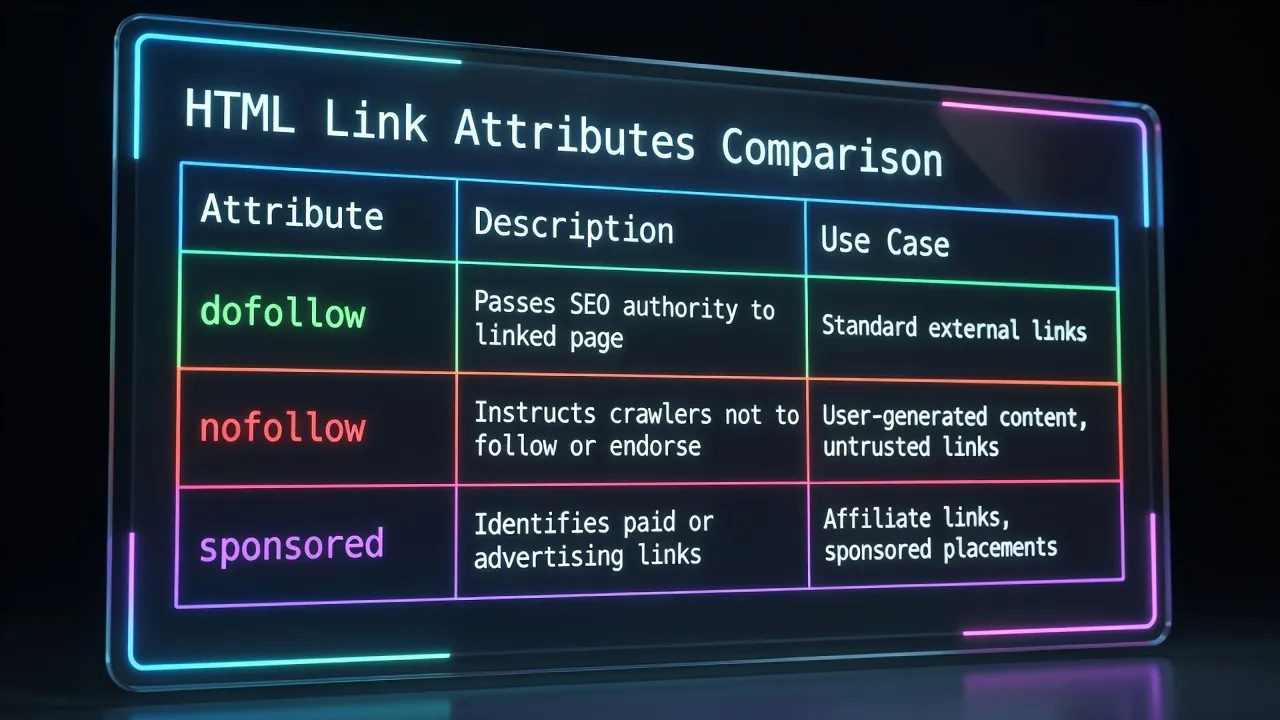
How outbound link attributes (dofollow, nofollow, sponsored) affect authority
Link attributes tell search engine crawlers how to treat the connection between your page and the destination URL. By default, any standard HTML link acts as a "dofollow" link, passing contextual signals and crawl attention to the target domain.
If you list an external service or affiliate product, using the wrong attribute can result in search penalties. The standard attribute choices include:
- Standard links (
dofollow): Used for genuine editorial references where you vouch for the source's credibility. rel="nofollow": Tells search engines not to associate your site with the target page or pass search authority.rel="sponsored": Required by search engines for any paid link, advertisement, sponsored article, or affiliate placement.rel="ugc": Designed for links contained inside user-generated content, such as blog comments or forum posts.
Using rel="sponsored" on monetization links protects your site from algorithmic link-spam filters. It allows search engines to identify commercial arrangements without penalizing your organic search footprint.
Managing outbound citations at scale with PulseRank
Maintaining accurate outbound citations across dozens of new articles requires a structured content pipeline. Citing real third-party sources, formatting anchor text correctly, and adding appropriate link attributes takes significant editorial effort when producing high-volume content.
This is where automated platform management helps scaling businesses. PulseRank is an organic content platform that handles keyword research, strategy, writing, image generation, and publishing in one system. For $499 per month, it builds a full 30-day content plan and publishes one citation-ready article per day directly to your website.
Every piece generated by PulseRank includes pre-researched third-party facts, structured data tables, and natural internal links to existing assets on your site. The built-in Google Search Console view lets you monitor how each published page ranks and tracks generative AI citations in real time.
If you are expanding your publishing calendar, automating fact-checking and outbound citation structures prevents editorial bottlenecks while keeping your site compliant with modern search guidelines.
Frequently Asked Questions
Do outbound links reduce my page authority?
No, normal outbound links do not drain or leak your website authority in a harmful way. Linking out to relevant, trustworthy resources helps search engines understand your content context and improves page quality.
Should outbound links open in a new tab?
Yes, opening external links in a new browser tab (target="_blank") is recommended. This allows readers to review the external source without losing their place in your article.
What is the difference between an inbound link and an outbound link?
An inbound link (backlink) comes from an external website pointing toward your site. An outbound link is a hyperlink on your website pointing out to an external domain.
Can linking to bad sites hurt my search rankings?
Yes, linking to spammy, deceptive, or irrelevant websites can hurt your site's search reputation. Always link to trusted, authoritative destinations or use rel="nofollow" if you must link to an unverified source.
Is there a penalty for having too many outbound links?
There is no automated penalty for a high link count alone, but excessive linking that disrupts reading or looks like a link exchange scheme can trigger web spam algorithms. Keep links helpful and natural.
Do AI answer engines look at outbound links?
Yes, generative search engines evaluate external sources cited on web pages to verify factual claims before using those pages as citation sources in AI overviews.