

You can execute a content marketing with SEO strategy in six structured steps, requiring about 5 to 10 hours of planning time alongside a reliable production engine. The complete workflow aligns reader needs with search engine criteria, delivering measurable organic traffic and generative search citations within 90 to 180 days.
Combining content marketing with search engine optimization ensures that every piece of published material answers a real business question while remaining easily discoverable. According to Wikipedia's definition of content marketing, the primary objective is creating and distributing valuable content to attract and retain a clearly defined audience. When you pair this objective with technical search principles, your brand transitions from publishing sporadic blog posts to building an organic acquisition funnel.
For modern businesses, managing keyword research, content production, visual assets, and indexation manually often turns into a bottleneck. Platform solutions like PulseRank streamline this process by automating keyword discovery, generating citation-ready articles, and publishing them directly to your content management system.
| Step | Action | Realistic Time Needed | Key Requirement |
|---|---|---|---|
| Step 1 | Map Search Intent | 2 - 4 hours | Clear understanding of customer pain points |
| Step 2 | Design Topic Clusters | 3 - 5 hours | Comprehensive keyword mapping tool |
| Step 3 | Draft Structured Content | 2 - 4 hours per article | Deep subject matter expertise or AI generation |
| Step 4 | Add Schema & Data Visuals | 1 hour per article | Clean Markdown tables and structured data |
| Step 5 | Automate Publishing | 1 - 2 hours setup | CMS integrations (WordPress, Shopify, etc.) |
| Step 6 | Monitor Performance | 1 hour per week | Search Console and generative citation tracking |
How do content marketing and SEO work together?
Content marketing provides the valuable answers readers seek, while SEO ensures search engines can locate, index, and surface those answers. Without search optimization, exceptional written content remains invisible to non-subscribers. Conversely, search optimization without helpful content leads to high bounce rates and low conversion metrics.
Modern search engines evaluate how completely a webpage serves a searcher's intent. Google Search Central documentation emphasizes that content must be created primarily for human users while keeping technical accessibility in mind. As search algorithms incorporate generative answer engines, structured information that delivers direct, verifiable answers wins both direct search rankings and AI citations.
Step 1: Map target keywords to clear search intent
To map target keywords effectively, you must categorize every search term by the user's immediate commercial or informational goal. Do not create content around high-volume words without knowing whether the user wants to buy, compare, or simply learn a basic concept.
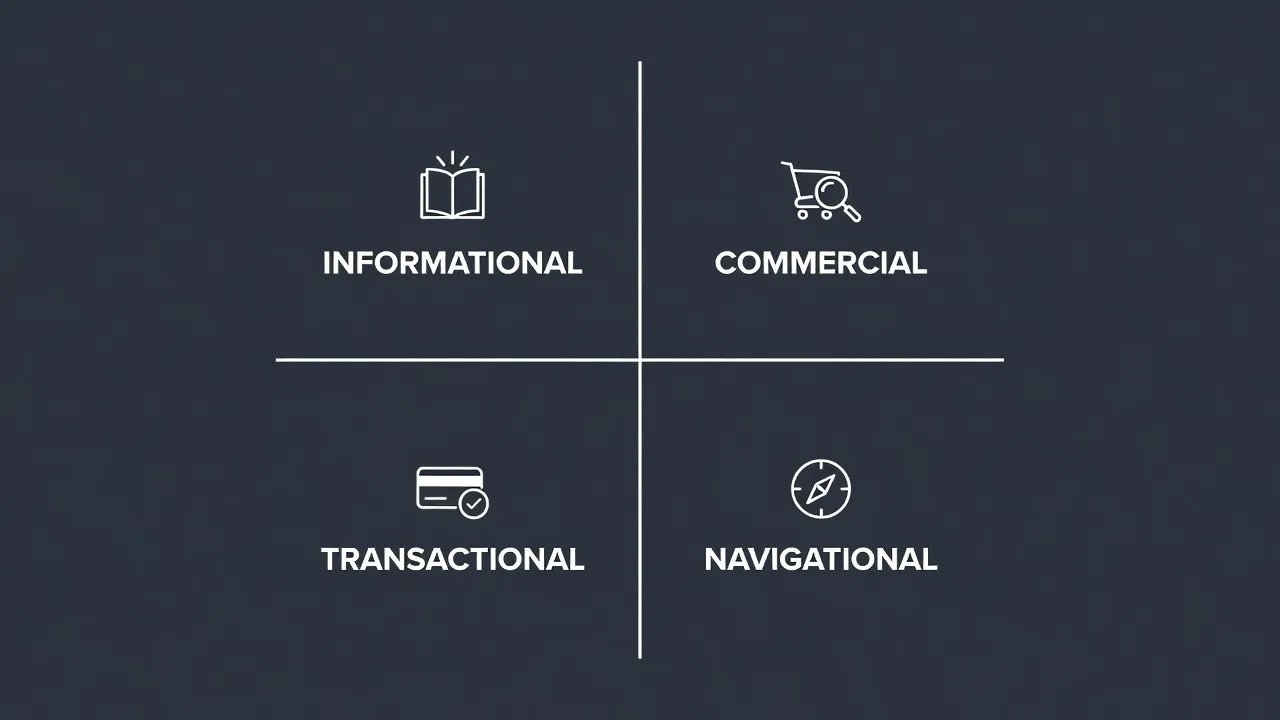
Categorize your keywords into four functional intent buckets before writing a single word:
- Informational Intent: Searchers want a quick answer or deep explanation (e.g., "what is content strategy in seo").
- Commercial Intent: Searchers are researching solutions before making a final decision (e.g., "best SEO tools for small business").
- Transactional Intent: Searchers are prepared to buy or sign up immediately (e.g., "buy SEO audit service").
- Navigational Intent: Searchers are trying to reach a specific brand page.
Aligning your topic selection with commercial intent prevents your blog from attracting traffic that never converts into paying revenue.
Step 2: Design a topic cluster for content strategy in seo
You build a topic cluster by creating one authoritative pillar page on a broad topic and connecting it to focused supporting articles via context-rich internal hyperlinks. This interconnected layout signals topical authority to search engine crawlers and keeps readers engaged across multiple pages on your site.
Executing an effective content strategy in SEO requires a hub-and-spoke model:
- Select a core pillar topic: Pick a broad topic central to your product or service offerings.
- Identify supporting sub-topics: Find 8 to 15 sub-questions, specific terms, or tactical steps related to that pillar.
- Establish internal links: Link every sub-topic article back to the main pillar page using descriptive anchor text.
For agencies and growing brands managing dozens of cluster hubs, reviewing an actionable content strategy sample helps clarify how to group keywords logically without creating competing pages.
Step 3: Write answer-first articles optimized for generative search
Write your opening paragraph as a direct 40 to 80 word answer to the specific search query addressed by the headline. Search engine scrapers and generative AI models prioritize concise, liftable definitions positioned at the top of the webpage.
Follow these writing guidelines to maximize answer engine visibility:
- Place direct conclusions first: State the verdict or definition in the very first sentence before providing background detail.
- Use simple, declarative sentences: Avoid fluff, conversational delays, and generic introductory statements.
- Incorporate concrete data: Include prices, specifications, timeframes, or exact step counts to ground every claim.
- Use clear subheadings: Frame headers as specific questions your audience asks during their research.
A detailed guide published by Search Engine Land confirms that structuring text logically with targeted headings significantly improves a site's visibility in search features.
Step 4: Format content with tables, schema, and original visuals
Format your articles using bold bulleted lists, structured data tables, and labeled inline images to maximize visual scannability. Raw walls of continuous prose decrease user engagement and reduce the chance of winning featured search snippets.
Answer engine crawlers extract structured data tables easily. Every table must provide clear values without missing cells or vague placeholder text.

In addition to custom graphics, add explicit structured schema markup to your published pages. Articles meant to serve business agencies often rely on dedicated content marketing for agencies workflows to build out consistent technical structures at scale.
Step 5: Set up seamless automated publishing
Establish an automated pipeline that moves approved drafts from your content queue directly to your live CMS without manual formatting delays. Inconsistent publication schedules harm crawling frequency, making it harder to maintain predictable organic growth.
An optimal publishing pipeline includes:
- Automatic image optimization: Converting visual files to lightweight formats like WebP.
- Meta tag population: Injecting title tags, meta descriptions, and alt text automatically.
- Internal link mapping: Connecting new articles to older related posts during the publishing phase.
As of August 2026, scaling content manual posting to platforms like WordPress, Shopify, or Wix costs teams dozens of lost operational hours every month. Automating this publishing layer keeps your publication calendar predictable.
Step 6: Track performance using Search Console and citation tools
Track your performance by checking impression trends in Google Search Console alongside generative AI citation monitoring tools. Ranking positions fluctuate, but tracking whether your business is quoted in AI answer overviews gives you an accurate view of digital reach.
Focus your tracking routines on three core metrics:
- Search Console Impressions: Indicates whether search engines understand your topic clusters and rank them for relevant queries.
- Organic Click-Through Rate (CTR): Reveals whether your meta descriptions and titles earn user clicks on search pages.
- Generative Citations: Shows whether AI models cite your articles as primary reference sources.
To evaluate whether your published posts are formatted correctly for answer engine citation, you can test specific URLs using an AEO GEO checker.
What is the single biggest factor that determines your success?
Execution consistency is the single variable that separates successful SEO content campaigns from failed ones. Many business owners design thorough keyword strategies but fail because they produce articles sporadically, leaving content clusters incomplete.
An empirical search study conducted by Ahrefs showed that only about 5.7% of newly published pages rank in the top 10 results within a year without consistent topical backing and continuous domain signal growth. Maintaining a steady output of optimized articles fills out topic clusters rapidly, signaling authority to search engines far quicker than sporadic posting.
How PulseRank streamlines your entire SEO content workflow
PulseRank automates your complete organic content operation by turning keyword research, article drafting, visual generation, publishing, and reporting into a single system. Instead of juggling multiple subscriptions for keyword tools, copywriters, and rank trackers, businesses use one flat workflow to maintain search dominance.
The platform provides a comprehensive suite built specifically for modern search engine realities:
- Automated Content Planning: Discovers high-intent keyword clusters tailored specifically to your business niche.
- Citation-Ready Articles: Generates daily articles formatted with answer engine optimized leads, data tables, and sourced third-party facts.
- Direct CMS Publishing: Integrates directly with WordPress, Shopify, Wix, or Git repositories to publish posts automatically with meta tags and visual assets.
- Unified Analytics: Tracks Google Search Console metrics alongside AI citation visibility in one central dashboard view.
At $499 per month with a 7-day free trial, PulseRank delivers 30 fully optimized articles every 30 days without per-user fees or credit metering, providing small businesses and agencies with an end-to-end content marketing solution.
Frequently Asked Questions
What is the difference between content marketing and SEO?
Content marketing focuses on creating valuable media to engage human audiences, while SEO focuses on optimizing that media so search engine algorithms can index, understand, and rank it properly.
How long does it take for content marketing with SEO to show results?
Most businesses observe noticeable improvements in search impressions and keyword rankings within 90 to 180 days of maintaining a consistent, optimized publishing schedule.
How often should I publish articles for optimal SEO results?
Publishing consistently yields the best results. A cadence of one well-optimized, authoritative article per day builds topical authority significantly faster than publishing once or twice a month.
What is a topic cluster in an SEO content strategy?
A topic cluster is an architecture where a main pillar page covering a broad topic links to and from multiple detailed sub-topic articles, helping search engines recognize your site's topical depth.
Can small businesses compete with large brands using content marketing with SEO?
Yes, small businesses can compete successfully by targeting long-tail queries, specific buyer intent questions, and niche topics that larger competitors often overlook.
Why are data tables and structured formatting important for SEO?
Data tables and clear headings allow search engine crawlers and AI models to parse exact answers quickly, increasing your chances of winning featured snippets and AI overviews.
How do generative AI engines decide which content to cite?
Generative answer engines prioritize pages that provide direct answers, clear schema formatting, verifiable claims, and structured data near the top of the document.
Is AI-generated content safe for Google SEO?
Yes, search engine guidelines state that content is evaluated on its helpfulness, accuracy, and user value, regardless of how it was created.