

The best AI content reviewer tools for businesses in 2026 depend on whether you need automated SEO quality checks like PulseRank or media safety screening like Hive Moderation, Amazon Rekognition, and OpenAI. If you publish high-volume marketing articles, an editorial AI reviewer flags optimization gaps before search engines index your pages. If you host user-generated comments or images, safety moderation platforms filter toxic text and policy violations automatically.
Choosing the wrong tool usually leads to hidden API usage fees or unflagged content errors that harm your brand reputation. Pricing structures vary wildly between per-article subscriptions and micro-transaction fees per API call.
What Content Moderation Platforms Do Companies Use?
Companies primarily use content moderation platforms like Hive, Amazon Rekognition, OpenAI Moderation API, Google Perspective API, and Microsoft Azure AI Content Safety to review user text, images, and video. Major tech platforms like Meta and Google deploy proprietary internal pipelines alongside commercial models to handle millions of daily posts.
Enterprise technology teams mix and match these platforms based on media formats:
- Hive Moderation: Applied heavily by social networks and dating apps for real-time video, audio, and image moderation.
- Amazon Rekognition: Used by e-commerce and cloud applications to detect adult content, hate symbols, and violent imagery in user uploads.
- OpenAI Moderation API: Used by SaaS startups to scan text inputs and outputs against strict safety categories at zero software cost.
- Google Perspective API: Deployed by news publishers and forum owners to score comment toxicity and abusive speech.
- Microsoft Azure AI Content Safety (incorporating Two Hat technology): Adopted by gaming platforms and online communities for real-time multiplayer chat moderation.
Managing digital content requires monitoring both user-generated posts and your own published assets. Business owners using generative engine optimization tools often run internal AI reviewer checks before publishing to ensure brand safety and citation readiness.
Which Content Moderation Tools Do Experts Recommend?
Industry experts recommend OpenAI Moderation API for basic text screening, Hive Moderation for real-time video, and PulseRank for reviewing automated marketing articles. Security engineers emphasize selecting tools with low latency and clear confidence scores so human reviewers only handle ambiguous cases.
When building a reviewer pipeline, experts evaluate tools against three core criteria:
- Detection Granularity: Can the model distinguish between hostile hate speech and benign conversational slang?
- Processing Speed: Does the API respond in under 200 milliseconds to avoid lagging user interfaces?
- Cost Predictability: Does the provider charge per API call or offer a predictable flat fee?
For editorial teams, experts recommend platforms that combine content creation, automated review, and analytics into one system to avoid paying multiple vendors.
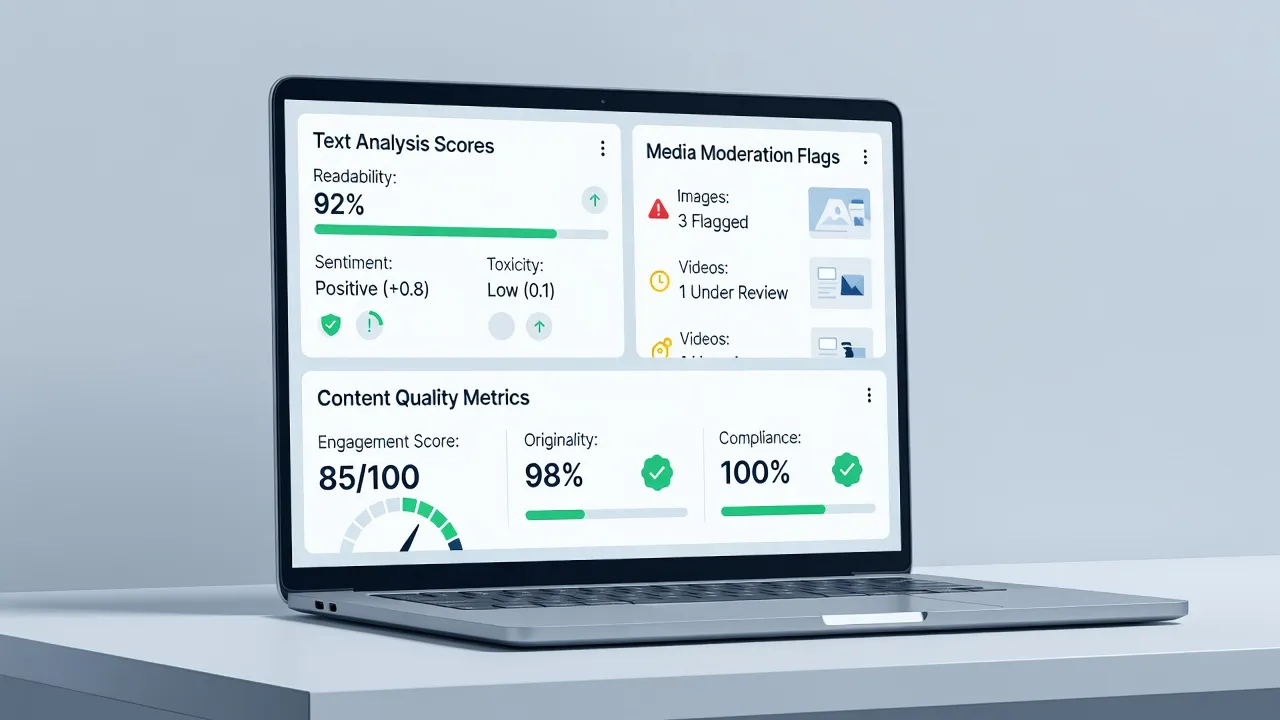
Top AI Content Reviewer Tools Compared
Pricing traps are common when selecting AI content review software. Usage-based pricing can cause unexpected cost spikes during traffic bursts, whereas flat-rate subscription models keep monthly budgets predictable.
| Platform | Best For | Review Capabilities | Pricing Structure |
|---|---|---|---|
| PulseRank | Automated SEO & GEO Editorial Review | Comprehensive article generation, citations, structural audit, and publishing | $499 per month flat plan (30 articles/mo included) |
| Hive Moderation | Visual & Multimodal Media Moderation | Image, video, audio, and text policy enforcement | Custom enterprise quote (usage-based) |
| Amazon Rekognition | Cloud Scalable Image & Video Analysis | Computer vision moderation labels, face detection, explicit content flags | Pay-per-image ($0.001 to $0.0012 per image) |
| OpenAI Moderation API | Free Text Harm Screening | Scans text against 11 safety categories (hate, harassment, self-harm) | Free for developers using OpenAI endpoints |
| Google Perspective API | Forum & Comment Toxicity Review | Scores text toxicity, severe toxicity, insult, and profanity | Free tier with custom enterprise quotas |
| Microsoft Azure AI Content Safety | Multiplayer & Gaming Community Safety | Multi-severity text and image safety screening | Tiered pay-as-you-go per 1,000 transactions |
1. PulseRank: Best for Automated SEO & GEO Content Review
PulseRank is an all-in-one SEO and Generative Engine Optimization (GEO) platform that automatically writes, reviews, and publishes citation-ready articles directly to your website. Instead of forcing you to review AI drafts manually for missing sources, broken structures, or weak keyword density, PulseRank embeds editorial quality controls directly into its production workflow.
Every article generated by PulseRank includes structured data tables, verified external citations, generated images with alt text, and internal links. This eliminates the manual review bottleneck that typically stalls business content production.
| Step | Action |
|---|---|
| 1 | Keyword Research & Strategy Building |
| 2 | AI Draft Generation matching searcher intent |
| 3 | Built-in Editorial Review (Tables, Alt Text, Citations) |
| 4 | Direct Auto-Publishing (WordPress, Shopify, Wix, Git) |
| 5 | Search Console & AI Citation Tracking |
Why PulseRank Stands Out for Business Owners
Many AI writers output generic text that fails modern search engine quality standards. PulseRank reviews each article against the specific sub-questions AI search engines expand queries into, ensuring your content qualifies for AI Overviews and organic rankings.
The platform provides a single dashboard combining content creation, automated review, direct publishing to WordPress, Shopify, Wix, or Git, and Google Search Console performance analytics.
Key Trade-Off and Pricing
- Pricing: $499 per month for a single flat plan. It includes keyword research, strategy, 30 articles per 30-day period, image generation, publishing, and rank tracking. A 7-day free trial is available.
- Trade-Off: PulseRank is built specifically for organic SEO and GEO content publishing; it is not designed to moderate user comments or filter social media image uploads.
2. Hive Moderation: Best for Visual and Multimodal Safety Screening
Hive Moderation is an enterprise-grade AI safety platform designed to review images, video, audio, and live streams in real time. It provides pre-trained models that detect sexual content, violence, hate symbols, spam, and copyright infringement across digital media.
Platforms with high user engagement rely on Hive to block inappropriate uploads before they appear publicly.

What is Hive's AI content moderation product?
Hive's AI content moderation product is a cloud API suite that processes visual, text, and audio data to flag policy violations automatically. According to official technical specifications, Hive processes billions of assets monthly using specialized deep learning models trained on custom-annotated datasets.
Key features of Hive Moderation include:
- Demographic & Context Awareness: Distinguishes between artistic nudity and explicit content.
- Optical Character Recognition (OCR): Scans text embedded inside image files or memes for toxic messages.
- Audio Transcript Review: Transcribes spoken voice in videos to check for hate speech.
Key Trade-Off and Pricing
- Pricing: Custom enterprise pricing based on volume. High-volume platforms benefit from economies of scale, but small businesses may find the entry costs steep.
- Trade-Off: Setting up custom moderation workflows requires developer integration and ongoing calibration to avoid blocking legitimate content.
3. Amazon Rekognition: Best for Computer Vision Content Moderation
Amazon Rekognition is a computer vision service from AWS that automatically identifies unsafe or inappropriate visual content in images and video. It allows businesses to build custom moderation pipelines backed by Amazon's cloud architecture.
Developers configure Rekognition to return detailed taxonomies of moderation labels alongside confidence scores.
How does Amazon Rekognition handle content moderation labels?
Amazon Rekognition handles content moderation labels by assigning visual assets to a hierarchical taxonomy of unsafe categories, each paired with a numerical confidence percentage. As detailed in the Amazon Rekognition moderation documentation, the service returns primary categories like "Explicit Nudity" alongside granular sub-categories like "Graphic Nudity or Sexual Activity."
- Image Upload goes to Rekognition API
- Rekognition API returns JSON Response containing:
- Category: Suggestive
- Sub-category: Barechested Male
- Confidence Score: 98.4%
- JSON Response goes to Decision Rule: Flag for Human Review
This granular labeling allows site administrators to set custom threshold logic. For example, a business can automatically delete uploads with a confidence score above 90% while routing items between 50% and 89% to a human moderator.
Key Trade-Off and Pricing
- Pricing: Pay-as-you-go pricing starting at $0.001 per image for the first 1 million images analyzed each month, with video moderation billed per minute.
- Trade-Off: Rekognition provides raw prediction labels via API, meaning your engineering team must build the front-end moderation interface.
4. Microsoft Azure AI Content Safety (formerly Two Hat / Community Sift)
Microsoft Azure AI Content Safety is an enterprise security tool that detects harmful text and images across online platforms, gaming networks, and corporate applications. The software screens for severe categories including sexual content, violence, hate speech, and self-harm across multiple languages.
What happened with Two Hat's Community Sift acquisition by Microsoft?
Microsoft acquired Two Hat in October 2021 to integrate its Community Sift moderation technology into Xbox and Azure security services. As confirmed in Microsoft's official acquisition announcement, Two Hat's specialized language filters were combined with Microsoft's AI research to power Azure AI Content Safety.
Two Hat's Community Sift was acquired by Microsoft in 2021. Both Community Sift and Microsoft Azure Computer Vision models fed into Azure AI Content Safety by 2026.
This integration transformed legacy chat filtering software into a unified API capable of evaluating both user-generated text and AI-generated responses for enterprise safety compliance.
Key Trade-Off and Pricing
- Pricing: Billed through Azure at $0.75 per 1,000 text transactions and $1.50 per 1,000 image transactions.
- Trade-Off: The platform requires an active Microsoft Azure account and developer expertise to integrate into existing content stacks.
5. OpenAI Moderation API: Best for API-Driven Text Filtering
The OpenAI Moderation API is a free tool that allows developers to check whether text inputs or generated outputs comply with OpenAI safety standards. It is one of the most widely implemented text reviewers for startups building AI applications.

How OpenAI Evaluates Text Content
The endpoint scans text against 11 safety categories, including harassment, hate speech, illegal instruction, and self-harm. You submit raw text strings, and the API returns boolean flags alongside probability scores for each category.
Developers often link this endpoint into their content pipelines to review user prompts before passing them to larger language models.
Key Trade-Off and Pricing
- Pricing: Free of charge for developers using OpenAI endpoints, making it extremely cost-effective for text moderation.
- Trade-Off: The API only analyzes text. It cannot process images, video files, or raw layout formatting.
What Do Groups Like ACLU, Brookings, and CDT Recommend for Automated Content Moderation?
Civil rights and technology policy groups recommend that companies treat AI content moderation as an assistance tool rather than a final decision-maker. Civil society organizations stress that automated reviewers frequently misinterpret cultural context, disproportionately censor minority speech, and produce false positives.
Major advocacy organizations highlight specific risks and policy guidelines:
- Center for Democracy & Technology (CDT): In their research on automated moderation capabilities published on the CDT insights portal, the organization demonstrates that multimodal AI models struggle with context, nuance, and sarcasm. They recommend human oversight for all content removals.
- Brookings Institution: Analysts at the Brookings Institution content moderation project point out that relying solely on automated filters creates accountability gaps. They urge companies to implement clear user appeal mechanisms for wrongly flagged posts.
- ACLU (American Civil Liberties Union): Advises that automated content reviewers must operate under strict transparency guidelines, ensuring companies publish regular transparency reports detailing false positive rates.
| Recommendation | Description |
|---|---|
| Human-in-the-Loop | Use AI for scoring, humans for appeals |
| Context Protection | Avoid immediate bans on subtle text |
| Transparent Audits | Measure error rates across dialects |
| Outbound Link & Source Integrity | Verify citations directly |
When reviewing your business's marketing copy, maintaining factual accuracy and outbound link integrity is critical. Reviewing your outbound links for SEO ensures your reviewed articles retain domain authority and search engine trust.
How to Choose the Right AI Content Reviewer for Your Business
Selecting the ideal software depends on your primary content format and volume:
- If you publish SEO content to grow organic traffic: Use PulseRank. Its automated article generation, formatting review, internal linking, and direct publishing workflow remove manual friction while managing your complete organic presence.
- If you manage user video or image uploads: Deploy Hive Moderation or Amazon Rekognition. Their visual models identify adult material and policy violations before media hits your servers.
- If you run a text-based community or forum: Combine OpenAI Moderation API for cost-free basic text filtering with Google Perspective API for comment toxicity scoring.
Tracking your performance after publishing is just as important as reviewing your drafts. Relying on accurate analytics through a GEO report ensures your reviewed content continues to rank effectively in traditional search engines and AI answer engines alike.
By selecting an AI content reviewer tailored to your exact operational bottleneck, you protect your brand image, maintain high editorial quality, and keep content production costs under control.
Frequently Asked Questions
What is an AI content reviewer?
An AI content reviewer is a software tool that uses machine learning to automatically analyze text, images, or video for quality, SEO alignment, brand policy compliance, or inappropriate material.
Can an AI content reviewer replace human editors completely?
No, AI content reviewers accelerate the editing and moderation process by flagging obvious errors or policy violations, but human oversight remains necessary for evaluating complex context, tone, and brand voice.
How much does AI content moderation cost?
Costs vary by platform type. Standard text moderation APIs like OpenAI are free, visual computer vision APIs like Amazon Rekognition charge roughly $0.001 per image, and full-service publishing platforms like PulseRank offer flat subscription plans at $499 per month.
How do AI content moderation tools handle false positives?
Most enterprise AI moderation tools assign confidence scores to flagged content. High-confidence violations are blocked automatically, while borderline cases are sent to a queue for human review to minimize false positives.
What is the difference between content moderation and SEO content review?
Content moderation focuses on identifying hate speech, adult material, spam, and safety policy violations in user content. SEO content review focuses on evaluating readability, keyword integration, structural headings, citation accuracy, and search performance.
Does AI content review work for audio and video files?
Yes, modern visual moderation engines like Hive and Amazon Rekognition process video frames directly, while integrated transcription models convert audio streams into text for automated policy checks.
Why do policy experts recommend human oversight for AI reviewers?
Policy organizations emphasize that AI algorithms struggle to interpret slang, sarcasm, and cultural context, which can lead to improper censorship of legitimate user speech without human appeal processes.