
A dofollow backlink is a standard HTML hyperlink without a rel="nofollow" (or rel="ugc" / rel="sponsored") attribute, instructing search engine crawlers to pass PageRank value and authority to the target URL. Unlike nofollow links, which explicitly request search engines to ignore the connection for ranking calculations, dofollow links function as digital votes of confidence that directly improve a destination site's search engine rankings.
When a high-authority site points a dofollow link toward your website, search engines interpret that signal as a endorsement of your content's trustworthiness and relevance.
How do dofollow backlinks transfer PageRank authority?
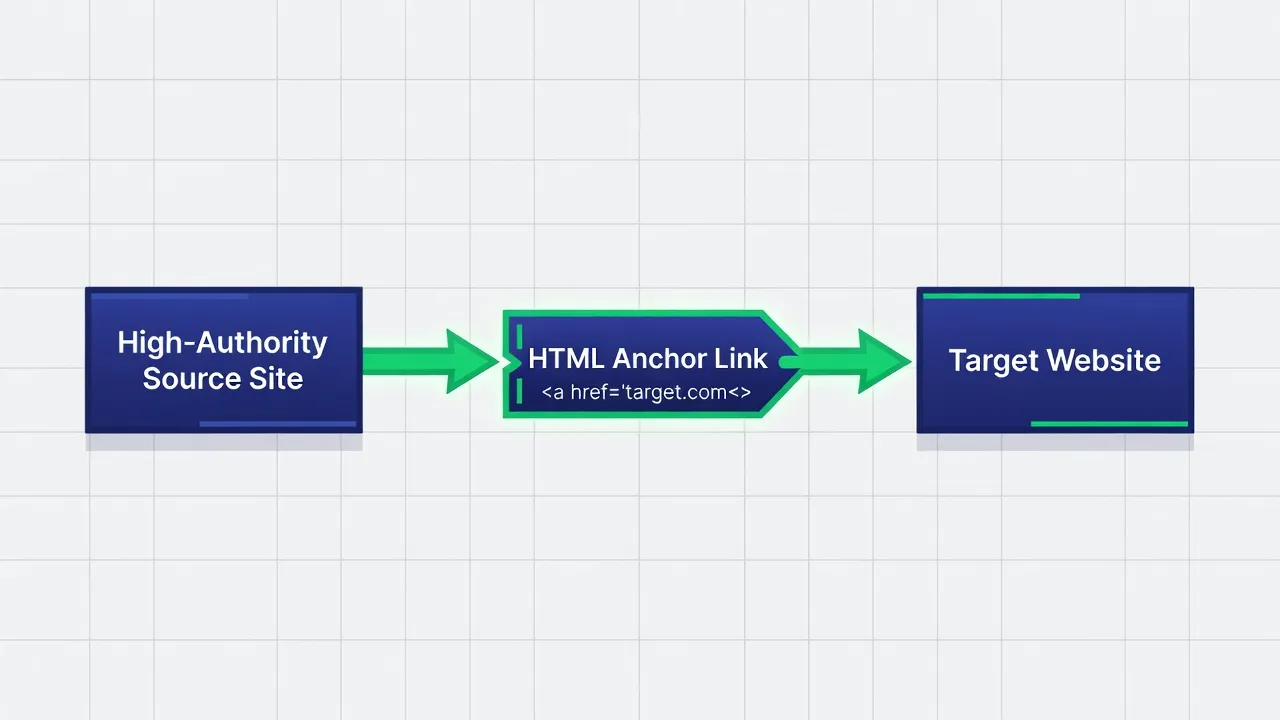
Dofollow backlinks transfer PageRank by passing a portion of the source page's algorithmic equity—often called "link juice"—directly to the linked target URL. Search engines evaluate the sending domain's overall trust score, the topic relevance of the surrounding text, and the specific anchor text used in the HTML code.
Under the hood, HTML links do not require a literal rel="dofollow" tag. In standard web standards outlined by the World Wide Web Consortium (W3C), any hyperlinked anchor tag (<a href="...">) is treated as a dofollow link by default unless an explicit rel attribute overrides it.
Three main factors govern how much value a dofollow link passes:
- Source Authority: A link from a site with high domain trust passes vastly more equity than a link from a fresh blog.
- Contextual Relevance: A link within a paragraph discussing software development carries high weight if it points to a tech product, but far less if it points to a lawn care service.
- Anchor Text Specificity: Anchor text containing target keywords helps search engines understand the exact topic of the destination page.
Managing how your own site links out is equally important for maintaining search trust. Implementing proper outbound links in SEO ensures you maintain authority balance while citing reputable sources.
Do dofollow backlinks still work, and which platforms give them?
Yes, dofollow backlinks still work as one of the top three core ranking factors in Google's ranking algorithms as of 2026. However, platforms granting them have drastically tightened their qualification limits, auto-applying rel="nofollow" or rel="ugc" tags to prevent link spam.
Google updated its link processing guidelines on Google Search Central to treat link attributes as hints rather than absolute directives. Despite this shift, un-attributed dofollow links from editorial sources remain the strongest signal for boosting competitive search queries.
Most user-generated content (UGC) networks now disqualify casual link builders by default. Here is how major platform categories handle link attributes today:
| Platform Category | Default Link Attribute | Dofollow Qualification Requirement | Common Disqualifying Limit |
|---|---|---|---|
| Editorial Blogs & News | Dofollow | Manual editorial approval by human editors | Requires original source reporting or pitch |
| Social Media Profiles | Nofollow / UGC | Rarely available (mostly locked) | Profile bio links are hard-coded nofollow |
| Niche Web Forums | Nofollow / UGC | Earned karma, post count, or account age | Links blocked until user hits 15-50 posts |
| Open Blogging Hubs | Nofollow / UGC | Feature status or publication curation | Standard user posts default to UGC tag |
| Web Directories | Dofollow or Nofollow | Paid review or strict manual curation | Automated submissions are auto-flagged as spam |
What websites give dofollow backlinks (list of sites)?
Websites that give dofollow backlinks include GitHub (via README repository files), Medium (on select publication-curated articles), SourceForge, Product Hunt, and niche digital publications with guest contributor programs. However, almost every platform imposes strict account criteria before a link converts to dofollow.
If you are looking for places to secure dofollow links without risking algorithmic manual penalties, these specific sites offer legitimate opportunities under explicit conditions:
- GitHub: Profile links carry nofollow, but links inside public repository
README.mddocumentation files are crawled as standard links. The limit: spam repositories get hidden or de-indexed within days. - Product Hunt: Launching a product grants dofollow links on your main listing page. The limit: you must have an active product launch; profile links remain nofollow.
- SourceForge: Creating an open-source or commercial software project page provides dofollow outbound links. The limit: requires downloadable software binaries or verifiable developer assets.
- Listen Notes: Submitting a podcast RSS feed yields dofollow links on podcast directory pages. The limit: requires a live, functional podcast feed.
- Critique Circle: A community for writers that allows dofollow website links inside bio pages once you clear community participation checks. The limit: requires critique credits earned by reviewing others' work.
Relying solely on manual submissions is tedious and difficult to scale. Smart growth teams leverage link building tools to find real editorial targets rather than burning hours on profile creation.
Which high authority sites allow dofollow links via guest posts, comments, or profiles?
High-authority sites like Forbes, HubSpot, and Business Insider allow dofollow links strictly through paid editorial contributor networks or earned PR pitches, whereas their comment sections and user profiles are entirely nofollowed. The era of dropping a website URL into a high-DA profile field to harvest "link juice" ended years ago.
For platforms with Domain Authority (DA) above 70, the rules for obtaining a dofollow link are uncompromising:
- Guest Contributor Columns: Outlets like Entrepreneur or Fast Company give dofollow links only within the context of an expert guest column. The qualification rule: you must pass multi-stage pitch reviews, and outbound links are scrubbed by copy editors if they look commercial.
- Profile Pages: Sites like Behance, Dribbble, and Crunchbase give high-authority visibility, but profile outbound fields carry explicit
rel="nofollow"attributes. They drive brand discovery, not PageRank. - Blog Comments: High-authority blogs running WordPress or Disqus convert 100% of comment links into
rel="ugc"orrel="nofollow".
Attempting to trick high-DA sites with automated spam leads straight to blacklisting. If you manage a growing site, scaling high-value content that naturally attracts these outlets is far safer than manual outreach schemes.
Why scaling citation-ready content beats manual link building
Grinding through platform submission forms for a handful of dofollow profile links is a poor use of time for modern businesses. The highest-value dofollow links are never found on registration forms—they are awarded editorially by journalists, bloggers, and industry analysts referencing authoritative content.
This is where automated content engine strategies outperform legacy outreach. Instead of chasing link exchanges, tools like PulseRank automate the process of publishing deep, data-driven content that earns links naturally.
PulseRank ($499/month flat) functions as an all-in-one organic content operation:
- Keyword Strategy & Selection: Identifies high-intent topic clusters and conversational sub-questions that searchers and AI engines actively query.
- Citation-Ready Publishing: Writes and posts full-length articles daily to WordPress, Shopify, Wix, or Git platforms. Each article features structural data tables, sourced external facts, and contextual images.
- Performance Tracking: Connects directly with Google Search Console reporting to show keyword movements alongside AI citation tracking.
When your site consistently publishes high-trust articles engineered to answer granular search queries, other publications cite you as an authority. That yields organic, editorial dofollow backlinks on autopilot without manual outreach.
Are blog comments considered dofollow backlinks?
No, modern blog comments are almost never considered dofollow backlinks because virtually all modern content management systems auto-apply rel="ugc" or rel="nofollow" attributes to comment section links. WordPress introduced default nofollow attributes for comment author links back in 2005 to curb automated comment spam.
While a microscopic fraction of standalone blogs run custom plugins like "CommentLuv" to offer dofollow comment links as a reward for reader engagement, these links carry near-zero SEO weight. Search engine algorithms penalize sites that maintain unmoderated dofollow comment sections, making them a net liability.
Dropping links into blog comment boxes disqualifies your domain in three distinct ways:
- UGC Tagging: Search crawlers categorize the link as User Generated Content (
rel="ugc"), neutralizing its ability to pass domain equity. - Algorithmic Filtering: Spam filters like Akismet automatically hold comment links for moderation or trash them immediately.
- Domain Footprint Risks: Search engines recognize patterns of mass comment submissions. Gathering hundreds of low-quality comment links triggers algorithmic link-spam filters.
Which guest post sites offer dofollow backlinks?
Guest post sites that offer dofollow backlinks include industry publications like Hacker Noon, Search Engine Watch, Smashing Magazine, and SitePoint, provided your submission meets strict editorial benchmarks. These platforms grant contextual dofollow links inside the article body rather than the author bio.
To qualify for a dofollow link on a legitimate guest post site, your content must satisfy specific publisher constraints:
- Hacker Noon: Accepts technical articles, startup stories, and software tutorials. Outbound links are dofollow if they reference non-promotional source material or documentation. Commercial landing pages are stripped.
- Smashing Magazine: Offers editorial dofollow links for deep-dive design and web development tutorials. Articles undergo rigorous peer review taking up to 4 to 8 weeks.
- SitePoint: Accepts pitches covering web development, HTML/CSS, and JavaScript. Outbound links must serve as necessary contextual references for the reader.
Many low-grade sites advertise "guest posts with dofollow links" for $20 to $100. Be cautious: Google explicitly flags paid guest posts without a rel="sponsored" tag as a violation of its search essentials, placing both the buyer and seller at risk of site-wide de-indexing.

Which forums give dofollow backlinks?
Most major forums do not give dofollow backlinks, though specialized communities like Stack Overflow (for high-reputation accounts) and select specialized Discourse forums pass standard links once specific user requirements are met. The vast majority of mainstream forum software defaults to rel="nofollow" or rel="ugc" for all user submissions.
Understanding the explicit limits of popular forum networks prevents wasted effort:
- Reddit: All links submitted in posts or comments carry
rel="nofollow"by default. While rumors suggest posts reaching high upvote thresholds occasionally drop nofollow tags, Reddit links should be viewed strictly as traffic drivers, not PageRank passes. - Stack Overflow: Links posted by new accounts carry nofollow attributes. Once a developer earns 2,000+ reputation points through accepted answers and community votes, specific link restrictions ease, though aggressive self-promotion still triggers immediate account bans.
- Quora: Every link inside Quora answers and user profiles is hard-coded with
rel="nofollow". - XenForo & vBulletin Forums: Independent niche forums using standard forum software usually enforce nofollow on signature links and thread responses until an account accumulates a minimum post history (often 10 to 50 posts) and reaches a 30-day age threshold.
Evaluating how these platforms handle link attributes underscores a key reality: acquiring high-authority dofollow links requires substantial manual effort or exceptional content assets.
Comparing backlink acquisition channels for 2026
Building a resilient search profile requires balancing link acquisition channels against risk, cost, and time investments. Relying entirely on manual tactics creates a fragile authority profile that falls apart when algorithms update.
Here is how common backlink strategies stack up in terms of difficulty, risk, and long-term search engine value:
| Backlink Strategy | Link Attribute Type | Difficulty Level | Algorithmic Risk | Primary Limitation / Disqualifier |
|---|---|---|---|---|
| Editorial Resource Links | Dofollow | High | Very Low | Requires publish-grade data assets or proprietary tools |
| Organic Content Scaling (via PulseRank) | Dofollow | Low (Automated) | Very Low | Needs consistent publishing timeline to build topical authority |
| Guest Blogging (High Tier) | Dofollow | High | Low | Slow editorial reviews (1 to 3 months per article) |
| Niche Forum Engagement | Nofollow / UGC | Medium | Low | Long account warm-up periods (20+ posts required) |
| Blog Commenting | Nofollow / UGC | Low | High | Standardized UGC tags nullify SEO authority transfer |
| Paid Link Networks | Dofollow | Low | Extreme | Violates Google Search Essentials; invites link penalties |
For small and mid-sized businesses, spending hundreds of hours pitching guest blogs yields minimal return compared to building automated topical authority. When you deploy strategic content generation, your site automatically earns dofollow citations from third-party writers searching for references.
How to check if a backlink is dofollow or nofollow
To check if a backlink is dofollow, right-click the hyperlink in your web browser, select "Inspect" (or "Inspect Element"), and review the resulting HTML code inside the Developer Tools panel. If the anchor code <a href="..."> contains no rel attribute—or contains attributes like rel="opener" without nofollow—the link is dofollow.
Follow these simple steps to verify any link attribute in under 10 seconds:
- Open Chrome or Firefox: Navigate to the page containing your target link.
- Inspect the Link Element: Hover directly over the hyperlinked text, right-click, and choose Inspect.
- Analyze the HTML Tag: Look at the highlighted DOM line:
- Dofollow Example:
<a href="https://example.com">Target Text</a> - Nofollow Example:
<a href="https://example.com" rel="nofollow">Target Text</a> - UGC Example:
<a href="https://example.com" rel="ugc">Target Text</a>
- Dofollow Example:
Alternatively, free browser extensions like "Nofollow" automatically highlight nofollow, UGC, and sponsored links in red overlays across any webpage you visit.
How do dofollow backlinks impact generative AI answer engines?
Dofollow backlinks directly impact Generative Engine Optimization (GEO) because modern AI engines like Perplexity, ChatGPT, and Google Gemini rely on traditional search indexes to identify trustworthy authoritative sources. AI models pull citations primarily from websites that exhibit strong PageRank and topical authority—metrics driven largely by dofollow link profiles.
While standard search engines use links to rank blue links on a page, AI answer engines use link-backed authority to select which sites to quote in generated summaries. When your domain holds dofollow references from trusted publications, AI engines view your content as a verified source of truth.
Combining an organic dofollow backlink profile with structured, quote-ready content ensures your business stays visible whether users perform a classic search query or ask an AI assistant for a product recommendation. Leveraging modern solutions like PulseRank helps automate this process, allowing you to establish topical dominance while acquiring organic editorial citations across the web.
Frequently Asked Questions
What is the difference between a dofollow and nofollow backlink?
A dofollow backlink instructs search engines to crawl the link and pass PageRank equity to the target page, directly improving its search rankings. A nofollow backlink contains a rel="nofollow" HTML attribute telling crawlers to ignore the link for authority transfer purposes.
Do dofollow backlinks guarantee higher search engine rankings?
No, dofollow backlinks do not guarantee higher rankings on their own. Rankings depend on a combination of domain authority, content quality, page speed, user search intent alignment, and overall topical relevance alongside your backlink profile.
Can a dofollow backlink hurt my site's SEO?
Yes, a dofollow backlink can hurt your site's SEO if it comes from a spammy, low-quality, or penalized domain, or if it is part of an artificial link network. Search engines may flag suspicious dofollow links as link spam and issue manual or algorithmic penalties.
Should I disavow low-quality dofollow backlinks?
You should disavow low-quality dofollow backlinks only if you receive a manual action warning in Google Search Console or notice clear evidence of a toxic negative SEO attack. Google's algorithms automatically ignore most low-quality web spam without requiring manual disavow files.
How many dofollow backlinks do I need to rank on page one?
There is no fixed number of dofollow backlinks required to rank on page one. Highly niche or low-competition keywords may rank with zero backlinks, while competitive commercial terms often require dozens of high-authority, topically relevant dofollow links from unique domains.
Do nofollow links have any SEO value at all?
Yes, nofollow links still provide valuable SEO benefits by driving direct referral traffic, building brand awareness, and diversifying your overall link profile. Search engines like Google also view nofollow links as secondary signals for discoverability and brand trust.
Is buying dofollow backlinks against search engine guidelines?
Yes, buying or selling dofollow backlinks intended to pass search authority violates Google Search Essentials guidelines. Unlabeled paid links risk search penalties unless they carry a rel="sponsored" or rel="nofollow" attribute.