

GEO analysis (Generative Engine Optimization analysis) is the process of evaluating how artificial intelligence platforms like ChatGPT, Perplexity, and Google AI Overviews cite, summarize, and extract data from your website. Unlike traditional SEO analysis that measures page ranks on standard search results pages, GEO analysis tracks your brand's share of voice inside synthesized AI responses.
As of September 2026, millions of search queries that once ended on traditional blog posts now resolve inside zero-click AI summaries. If your business relies entirely on standard keyword tracking, you are missing the exact layer where buyers make decisions. Conducting a proper GEO analysis reveals whether large language models (LLMs) trust your brand as an authority or skip your domain entirely in favor of competitors.
What is GEO analysis and how does it differ from traditional SEO analysis?
GEO analysis measures your website's visibility inside AI-generated answers, whereas traditional SEO analysis measures blue link positions on search engine result pages. While traditional SEO focuses on crawl errors, backlinks, and exact-match keyword density, GEO analysis evaluates semantic entities, structured facts, and retrieval authority.
Generative engines do not scan the web the same way standard Google bots do. Instead of serving a list of links ranked by PageRank, an AI engine reads indexed content, pulls relevant facts, and generates a fresh text response.
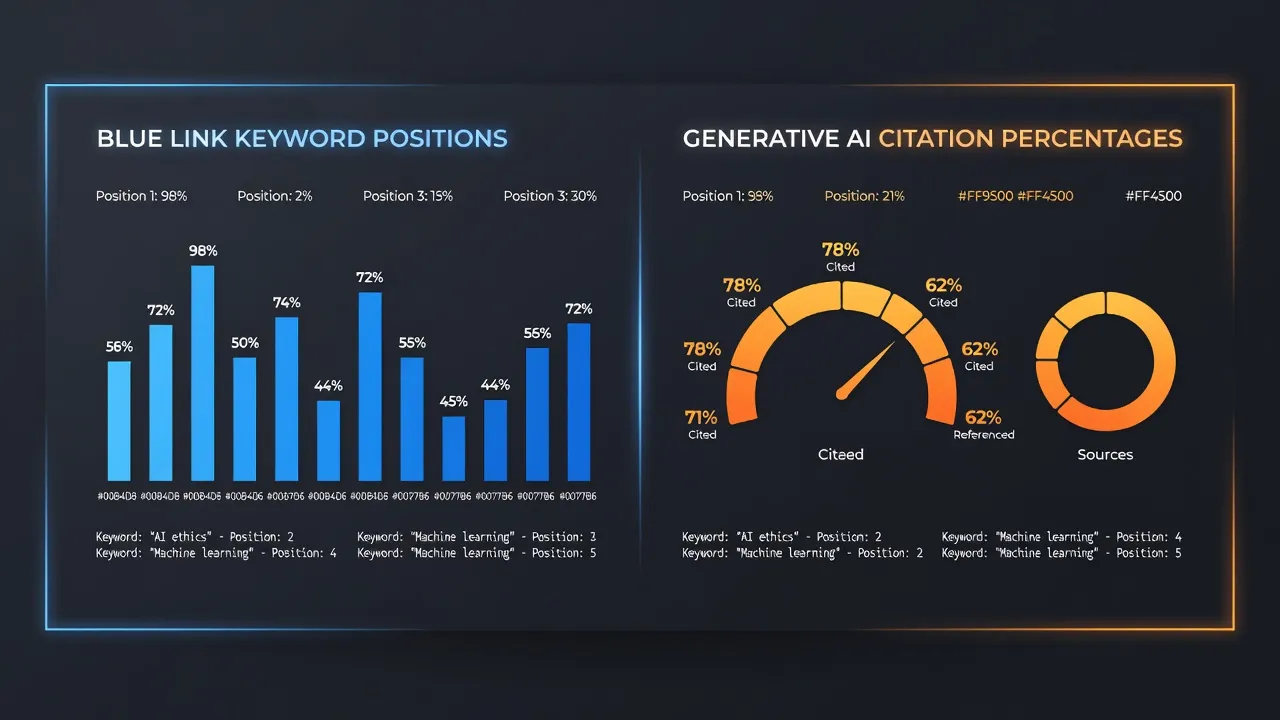
To understand why your site appears or disappears in these AI answers, you have to measure three distinct operational layers:
- Entity extraction: How accurately AI models identify your brand name, core products, and official claims.
- Citation rate: The percentage of target prompts where an AI engine links back to your domain as a primary source.
- Sentiment and context: Whether the LLM describes your company positively, accurately, and alongside the correct product categories.
If you want to understand how software platforms handle this multi-layer audit, reviewing recommended generative engine optimization software helps clarify what automated tools look for during a crawl.
What do most businesses get wrong about GEO analysis?
Most businesses fail at GEO analysis because they assume high organic search rankings automatically translate into AI citations. In reality, an article sitting in position one on Google can be completely ignored by ChatGPT if its text lacks direct answers, liftable data tables, or explicit source attribution.
Relying on outdated SEO logic creates severe tracking blindspots. Here are the three costliest mistakes companies make when assessing their AI visibility in 2026:
Mistake 1: Tracking keyword positions instead of prompt triggers
Tracking static keyword rankings tells you nothing about how LLMs respond to conversational user prompts. Searchers do not type "best CRM for plumbers" into AI engines; they type "Compare the top three CRMs for a 5-person plumbing business and tell me which one integrates with QuickBooks."
If your GEO analysis only tests short-tail keywords, you miss the complex multi-turn prompts where actual buying decisions happen.
Mistake 2: Ignoring third-party citation sources
AI models frequently source their information about your business from third-party sites rather than your own homepage. If an AI engine relies on Wikipedia, Reddit, industry review sites, or external blogs to answer questions about your pricing, an internal audit of your own site will miss the root cause of inaccurate answers.
Failing to audit third-party digital footprints leads to missing citations, inaccurate pricing quotes in AI summaries, and uncorrected negative claims across LLM outputs.
Mistake 3: Measuring traffic volume instead of citation presence
Evaluating GEO performance solely by web traffic numbers leads to false conclusions because AI engines generate zero-click answers. An AI engine might cite your study in front of 10,000 users, but only 200 of them will click through to your site.
If you treat that low click-through count as a failure, you miss the immense brand authority gained by being the sole cited reference in an AI summary.
How do generative engines select their cited sources?
Generative engines select cited sources using Retrieval-Augmented Generation (RAG), a process that pulls live, trustworthy web documents to ground the AI's answer in factual data. When a user submits a prompt, the system searches its index for high-density information blocks before writing its response.
According to research documented on Wikipedia's entry on Retrieval-Augmented Generation, RAG systems reduce model hallucinations by anchoring language models on verified external knowledge bases.
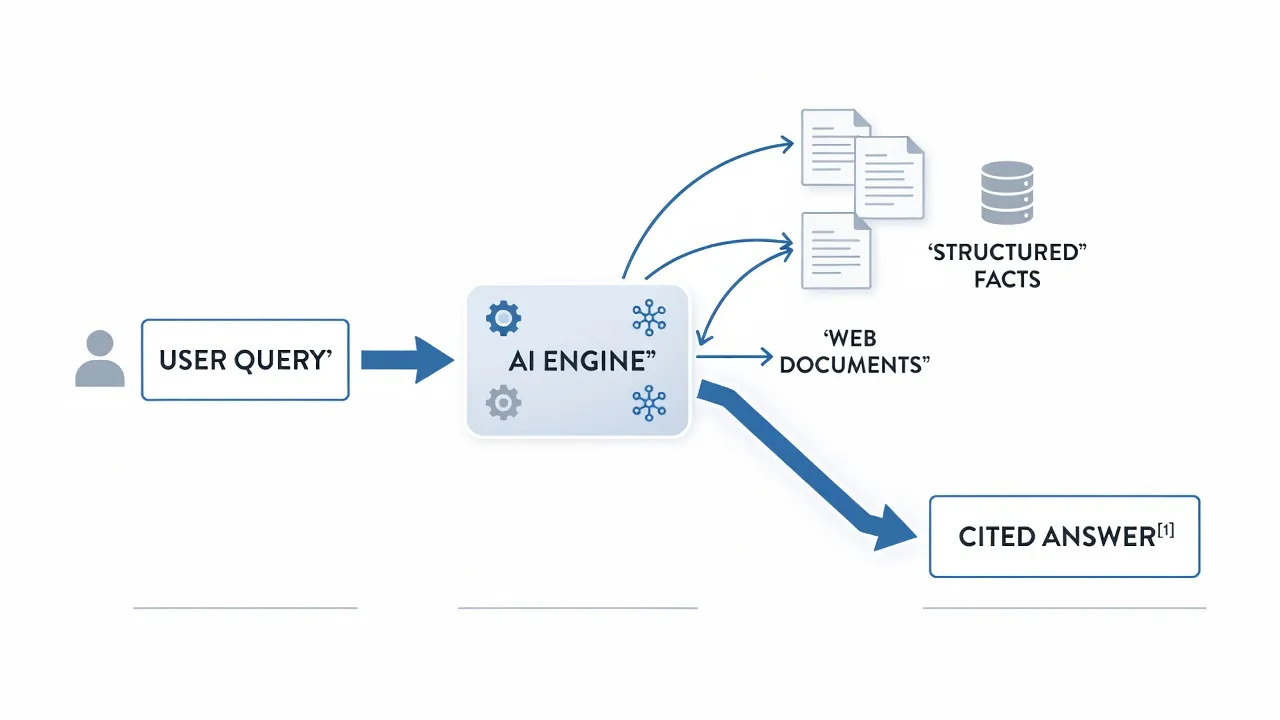
To pass an AI engine's retrieval filter during a live prompt query, your content must satisfy four structural criteria:
- Direct answer alignment: The text immediately answers the target question within the first 50 words of a section.
- Data density: The page contains explicit numbers, prices, specs, step counts, or dates that the model can lift directly.
- Structured schema markup: Technical markup like Organization or Article schema helps machines verify entity ownership. Guidance on Google Search Central emphasizes that structured data explicitly defines page content for automated parsers.
- Attributed facts: Statements backed by linked third-party sources demonstrate high factual trust to the retriever model.
SEO analysis vs. GEO analysis: Key technical differences
The fundamental difference between SEO analysis and GEO analysis lies in the target system: SEO optimizes for search engine crawlers, while GEO optimizes for LLM vector databases and retrieval mechanisms.
The table below breaks down how technical requirements, evaluation metrics, and optimization targets differ between the two methodologies:
| Metric / Dimension | Traditional SEO Analysis | Generative Engine Optimization (GEO) Analysis |
|---|---|---|
| Primary Target | Search engine indexing bots (Googlebot, Bingbot) | Vector stores and RAG retrieval systems |
| Core Visibility Metric | SERP Rank (Positions 1–10) | Citation Rate & Share of Model (SoM) |
| Content Formatting | Long-form content, keyword placement | Direct answers, bulleted summaries, tables |
| Authority Source | Backlink profile and domain authority | Semantic entity clarity and factual consistency |
| Traffic Outcome | Direct website clicks | Zero-click answers, brand impressions, selective clicks |
| Tracking Tooling | Google Search Console, Rank Trackers | AI prompt monitoring, LLM response auditing |
Running both analysis types side-by-side reveals where your standard content strategy falls short. For instance, comparing metrics in Google Search Console vs Google Analytics shows traditional search clicks, but identifying AI citations requires analyzing prompt outputs across platforms like ChatGPT, Claude, and Perplexity.
What metrics should you track during a GEO audit?
During a GEO audit, you should track citation frequency, source attribution hierarchy, entity sentiment, and factual accuracy across multiple LLMs. Tracking these metrics provides a complete picture of your brand's standing inside synthetic answers.
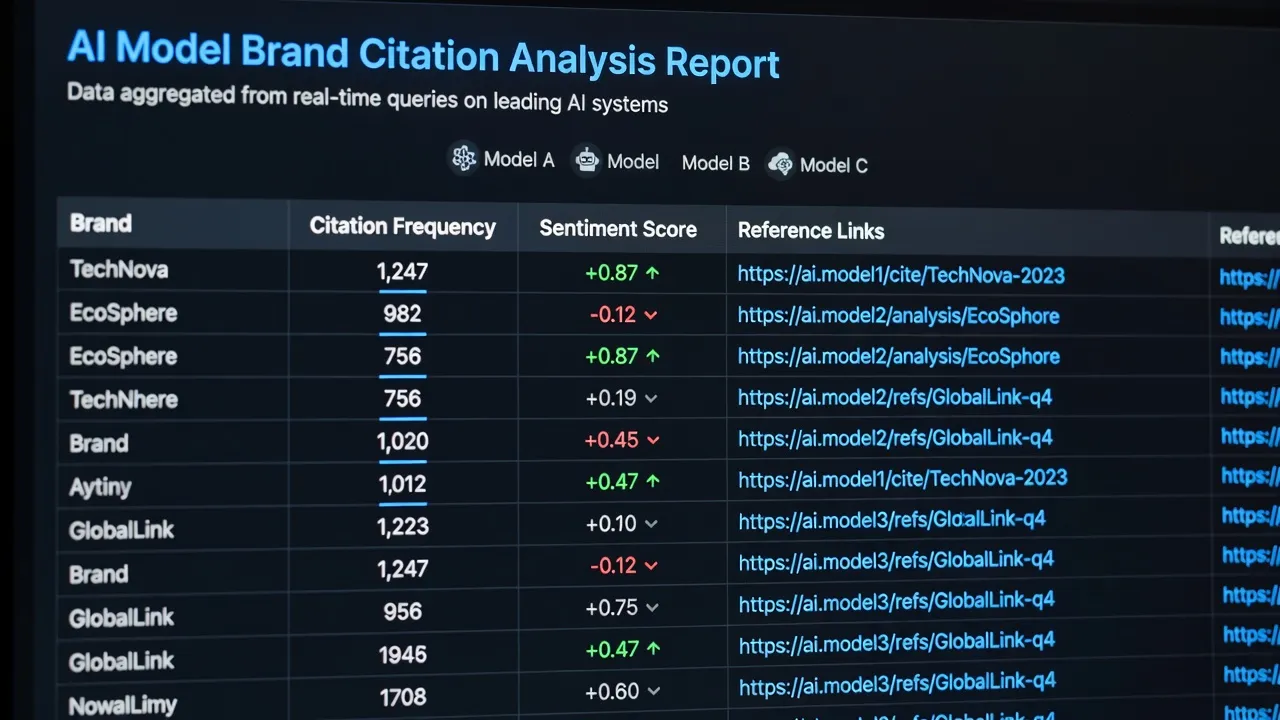
1. Citation Frequency (Share of Model)
Citation frequency measures how often an AI engine includes a link to your domain when answering industry-relevant prompts. To calculate this, run a benchmark set of 50 to 100 conversational prompts through ChatGPT, Perplexity, and Google AI Overviews.
Divide the number of answers containing your link by the total number of prompts tested. A healthy baseline for established B2B brands sits between 15% and 35%.
2. Source Attribution Hierarchy
Source attribution hierarchy identifies whether an AI model treats your website as a primary source or a secondary reference.
If Perplexity cites your official product page when explaining your feature set, you hold primary attribution. If it cites a third-party software review roundup instead, your direct content is failing the retrieval check, forcing the LLM to rely on middleman sites.
3. Entity Sentiment and Context
Entity sentiment measures whether generative engines represent your brand accurately and favorably.
Unlike standard search results where you control the meta description, an AI engine writes its own summary of your reputation. If an LLM consistently adds qualifiers like "expensive," "lacks customer support," or "outdated" when mentioning your business, your GEO analysis must target the external platforms feeding that negative context.
4. Semantic Schema Coverage
Semantic schema coverage checks whether your technical markup strictly complies with web standards like Schema.org.
According to official specification documentation on Schema.org, structured vocabulary allows webmasters to define real-world entities like products, organizations, and FAQs in machine-readable JSON-LD format. Without clean schema, AI parsers struggle to connect your content to your brand entity.
How PulseRank automates GEO analysis and content execution
PulseRank streamlines the entire GEO analysis and content creation pipeline by combining research, strategy, writing, and reporting into a single platform. Rather than forcing business owners and agencies to assemble a costly stack of separate research tools, rank trackers, and writing assistants, PulseRank manages the entire organic operation in one continuous workflow.
For a flat fee of $499 per month, the platform handles:
- Targeted Keyword & Prompt Research: Identifying the specific conversational sub-questions and long-tail prompts that generative engines expand queries into.
- Daily Citation-Ready Content: Generating and publishing 30 articles per month directly to WordPress, Shopify, Wix, or Git repositories. Each piece includes structured data tables, sourced third-party facts, generated images with custom alt text, and contextual internal links.
- Unified Search & Citation Reporting: Combining built-in Google Search Console performance views with AI citation tracking so you can see exact keyword positions alongside LLM citation metrics.
For growing businesses and any generative engine optimization agency managing multiple client accounts, having strategy, publishing, and reporting centralized eliminates manual prompt testing while ensuring content consistently satisfies RAG retrieval standards.
How can agencies deliver GEO analysis to client accounts?
Agencies can deliver GEO analysis to client accounts by providing structured AI visibility audits alongside traditional monthly SEO performance reports. Offering GEO auditing creates immediate value by exposing visibility gaps that standard rank trackers completely miss.
To build a client-facing GEO analysis deliverable, follow this four-step structure:
- Establish a Prompt Baseline: Select 30 to 50 core commercial prompts representing the client's high-value services.
- Map Competitor Citations: Audit which competitors currently dominate AI summaries for those target prompts and document the exact URLs cited.
- Identify Content Gaps: Pinpoint missing direct answers, absent data tables, or unformatted schema markup on the client's current landing pages.
- Execute Structured Upgrades: Update existing content with clear definitions, quantitative facts, sourced statistics, and explicit H2 question headers.
By framing GEO analysis as a necessary expansion of traditional organic search services, agencies protect their clients from losing traffic to zero-click generative search interfaces.
Frequently Asked Questions
What is the difference between SEO analysis and GEO analysis?
SEO analysis focuses on website rankings in standard search engine result pages, analyzing backlink profiles, technical site speed, and keyword placement. GEO analysis evaluates how AI engines like ChatGPT, Perplexity, and Google AI Overviews cite, extract, and summarize your content inside conversational responses.
How do I track my website's citations in ChatGPT?
You can track website citations by running a standardized set of industry prompts through ChatGPT and recording how often your domain appears as a hyperlinked source. Automated GEO platforms also monitor prompt outputs programmatically to track domain citation rates over time.
Is GEO analysis necessary if my site already ranks #1 on Google?
Yes, GEO analysis is necessary because ranking number one on Google does not guarantee an AI citation. Generative engines use retrieval filters that prioritize structured facts, clear data tables, and direct Q&A phrasing over traditional search ranking position.
What is Retrieval-Augmented Generation (RAG) in GEO?
Retrieval-Augmented Generation is a technology used by AI engines to pull live, factual data from web indexes into generated responses. GEO analysis identifies whether your page structure and factual content meet the retrieval standards needed for an LLM to select your site as a source.
How often should a business perform a GEO analysis?
A business should conduct a GEO analysis monthly or whenever major generative engine models update their retrieval pipelines. Regular monitoring ensures your content remains structured properly as search platforms update how they synthesize web information.
Can structured data schema help improve my GEO citations?
Yes, implementing JSON-LD schema markup like Organization, Product, and Article types helps AI crawlers correctly parse your entities, brand facts, and relationships, making your content easier for LLMs to cite accurately.
What tools are used for GEO analysis?
GEO analysis uses specialized AI citation tracking platforms, prompt monitoring scripts, structured data validators, and unified SEO platforms like PulseRank that track AI visibility alongside traditional Google Search Console performance data.