
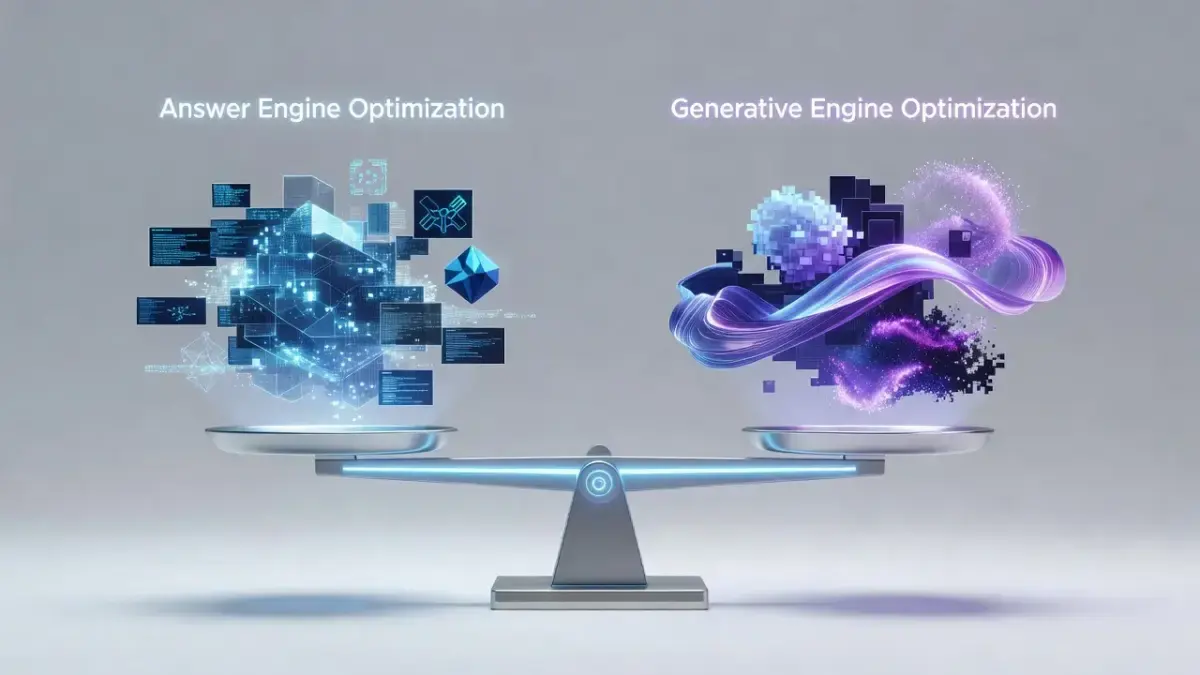
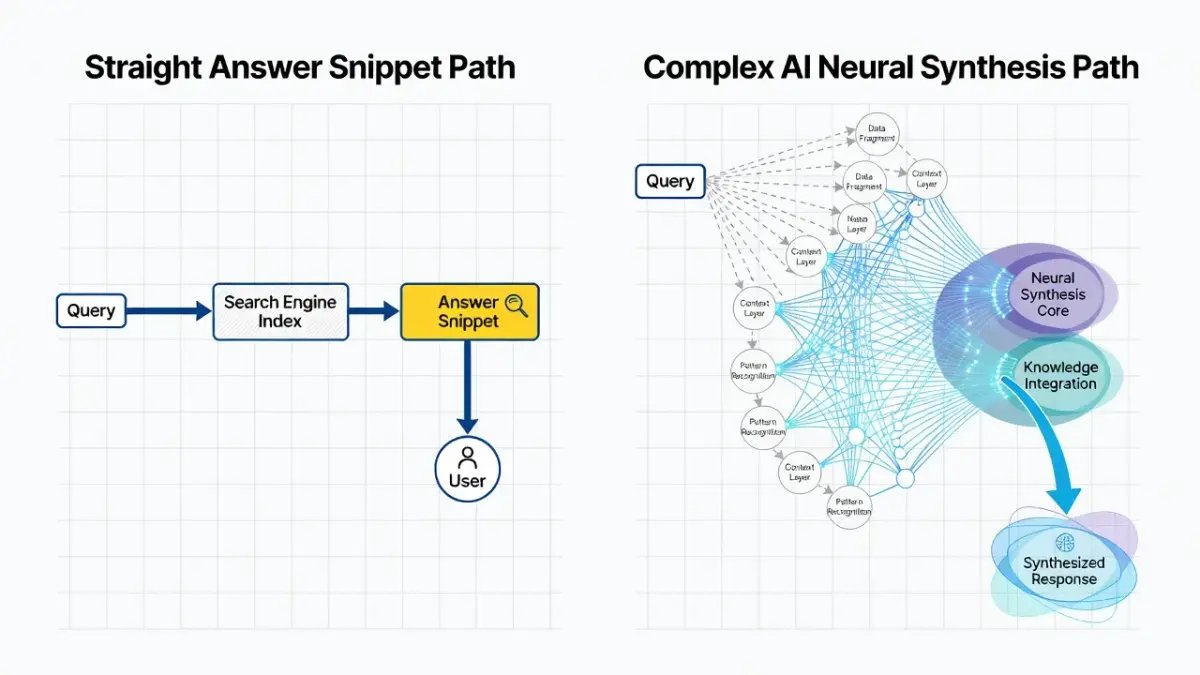
Answer engine optimization (AEO) targets quick, direct extraction by voice assistants and search snippets, while generative engine optimization (GEO) optimizes content to be synthesized, cited, and recommended inside complex AI model responses. While AEO focuses on claiming a single factual answer slot in platforms like Perplexity, Google Overviews, or Siri, GEO focuses on establishing brand context so large language models (LLMs) like ChatGPT and Claude include your brand in multi-step buying recommendations. Understanding the operational requirements and limits of both approaches determines whether your business captures modern organic traffic or gets bypassed by AI search engines.
As of November 2026, relying purely on traditional link-building or basic keyword stuffing rules out your business from appearing in AI-synthesized answers. AI search interfaces do not scan pages the way old crawlers did; they parse context, authority markers, and entity structures. If your site lacks schema markup, clear direct statements, and broad co-citations, AI engines simply select your competitors instead.
What is the definition of Answer Engine Optimization (AEO)?
Answer Engine Optimization (AEO) is the process of structuring content so search algorithms and voice assistants can extract precise, factual answers to immediate user queries. It targets single-turn responses where a searcher needs a quick resolution, such as a business phone number, a pricing threshold, or a short definition.

AEO relies heavily on technical markup and explicit syntax. When you format data using Schema.org structured documentation, you allow platforms like Apple Siri, Google Assistant, and Perplexity to read your data without guessing.
Key technical requirements for AEO include:
- JSON-LD Schema Implementation: Wrapping FAQ data, organization details, and product specs in structured schema code.
- Direct Question Headers: Using exact user questions as H2 or H3 titles with a bolded answer sentence immediately following.
- Factual Data Tables: Presenting specs, costs, and limits in plain HTML table cells that engines extract cleanly.
- Low-Latency Rendering: Ensuring pages load under 1.5 seconds so real-time answer engines parse the HTML body before timing out.
If your site fails to provide explicit answers in the top 300 words of a page, answer engines skip your domain entirely. Small businesses often get ruled out of AEO because their content hides core facts behind lengthy introductory paragraphs.
What is the definition of Generative Engine Optimization (GEO)?
Generative Engine Optimization (GEO) is the strategy of optimizing content so AI models synthesize, mention, and cite your brand when generating comprehensive, multi-turn answers. Unlike AEO, which targets single factual extracts, GEO focuses on shaping the underlying knowledge base and retrieval-augmented generation (RAG) sources used by modern LLMs.
The term gained industry recognition following research published by computer scientists at Princeton, Georgia Tech, and the Allen Institute for AI in their seminal arXiv paper on Generative Engine Optimization. Their findings showed that specific formatting adjustments, such as adding authoritative quotes and statistics, boosted a brand's visibility in generative search engine outputs by up to 40%.
GEO requires a broader content footprint across multiple web platforms:
- Third-Party Entity Citation: Earning mentions on Wikipedia, Reddit, industry publications, and third-party review directories that LLMs crawl for training data.
- Semantic Context Clustering: Grouping related sub-topics across comprehensive articles so AI models perceive your site as a primary subject matter expert.
- Information Gain: Adding unique data, proprietary statistics, or distinct methodology rather than repeating generic web content.
- Multi-Modal Data Formatting: Using structured lists, comparative metrics, and clear definitions that vector databases turn into numerical embeddings.
If your content only covers superficial topic summaries without authoritative statistics or third-party corroboration, generative engines will classify your site as low-confidence noise. For a deeper breakdown of generative search ranking factors, read our guide on AI optimization for generative search.
Are marketers/SEOs prioritizing AEO or GEO?
Most digital marketing teams in 2026 prioritize GEO over AEO because generative search engines now handle the vast majority of commercial and research-driven user queries. While AEO remains essential for local search and direct informational queries, GEO drives high-intent B2B and consumer buying decisions inside conversational AI interfaces.
According to search engine technical documentation from Google Search Central, modern search systems use deep neural networks to synthesize information across dozens of web resources simultaneously. This structural shift means ranking for a single snippet (AEO) yields fewer clicks than being cited as a top recommendation in an AI Overview (GEO).
Here is how marketing priorities split across organization types:
- Local Businesses: Prioritize AEO to capture "near me" voice searches, operating hours, and localized service queries.
- B2B & SaaS Companies: Prioritize GEO to ensure LLMs recommend their platform during multi-vendor comparisons.
- E-commerce Brands: Use a hybrid model, leveraging AEO for product specs and GEO for buying guides and category roundups.
- Agencies: Focus heavily on GEO reporting, tracking brand citation frequency inside ChatGPT, Claude, and Perplexity.
To evaluate where your domain currently stands across these platforms, you can run a targeted audit using our specialized Profound Answer Engine Optimization guide or perform an automated audit with an AEO GEO checker.
Key differences between AEO, GEO, and traditional SEO
Understanding how these three strategies differ helps teams allocate resources effectively without burning time on outdated tactics.
Traditional SEO focuses on page rank, keyword density, and direct organic link clicks from a blue link search engine results page (SERP). AEO narrows that focus to zero-click extraction, serving answer engines that display a single definitive snippet. GEO expands beyond single pages, optimizing your brand's overall digital footprint so AI models synthesize your content into multi-paragraph recommendations.
| Approach | Outcome |
|---|---|
| Traditional SEO | Ranks web pages for direct link clicks |
| AEO | Extracts exact facts for quick direct answers |
| GEO | Synthesizes entity brand authority into AI responses |
The limits of traditional SEO become obvious when tracking user behavior. If a prospect asks an AI model for a multi-step software implementation plan, traditional SEO leaves you hoping they click your link on page one. GEO ensures the AI model includes your brand directly inside the generated step-by-step instructions.
However, GEO requires significantly more operational discipline. You cannot simply tweak meta tags and win GEO citations; you must produce high-volume, citation-ready content backed by verifiable facts and structured data across your entire site.
Comparing the 4 core visibility strategies for 2026
To select the right approach for your team, compare the operational requirements, costs, and primary limitations of traditional SEO, manual AEO, automated platform workflows, and custom enterprise GEO operations.
| Optimization Approach | Primary Objective | Key Requirements | Operational Limits | Cost Structure |
|---|---|---|---|---|
| Traditional SEO | Direct organic clicks on SERPs | Backlinks, keyword mapping, basic meta tags | Gets zero traffic from conversational AI users | Varies ($1,000 - $5,000/mo) |
| PulseRank Platform | End-to-end AEO & GEO automation | Connect CMS repository (WordPress, Shopify, Git) | Requires standard publishing integrations | $499/mo flat plan |
| Manual AEO Strategy | Featured snippets & voice answers | Schema markup, short FAQ answers, microdata | Fails to influence complex generative AI answers | In-house labor heavy |
| Enterprise GEO Agency | AI LLM training set inclusion | Press releases, multi-channel PR, entity building | Slow execution cycles, high minimum retainer costs | High ($8,000 - $20,000+/mo) |
I'd rule out manual AEO as a standalone strategy unless you are a purely local service business, where turning to dedicated AEO providers for AI visibility can fill the gap. Sticking strictly to short schema answers leaves your brand invisible when prospects ask generative engines for complex product evaluations or service recommendations.
For growing businesses that need consistent AI citation growth without agency overhead, automated workflows offer the clearest path forward. PulseRank sits in the mid-market execution layer, handling keyword discovery, content planning, structured writing, image generation, and multi-platform publishing in one automated subscription. Instead of juggling separate subscriptions for rank trackers, schema plugins, and copywriters, it handles the end-to-end GEO pipeline directly on your site.
If your team is considering external help, evaluate specialised providers by checking our list of the best generative engine optimization services.
How to build a unified strategy for AEO and GEO
To build a successful hybrid strategy, structure every piece of content to serve single-fact extraction at the top and deep semantic synthesis in the main body. This dual-layer architecture ensures you win immediate featured snippets while providing the rich informational context required by LLMs.
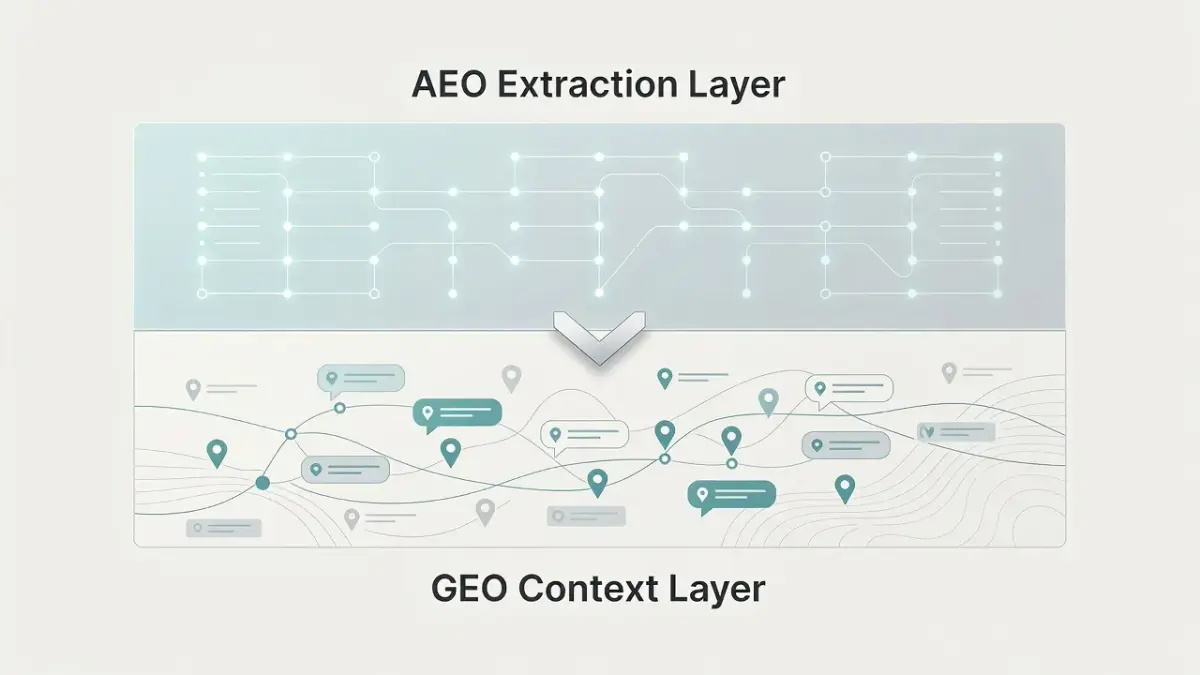
Follow these execution steps to format your site for both answer engines and generative models:
- Lead with Zero-Click Answers: Place a bolded direct answer (40 to 80 words) in the first paragraph of every article to capture AEO extractions.
- Use Question-Based H2 Headers: Formulate at least 70 percent of your subheadings as explicit questions typed by real users.
- Embed HTML Data Tables: Convert key specifications, feature comparisons, and pricing details into clear HTML tables that vector crawlers parse effortlessly.
- Anchor Claims with Third-Party Sources: Link out to recognized domain authorities, documentation pages, or academic studies to build entity trust.
- Implement Comprehensive JSON-LD Schema: Ensure every page includes complete Organization, Article, and FAQ schema properties.
If your team lacks the bandwidth to maintain this rigid structural formatting across dozens of pages every month, scaling organic growth stalls quickly. Implementing automated production schedules ensures your content pipeline stays active and structurally aligned with evolving search algorithms.
Frequently Asked Questions
What is the main difference between AEO and GEO?
AEO focuses on extracting concise, direct facts for voice assistants and quick answer boxes, while GEO focuses on getting your brand synthesized and recommended inside complex, conversational AI outputs like ChatGPT and Gemini.
Is traditional SEO obsolete in 2026?
No, traditional SEO is not obsolete, but it is incomplete on its own. Technical SEO fundamentals like page speed, indexability, and mobile optimization serve as the essential baseline before AEO and GEO strategies can succeed.
How do search engines extract content for AEO?
Answer engines read structured microdata, JSON-LD schema, direct HTML lists, and clear Q&A content blocks placed near the top of web pages to deliver direct answers to user queries.
What makes content rank well in generative engine output (GEO)?
Generative engines favor content that includes authoritative third-party source links, unique factual data tables, direct expert quotes, and structured semantic entity coverage that vector databases can embed cleanly.
Do small businesses need both AEO and GEO strategies?
Yes, small businesses need both strategies to stay visible. AEO captures local customers looking for immediate answers, while GEO captures buyers asking AI assistants for vendor comparisons and service recommendations.
How do I track whether AI models are citing my website?
You can track AI citations by monitoring referral traffic from generative platforms in web analytics, using specialized AI search monitoring software, or querying LLM APIs directly for brand attribution metrics.
Can schema markup help with generative engine optimization?
Yes, schema markup helps generative engines understand exact relationships between your products, organization, and authors, which increases the confidence score assigned to your content during AI synthesis.
What is the fastest way to format existing blog posts for GEO?
The fastest way is to add clear question headers, insert a direct answer sentence immediately below each header, include at least one data table per post, and link claims to external authoritative sources.