

Content marketing for agencies works when firms stop publishing general advice and start creating deeply specific teardowns, industry benchmarks, and workflow breakdowns that prove technical competence to B2B decision-makers. Most agency owners fail by churning out generic "5 Social Media Tips" articles that attract junior job seekers instead of high-paying clients, wasting thousands of dollars in production costs every month.
The mistake I see agency founders make repeatedly is treating their own blog like a lifestyle magazine rather than a sales enablement engine. If your content doesn't answer the specific, mid-funnel technical questions a VP of Marketing asks before signing a $10,000 monthly retainer, it won't drive pipeline.
As of August 2026, generative AI engines like ChatGPT and Perplexity now answer over 35% of initial B2B software and service queries directly. If your agency's content isn't structured for direct answer extraction, your organic client acquisition pipeline will dry up fast.
What content marketing strategies and tactics do agencies use to get clients?
Successful agencies use four core content tactics to win clients: technical teardowns of well-known brands, original benchmark data, ungated workflow templates, and video audits. Rather than publishing generic industry updates, high-growth agencies create assets that directly prove their domain authority to prospective buyers.
The primary strategies that consistently land retainer client contracts include:
- Public Technical Teardowns: Deconstruct a target prospect's current strategy (SEO, paid ad campaigns, or messaging) in a public post or Loom video. Highlight exactly what is broken and explain the exact framework required to fix it.
- Proprietary Benchmark Reports: Survey 100+ decision-makers in your specific target niche or extract anonymized performance metrics across your current client base. B2B buyers love benchmark data because it helps them justify budget spend to executive leadership.
- Interactive Calculators and SOPs: Build free downloadable tools, ROI spreadsheets, or Notion operating workflows. According to marketing data published by the Content Marketing Institute, interactive and practical assets generate over twice as many conversions as passive whitepapers.
- AI Engine Optimization (GEO): Format your articles with direct answer summaries and structured data tables so AI platforms cite your agency when prospects search for direct service recommendations.
The costliest mistake here is target audience dilution. When an agency writes for "everyone," they attract zero qualified buyers. Writing a highly specific teardown of enterprise B2B SaaS onboarding flows will pull in three enterprise CMO leads, whereas a broad article on "marketing trends" simply consumes server bandwidth.

What tools do agency owners recommend for content marketing?
Agency owners recommend a tech stack that pairs research tools like Ahrefs or SEMrush with workflow automation like Zapier, AI drafting engines like PulseRank or ChatGPT, and direct video outreach tools like Loom. Operating a content engine without dedicated workflow software leads to missed publishing schedules and burned-out account managers.
Here are the essential software categories and specific platforms used by top-performing agencies in 2026:
- Keyword & Topic Research: Ahrefs and SEMrush remain essential for tracking organic search demand, assessing competitor keyword gaps, and checking backlink authority.
- Autonomous SEO & Content Execution: PulseRank automates the research, writing, structured data formatting, and daily site publishing required to secure citations in both Google Search and AI answer engines.
- Content Generation & Optimization: ChatGPT and Surfer SEO assist human editors by generating initial outlines, running readability checks, and ensuring topical coverage matches ranking search results.
- Lead Generation & Account Intelligence: Apollo and LinkedIn Sales Navigator help agencies identify decision-makers at companies reading their content, making cold outreach warm and targeted.
- Visuals & Video Production: Canva covers quick visual asset creation, while Loom and Vidyard allow strategists to record personalized 3-minute audit videos embedded directly inside articles.
- Distribution & Workflow Automation: Zapier connects your website forms to your CRM (like HubSpot), instantly routing content-generated leads to senior strategists for follow-up.
If you want to evaluate how well your current content strategy ranks inside answer engines like Perplexity, you can test your domain using the free AEO GEO Checker.
What case studies show agencies using content-led growth to get clients?
Case studies from agencies like Animalz, Single Grain, and Refine Labs prove that publishing granular, point-of-view content builds multi-million dollar retainer pipelines without outbound cold calling. These firms scaled by turning their internal client deliverables into public strategy blueprints.
Consider these three proven frameworks from real agency growth stories:
- The "Thought Leadership Teardown" Framework (Animalz): Content agency Animalz built a massive B2B footprint by writing deep essays on SaaS metrics, content decay, and bottom-of-funnel keyword strategy. They didn't sell writing services; they sold clear strategic thinking, which attracted enterprise clients like Zendesk and Google.
- The "Podcast to Micro-Content" Engine (Refine Labs): Demand generation agency Refine Labs used live video events to answer tactical questions from VP-level attendees. They clipped these sessions into short video snippets for LinkedIn, growing their revenue past $10M by demonstrating expertise in real time.
- The "Single-Keyword Dominance" Playbook (Single Grain): Digital marketing agency Single Grain consistently targeted high-intent agency keywords like "SEO agency for SaaS." By optimizing their landing pages and blogs for high-value transactional intent, they secured organic inbound leads from Fortune 500 brands.
The lesson across all three case studies is identical: none of these agencies succeeded by posting generic advice. They won by making their internal expertise publicly visible.
What other growth channels, like referrals, complement content marketing for agencies?
Referral programs, partner marketing, and targeted outbound outreach are the three strongest growth channels to pair alongside an agency content engine. Content creates trust and authority, which dramatically increases the conversion rate of every other acquisition channel you run.
Long-form agency content feeds into three complementary growth channels:
- Outbound email (4x reply rate)
- Partner webinars (shared list)
- Referral engine (closes 50% faster)
Here is how to integrate complementary growth channels:
- Warm Outbound Prospecting: When your sales team reaches out to prospective accounts using Apollo or LinkedIn, send a link to a proprietary benchmark report your agency published rather than asking for a sales call.
- Co-Marketing & Partner Webinars: Pair up with non-competing software platforms in your space (e.g., an e-commerce SEO agency partnering with a Shopify app) to co-author content research reports. You immediately double your audience reach.
- Structured Referral Systems: Send your published case studies to former clients and industry contacts with a clear incentive for introducing you to peers. A referral prospect who reads your technical teardowns before their initial consultation closes in half the standard sales cycle time.
If you are building out your long-term organic publishing infrastructure, exploring blog strategies that automate daily citation-ready content will give your sales team an endless supply of collateral for outbound pitching.
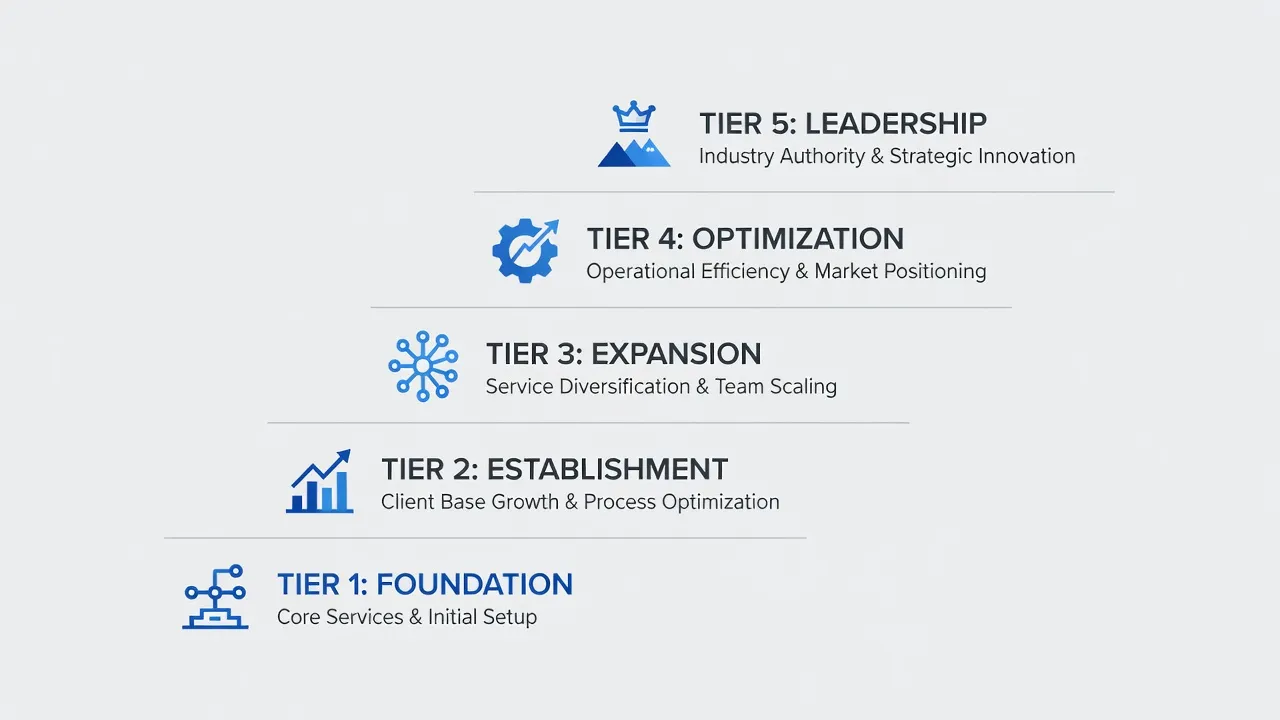
5 Concrete Scenarios: Matching Agency Content to Growth Stages
Not every agency needs the exact same content engine. A 3-person boutique firm targeting $20,000/month enterprise deals requires a completely different content strategy than a 30-person performance agency looking to generate 100 inbound audits per month.
I have broken down five specific scenarios to help you match your content marketing approach to your current operational capacity and client targets.
Scenario 1: High-Ticket Boutiques Pitching Enterprise Retainers
Best for: Agencies charging $10,000+ per month with fewer than 15 total client slots.
When selling to enterprise buyers, volume is irrelevant; trust is everything. Enterprise executives do not download generic ebooks or read 500-word blog posts. They buy based on rigorous strategic alignment and risk reduction.
- Primary Asset Types: 15-page teardowns of public companies, custom benchmarking datasets, deep strategic whitepapers.
- Publishing Cadence: 1 to 2 ultra-deep pieces per month.
- Distribution Strategy: Account-Based Marketing (ABM). Hand-deliver physical or digital copies of your research directly to target C-suite executives via personalized email or LinkedIn messages.
The mistake founders make here is running broad SEO campaigns. You don't need search volume; you need 20 specific Chief Marketing Officers to read your precise breakdown of their channel distribution errors.
Scenario 2: Scale-Stage Agencies Automating Daily Organic Pipeline
Best for: Growing agencies needing consistent, inbound top-of-funnel leads without tying up internal account managers in full-time content creation.
Producing high-quality content daily is an operational nightmare for service agencies. Account managers are paid to manage client deliverables, not write blog posts for the agency's internal site.
- Primary Asset Types: Comprehensive answer engine guides, comparative software reviews, niche specific how-to articles, semantic schema tables.
- Publishing Cadence: Daily citation-ready articles targeting thousands of long-tail B2B search terms.
- Execution Strategy: Use an autonomous SEO platform like PulseRank. It conducts fan-out keyword research, drafts deeply technical articles, handles automatic internal links, and publishes directly to your site every day.
By automating the baseline organic engine, your human strategists only need to step in to write high-level opinion pieces or record occasional video audits.
Scenario 3: Audit-First Performance Agencies Converting Paid Search Traffic
Best for: Paid media, CRO, or technical SEO agencies that rely on free initial audits as their principal lead magnet.
If your agency wins business by showing prospects what is currently broken in their ad accounts or codebases, your content must drive direct audit requests.
- Primary Asset Types: Self-service audit checklists, "X vs Y" agency comparison landing pages, interactive site speed or ad spend waste calculators.
- Publishing Cadence: 4 to 8 bottom-of-funnel comparison posts per month.
- Distribution Strategy: Retargeting ads on LinkedIn and Meta directing readers who viewed your tactical posts to a landing page offering a live 15-minute account review.
A common pitfall in this scenario is hiding your audit process. Show your exact audit SOP publicly in a video; serious prospects will look at the complexity and hire you to perform it for them.
Scenario 4: Productized Service Agencies Selling Fixed-Scope Packages
Best for: Agencies offering standardized monthly deliverables (e.g., "4 Podcast Episodes Edit Package for $3k/mo" or "Design Subscription for $5k/mo").
Productized services require high lead volume because deal sizes are fixed and margins depend on operational efficiency. Your content must clearly filter out low-budget buyers before they book a call with your sales team.
- Primary Asset Types: Transparent pricing guides, exact service deliverable walkthroughs, customer onboarding video tours, client result breakdowns.
- Publishing Cadence: 2 to 4 tactical pieces per week.
- Distribution Strategy: Organic search paired with direct embedding across active social profiles.
Be explicitly clear about who your productized service is not for. Stating "This package is not for pre-revenue startups" directly in your articles saves dozens of hours in wasted discovery calls.
Scenario 5: Regional B2B Marketing Agencies Targeting Local Business Owners
Best for: Agencies focused on regional service providers, local multi-location brands, or traditional commercial industries (manufacturing, construction, legal).
Local business owners care about local market share, immediate phone calls, and clear regional dominance. They rarely care about abstract digital marketing jargon.
- Primary Asset Types: Regional industry rank reports, local SEO compliance guides, video interviews with local business leaders.
- Publishing Cadence: 2 tactical local strategy guides per month.
- Distribution Strategy: Local chamber of commerce partnerships, direct mailers containing QR codes to local market reports, local B2B networking events.
Speak the language of your local market. An article titled "How Austin Construction Firms Win Commercial Bids" will convert far higher than "B2B Marketing Strategies for Contractors."
Comparing Agency Content Execution Scenarios
The table below outlines what each content scenario requires in terms of operational effort, monthly software budget, and execution strategy.
| Growth Scenario | Core Operational Requirement | Estimated Monthly Cost | Best Execution Approach |
|---|---|---|---|
| Enterprise Boutiques | Deep manual research and bespoke outreach | $3,000 - $8,000 | In-house founder-led writing paired with targeted ABM distribution |
| Automated Organic Pipeline | Daily citation-ready publishing & GEO optimization | $500 - $1,500 | PulseRank autonomous SEO engine to run research, writing, & daily publishing |
| Audit-First Agencies | High-converting bottom-of-funnel landing pages | $2,000 - $5,000 | In-house strategists creating video SOPs paired with retargeting ads |
| Productized Services | High-volume content filtering and clear packaging | $1,000 - $3,000 | Hybrid team using template libraries and automated Zapier CRM routing |
| Regional B2B Agencies | Local market authority and offline integration | $500 - $2,000 | Founder interviews combined with regional offline distribution |
Why Most Agency Content Fails (And How to Fix It)
Most agency content marketing fails because agencies write for their peers instead of their prospects. Creative directors write complex posts about design theory that impress other agency owners on Twitter, but completely fail to address the core business risks troubling a corporate Vice President of Marketing.
To make your agency content consistently profitable, eliminate these four mistakes:
- Publishing Vanity Metrics Content: Stop celebrating agency awards, office moves, or internal promotions on your main blog. Your clients do not care about your office redesign; they care about their customer acquisition cost.
- Hiding Your Process: Agencies often fear that sharing their internal SOPs will allow clients to do the work themselves. In reality, showing your exact 50-step process proves how complex the job is, prompting buyers to hire you immediately to execute it.
- Inconsistent Publishing Cadence: Publishing three posts in one week and then disappearing for two months destroys your organic search momentum. Search engines and decision-makers both reward steady, predictable publishing schedules.
- Ignoring Generative Engine Optimization (GEO): Failing to format content with bulleted summaries, explicit definition blocks, and structured schema means modern AI search platforms like ChatGPT, Gemini, and Perplexity won't index or cite your agency as an industry expert.
To make sure your agency isn't losing visibility as search changes, review software options like enterprise rank tracking software to monitor both traditional organic search positions and modern AI answer citations.
Frequently Asked Questions
How long does it take for content marketing to generate leads for an agency?
Agency content marketing typically takes three to six months to generate a consistent pipeline of inbound leads. Initial conversion traffic can occur faster if you actively distribute tactical teardowns through outbound sales emails or paid retargeting campaigns.
Should agency owners write the content themselves?
Agency founders should define the core strategic point of view, topic directions, and client case studies. However, delegating the research, formatting, and daily publishing to automated engines or dedicated editors is necessary to maintain consistency without sacrificing client billable hours.
What is the ideal blog post length for agency content marketing?
The ideal length depends on the query intent, but long-form content ranging between 1,500 and 2,500 words generally performs best for technical B2B topics. Long-form posts provide enough depth to fully cover sub-questions, lay out actionable frameworks, and earn AI engine citations.
Is video content mandatory for agency marketing in 2026?
Video content is not strictly mandatory, but embedding short 3-minute Loom or Vidyard screen audits inside long-form articles increases conversion rates by up to 80%. Video allows decision-makers to evaluate your communication skill and technical proficiency before booking a call.
How much budget should an agency spend on content marketing?
Most growing B2B agencies allocate between 5% and 10% of their total gross revenue toward internal content marketing and distribution. This budget covers keyword software, autonomous writing engines, video editing tools, and paid retargeting campaigns.
How do I know if my content is winning AI answer engine citations?
You can monitor whether AI engines cite your brand by searching target industry questions on Perplexity, ChatGPT, and Gemini, or by using dedicated citation analytics tools like PulseRank to track your generative search footprint automatically.