

Building a sustainable content generation strategy requires five sequential steps—from mapping topic clusters to setting up automated publishing—and costs between $500 and $5,000 per month depending on tool automation. Business owners can execute this framework in about 10 to 15 hours of initial architecture work before turning it into a daily publishing workflow. Rather than spending thousands on fragmented agency retainers, establishing an end-to-end operational blueprint lets you maintain high article output without sacrificing editorial quality or search visibility.
Managing an ongoing publishing schedule internally often exposes major budget traps. Retaining traditional copywriters runs anywhere from $150 to $500 per article, while stacking separate tools for keyword research, outline building, writing assistance, visual generation, and rank tracking easily climbs past $800 every month in software subscriptions alone. Solutions like PulseRank streamline this stack by handling keyword discovery, 30-day strategy creation, citation-ready writing, and direct site publishing for a flat $499 per month.
The table below breaks down the five core steps to implement a modern content strategy, along with realistic timing, technical requirements, and typical market costs.
| Strategy Phase | Primary Deliverable | Setup / Execution Time | Typical Cost Range |
|---|---|---|---|
| Step 1: Topic Clustering | 30-day keyword & sub-question map | 3–5 hours | $0 – $200/mo (Software) |
| Step 2: Editorial Standards | Brand voice guide & source criteria | 2–4 hours | $0 (Internal labor) |
| Step 3: Pipeline Automation | Draft generation & CMS integration | 3–5 hours | $499 – $3,000/mo |
| Step 4: Data & Visual Layering | Markdown tables & custom inline visuals | 1–2 hours per piece | $50 – $300/mo (Assets) |
| Step 5: Audit & Track | GSC & Answer Engine citation monitoring | 1 hour weekly | $0 – $100/mo |

Step 1: Map your core topic clusters and keyword seed pool
The first step in any content generation strategy is identifying high-intent seed topics and expanding them into structured semantic clusters. Instead of chasing isolated, high-volume keywords that target broad audiences, focus on grouped topical themes that demonstrate authority to search engines.
Start by collecting 5 to 10 core seed concepts that directly touch your products or services. From there, extract long-tail questions and search queries around those seeds. A solid content strategy sample organizes keywords into hub-and-spoke frameworks, ensuring every main topic has supporting articles covering specific user sub-questions.
- Identify main hubs: Choose broad topics essential to your audience's purchasing decisions.
- Extract supporting sub-topics: Pull specific questions, comparison queries, and "how-to" searches.
- Group by intent: Separate informational guides from high-converting transactional pages.
Structuring topics this way avoids random posting. It also ensures every piece of content supports broader goals like organic traffic generation.
Step 2: Establish your editorial standards and sourcing criteria
Establishing rigid editorial rules upfront guarantees that high-volume publishing never degrades into generic, low-trust commentary. AI search engines and human readers both punish fluff, requiring every article to anchor its claims to real facts, numbers, and verifiable sources.
Create a brand guidelines document that explicitly bans vague introductory phrases, generic adjectives, and unsupported broad statements. Define acceptable third-party sources, such as official product documentation, government reporting, and accredited research studies.
- Require specific facts: Every major section must cite a price, step count, date, or named technical standard.
- Mandate external linking: Require links out to high-authority, non-competitor domains for every statistical claim.
- Ban generic AI phrases: Filter out overused transitions like "In conclusion," "Furthermore," and "It is important to note."
Pricing traps usually happen here when businesses hire cheap freelance networks. Without strict editorial briefs, budget writers deliver fluff that requires hours of internal editing to fix.
Step 3: Build an automated production and publishing pipeline
Connecting keyword strategy directly to your Content Management System (CMS) eliminates manual formatting bottlenecks and speeds up publishing. A reliable pipeline takes structured outlines, applies editorial rules, generates formatting markup, and posts directly to platforms like WordPress, Shopify, or Wix.
Setting up manual hand-offs between strategists, writers, and site managers slows output down to two or three posts per week. In contrast, automating your pipeline allows for daily publishing without adding headcount.
Using an end-to-end platform like PulseRank connects keyword discovery, 30-day plan creation, and direct publishing into WordPress or Shopify inside one workflow. Platforms that combine strategy and execution prevent tool sprawl and save hundreds of dollars compared to buying standalone SEO research, AI writing, and auto-posting tools separately.
Step 4: Layer in markdown data tables and visual entities
Adding structured data tables and rich inline images makes your content far more indexable for traditional search engines and AI answer engines alike. Modern search algorithms lift structured tables directly into zero-click feature blocks, while visual entities keep mobile readers engaged.
Include at least one clean Markdown data table in every article. Ensure every table cell contains concrete information—like prices, dimensions, timeframes, or explicit feature comparisons—rather than filler terms like "Varies" or "Good."
- Use standard Markdown tables: Keep header rows explicit and formatting simple for search crawlers.
- Insert visual placeholders: Plan relevant diagrams, workflow illustrations, or screen captures every 400 to 500 words.
- Write descriptive alt text: Label every image with functional, keyword-relevant alt text that describes the visual element clearly.
Combining textual answers with structured tables is essential when building content marketing with seo strategies designed to capture AI citations.

Step 5: Set up performance auditing and generative engine tracking
Tracking both traditional Google rank positions and AI answer engine citations gives you a clear picture of content performance. Standard analytics measure pageviews, but modern search strategy requires tracking whether generative models quote your pages as primary sources.
Connect your publishing engine directly to Google Search Console to monitor impression velocity and spot pages underperforming their ranking position. At the same time, monitor how frequently search platforms pull your brand into conversational summaries.
- Monitor impressions early: Track Search Console data weekly to spot keywords gaining traction in positions 11 through 30.
- Audit underperforming assets: Refresh articles that lose ground by updating facts, adding sources, or expanding sub-question coverage.
- Track AI citations: Check whether key industry queries generate direct citations pointing to your published guides.
What content marketing trends are working now for 2026?
The most effective content marketing trends in 2026 center on generative search optimization, direct site publishing automation, and high-density factual writing. Search engines are increasingly filtering out surface-level articles in favor of comprehensive content that directly answers complex user queries.
Businesses are shifting away from publishing two long blog posts a month. Instead, they rely on automated systems to maintain a consistent daily output of niche, hyper-specific guides.
Another major trend is optimizing content for zero-click AI overviews. By structuring headings as direct questions and immediately providing concise answers, companies ensure their site content gets selected as a primary reference by conversational search engines.
What do content marketing agencies recommend for content generation strategies?
Agencies recommend building a tightly clustered keyword foundation, maintaining high publishing velocity, and eliminating tool sprawl. Leading strategists advise companies against creating content ad-hoc, recommending instead a structured 30-day editorial roadmap built around clear topic silos.
Agencies also emphasize cost efficiency in execution. Agency retainers typically cost between $3,000 and $10,000 per month for managed content services. Because of these high costs, agencies increasingly suggest using integrated platforms to lower cost-per-article figures while keeping output quality high.
Finally, agencies push for multi-channel utility. Every long-form article produced should easily break down into micro-insights for social media, email updates, and sales collateral.
What does the Content Marketing Institute recommend for 2026 content strategy?
The Content Marketing Institute recommends prioritizing audience intent alignment, original data integration, and structured multi-format distribution. Their benchmark reports consistently show that top-performing organizations build strategies around deep operational workflows rather than ad-hoc creation.
According to research published by the Content Marketing Institute, successful B2B marketers focus heavily on documented strategies that measure performance across the entire buyer journey. Their framework highlights three central pillars:
- Documented strategic intent: Writing down explicit goals, target profiles, and performance metrics before creating content.
- Fact-based positioning: Replacing broad opinions with proprietary data, expert quotes, and verifiable research.
- Operational scalability: Establishing clear production workflows that prevent content bottlenecks as business needs grow.
What does HubSpot recommend for content strategy in 2026?
HubSpot recommends organizing website content around topic clusters, optimizing for conversational search queries, and leveraging smart automation. Their core methodology stresses creating a central pillar page for every major topic, connected to detailed cluster articles through strategic internal links.
In their comprehensive HubSpot content strategy guide, they highlight that search engines prioritize sites demonstrating clear topical authority over those with random, unlinked posts. HubSpot advises businesses to focus heavily on solving real user pain points rather than purely optimizing for keyword volume.
They also emphasize historical optimization. Regularly updating older blog posts with fresh data, improved tables, and current dates often yields a faster traffic return than creating brand-new pages from scratch.
What content generation strategies do experts like Neil Patel, Ahrefs, and Semrush recommend?
Search experts like Neil Patel, along with research teams at Ahrefs and Semrush, recommend focusing on search intent matching, programmatic content depth, and backlink-worthy asset creation. Leading SEO authorities consistently stress that content volume only works when backed by strong technical foundations.
Guidance provided in the Ahrefs content strategy blueprint emphasizes finding business-relevant keywords where searchers have clear commercial intent. Meanwhile, data insights from the Semrush content analysis guide highlight the importance of covering all logical sub-questions within a topic to secure featured snippets and top rankings.
- Neil Patel: Advocates for aggressive content refreshing and leveraging AI tools to scale research and drafting without losing brand voice.
- Ahrefs: Focuses heavily on "Business Potential" scores for keywords, prioritizing topics that directly showcase your product.
- Semrush: Highlights intent parsing, advising creators to align content structure (lists, tables, tools) with what Google currently ranks for that query.
How do AI, short-form video, and user-generated content fit into 2026 content strategies?
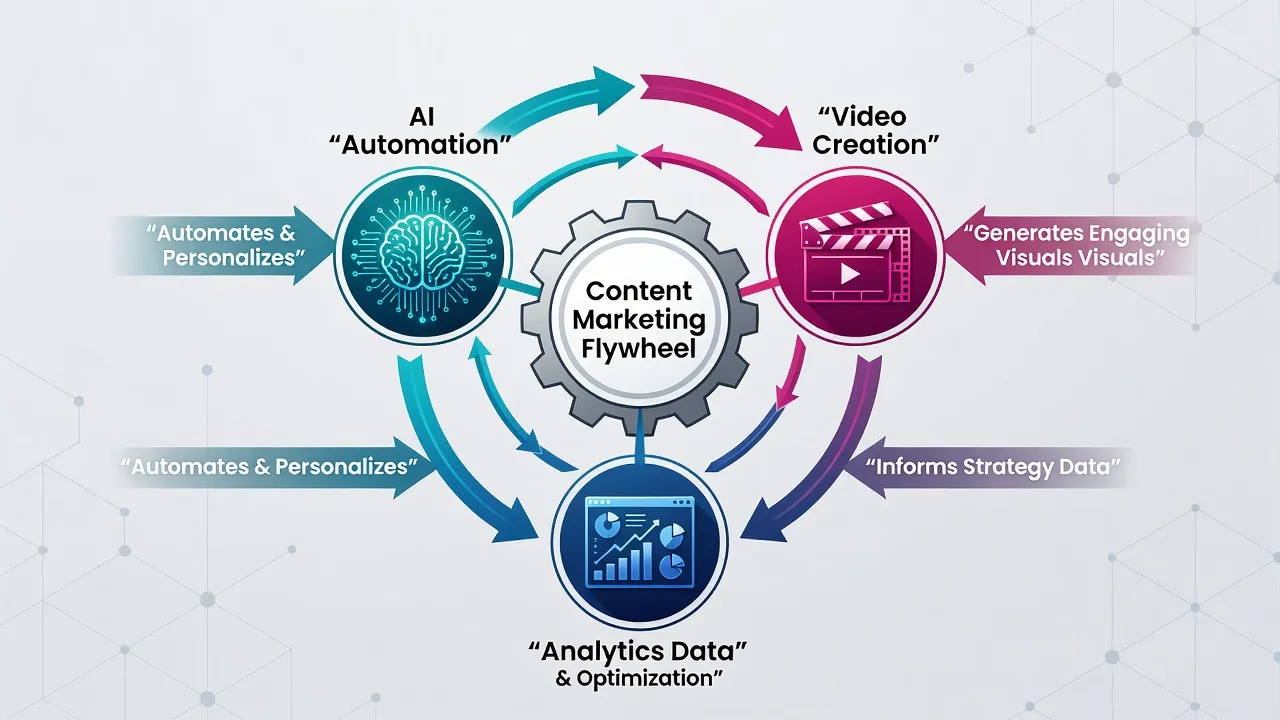
AI handles scale and research, short-form video drives immediate social engagement, and user-generated content provides authentic social proof. Combining these three components creates a comprehensive marketing flywheel that reaches users across multiple touchpoints.
AI tools accelerate keyword clustering, outline generation, and baseline draft writing. This allows small teams to publish comprehensive guides daily without burning out internal resources.
Short-form video acts as an engagement hook on social channels, driving traffic back to core website articles. User-generated content—like customer reviews, forum quotes, and real case studies—adds the human perspective that search engines and buyers look for.
How PulseRank simplifies your content generation strategy
Executing a continuous content generation strategy usually requires juggling five or six separate software subscriptions or paying steep agency retainers. PulseRank solves this fragmentation by offering a complete SEO and Generative Engine Optimization (GEO) platform in one unified workflow.
For a flat fee of $499 per month, PulseRank manages your brand's keyword pool, builds an actionable 30-day content calendar, and writes 30 ready-to-publish articles every month. Each piece includes structured markdown tables, sourced third-party links, inline images with alt text, and relevant internal links built-in.
Instead of managing separate research tools, copywriting freelancers, and publishing plugins, PulseRank handles the entire process and posts directly to WordPress, Shopify, Wix, or Git repositories. It also features built-in Google Search Console reporting and AI citation tracking, giving you complete visibility into search rankings and performance without extra fees or complex software stacks.
Frequently Asked Questions
What is a content generation strategy?
A content generation strategy is an operational plan for researching, writing, publishing, and maintaining digital content to grow organic search visibility and attract target customers.
How much does a business content generation strategy cost?
Costs range from $500 per month for automated single-platform solutions up to $10,000 per month when hiring full-service content marketing agencies.
How often should a business publish new content?
Publishing one well-researched, optimized article per day is ideal for building fast topical authority, though publishing two to three high-quality pieces weekly is a sustainable starting baseline.
What is the difference between content creation and content generation strategy?
Content creation focuses on the individual act of writing or designing an asset, while a content generation strategy covers the overall system, keyword research, workflow automation, and analytics tracking.
How long does it take to see results from a new content generation strategy?
Initial search engine impressions usually start building within 30 to 60 days, while substantial organic traffic growth typically takes 4 to 6 months of consistent publishing.
Can AI completely replace human content strategists?
No, AI accelerates research, drafting, and formatting, but strategic direction, high-level brand messaging, and final editorial quality standards still require human oversight.
Why are data tables important in modern content strategies?
Data tables provide structured factual information that search engines and AI answer engines can easily parse, index, and lift directly into featured answer snippets.