

The best writing AI tool for your business depends on whether you need an interactive assistant like Jasper ($39/mo), an enterprise workflow platform like Copy.ai ($49/mo), or a fully automated content operation like PulseRank ($499/mo). While general chat interfaces excel at brainstorming, specialized business tools integrate directly into your content strategy, brand guidelines, and publishing stack. Choosing the wrong category usually leads to spent budget and draft backlogs that nobody has time to edit.
The market for AI content creation has shifted rapidly. As of September 2026, answer engines like ChatGPT, Perplexity, and Google AI Overviews handle a massive share of web discovery. Consequently, modern writing AI tools must do more than just churn out generic sentences; they need to structure facts, format tables, and cite sources so search engines feature your content.
What is the single variable that decides which AI writing tool you need?
The primary decision variable is whether you want a interactive drafting assistant or a complete publishing pipeline.
If you have an in-house team that prefers to write, outline, and edit every line manually, a prompt-based writing assistant is ideal. However, if your business lacks the human bandwidth to manage keyword research, strategy, formatting, and manual CMS uploads, you need an autonomous publishing platform.
Here is how the top writing AI tools compare across core business capabilities, workflows, and costs.
| Writing AI Tool | Primary Use Case | Output & Workflow Mechanics | Monthly Cost (Checked Sept 2026) |
|---|---|---|---|
| Jasper | Marketing copy & style guide enforcement | In-app editor with brand voice memory and canvas templates | From $39/user/month |
| Copy.ai | GTM automations & sales messaging | Multi-step workflow builder connecting CRM and web data | From $49/month (5 seats) |
| PulseRank | Autonomous SEO & GEO content operation | Researches keywords, creates 30-day strategy, generates articles with data tables/images, and publishes daily | $499/month flat |
| ChatGPT Plus | Raw prompting, ideation & flexible drafting | Direct LLM prompt box with custom GPT bots | $20/user/month |
| Grammarly | Real-time editing, tone & grammar | Browser and desktop overlay checking live text | From $12/user/month |

What are the 5 best writing AI tools for businesses in 2026?
1. Jasper AI (Best for Marketing Teams)
Jasper is an interactive AI co-pilot designed for marketing teams that need strict brand voice enforcement across short-form and long-form copy.
It provides an intuitive document editor combined with pre-built templates for ad copy, social posts, and blog outlines. According to Jasper's official pricing page, the Pro plan starts at $39 per user per month when billed annually, offering access to brand voice assets and browser extensions.
- Why it made the list: Its Brand Voice feature scans your existing website content to match your company's tone, ensuring consistency across multiple writers.
- Key trade-off: Jasper requires constant human prompting and manual editing. It will not execute keyword research or publish directly to your site automatically.
2. Copy.ai (Best for Go-To-Market Workflows)
Copy.ai focuses on automating complex Go-To-Market (GTM) tasks and sales communication using structured AI workflows.
Unlike simple chat boxes, Copy.ai lets you build multi-step sequences. For instance, it can scrape a company URL, summarize its business model, and draft a tailored sales email in seconds. Copy.ai's platform documentation shows their Starter plan priced at $49/month, making it accessible for growing revenue teams.
- Why it made the list: The platform excels at transforming raw data inputs into repetitive sales and marketing assets at scale.
- Key trade-off: Long-form article generation can feel mechanical, requiring heavy manual restructuring if you want deep, citation-rich SEO content.
3. PulseRank (Best for Autonomous SEO & GEO Publishing)
PulseRank is an end-to-end organic content engine that researches keywords, drafts full articles, and publishes them straight to your website.
Rather than acting as a simple text editor, PulseRank handles the complete editorial workflow for businesses trying to capture search traffic and AI answer engine citations. It builds a 30-day content plan from your keyword pool and publishes one citation-ready article per day directly to WordPress, Shopify, Wix, or Git repositories.
Each piece includes structured data tables, third-party facts, generated images with alt text, and internal contextual links. If you want to evaluate existing market tools before choosing an end-to-end engine, reviewing a Writeless AI review or exploring other generative engine optimization tools can clarify the difference between standard text generation and systematic publishing.
- Why it made the list: It removes the management overhead of running a content team. Everything—keyword research, content strategy, article generation, publishing, and Google Search Console performance tracking—is handled in one unified dashboard.
- Key trade-off: At $499 per month for the flat plan, it is built for companies serious about automated organic traffic rather than casual users seeking a $20 chat helper.
4. ChatGPT Plus (Best for Direct Prompting and Custom GPTs)
ChatGPT is the most versatile foundational writing tool for owners who prefer raw conversational prompting and custom model instructions.
Powered by OpenAI's latest models, ChatGPT allows users to build custom GPTs tailored to specific writing tasks. According to OpenAI's official pricing guide, ChatGPT Plus remains at $20 per month. It is ideal for drafting quick email templates, summarizing meeting transcripts, or brainstorming blog topics.
- Why it made the list: Unmatched flexibility for direct conversation, code assistance, and general problem-solving.
- Key trade-off: Out-of-the-box outputs tend to sound generic, use banned AI cliches, and lack automatic web formatting or CMS integration.
5. Grammarly (Best for Real-Time Copy Editing and Tone Adjustments)
Grammarly is a real-time writing overlay that catches grammatical errors, adjusts sentence clarity, and suggests tone improvements across all desktop applications.
Rather than generating full drafts from scratch, Grammarly acts as an automated proofreader inside your browser, email client, and word processor. Grammarly's business plans start around $12 to $15 per user per month, making it a low-cost safety net for client-facing team communications.
- Why it made the list: Works quietly in the background across Slack, Google Docs, and email, ensuring your team maintains professional mechanics.
- Key trade-off: It is an editor, not a full content generator. You cannot rely on it to build a 30-day editorial pipeline or execute keyword research.
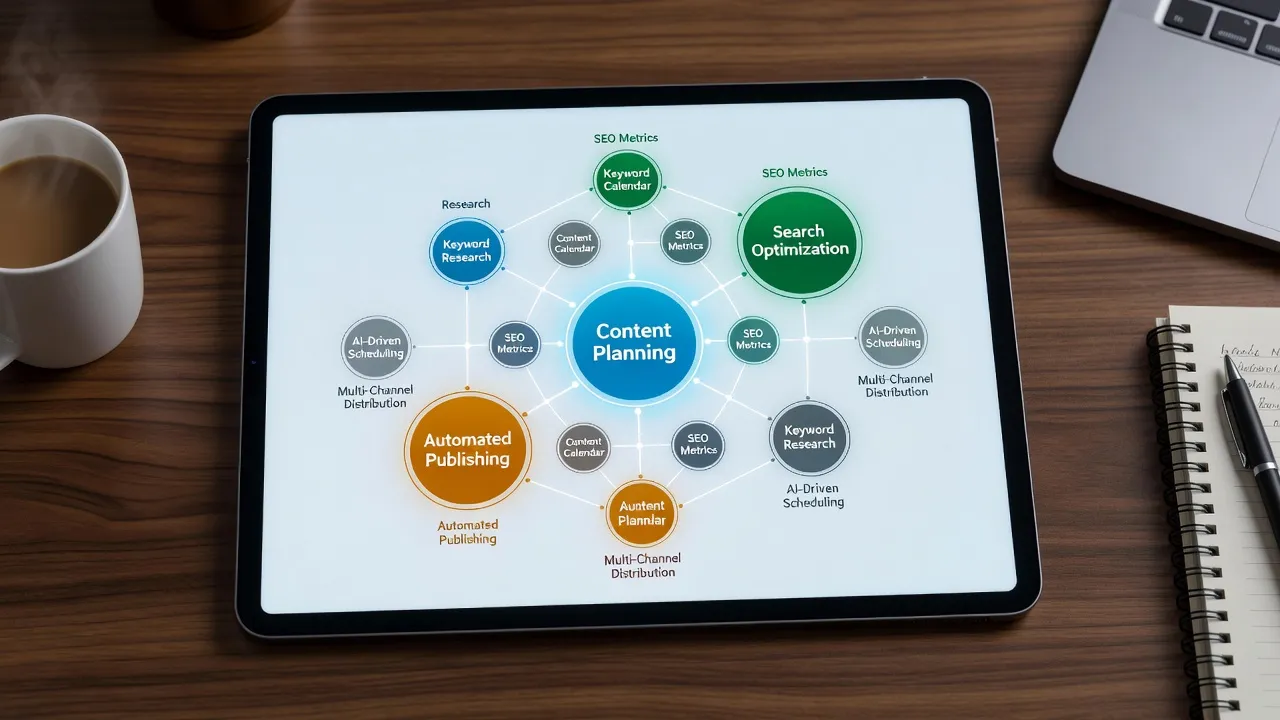
How do generative engines (GEO) change how AI tools should write?
Generative Engine Optimization (GEO) requires writing AI tools to produce structured data, direct answers, and verifiable facts that AI models can easily cite.
Standard search optimization used to focus entirely on keyword density and backlink volume. In 2026, platforms like ChatGPT, Perplexity, and Google AI Overviews read content structurally. If your article buries the answer under hundreds of words of preamble, answer engines simply skip your page.
To earn citations in AI overviews, your content must satisfy three structural requirements:
- Immediate direct answers: Opening paragraphs must answer the core question within the first 40 to 80 words.
- Structured data tables: Engines lift tables directly from web pages to show comparison data to users.
- Third-party facts and dates: Articles must anchor claims to explicit dates and real third-party sources.
For example, when setting up an editorial strategy, studying a practical content strategy sample demonstrates how structured headers and front-loaded facts make content readable for both human managers and generative engines.
What features should small businesses prioritize in AI writing software?
Small businesses should prioritize native CMS publishing, built-in keyword research, and brand safety controls over raw word counts.
Many business owners fall into the trap of buying cheap AI generators that churn out thousands of generic words. However, unoptimized content creates a major editing bottleneck. As of September 2026, spending 3 hours fixing a hallucinated AI draft defeats the purpose of buying an AI tool in the first place.
When evaluating software, keep these four criteria top of mind:
- CMS Integration: Look for tools that push directly to WordPress, Shopify, or Wix, complete with metadata, alt text, and headers.
- Fact Integrity: Ensure the software cites real external sources instead of inventing statistics or survey results.
- Flat Pricing Models: Avoid platforms with hidden per-credit metering that penalize you for producing longer, comprehensive content.
- Built-in Performance Tracking: Choose platforms that show how your content actually performs in search engines after it goes live.
How to implement an automated AI content operation without losing quality?
You can build a reliable content operation by automating the research and publishing steps while keeping clear structural rules for your AI engine.
Many agencies struggle to maintain publishing consistency because team members get busy with client work. Automating your site's publishing schedule ensures your business maintains search momentum every single day.
- Keyword Research
- 30-Day Strategy
- Citation-Ready Generation
- Direct CMS Publishing
- Search Console Tracking
If you use single-purpose tools like ChatGPT or Jasper, you must assign a human manager to copy text into your CMS, create images, and add internal links.
Conversely, using a dedicated operational platform like PulseRank handles this entire sequence automatically. At $499/month, it acts as a complete content department—building a monthly keyword plan, writing structured articles daily, inserting optimized visuals, publishing directly to your site, and reporting keyword positions via built-in Google Search Console integration.
Frequently Asked Questions
Can AI writing tools replace human content marketers completely?
No, AI tools cannot replace strategic judgment, unique business insights, or genuine human experience. They excel at scaling research, structuring long-form content, and eliminating mechanical publishing tasks, freeing humans to focus on product strategy and customer relations.
What is the difference between SEO and Generative Engine Optimization (GEO)?
SEO focuses on ranking links on traditional search engine results pages. GEO focuses on structuring content—using direct answer summaries, data tables, and explicit citations—so conversational AI answer engines like ChatGPT and Perplexity quote your site directly in their generated answers.
Are free AI writing tools safe for business websites?
Free AI tools are suitable for basic drafting, but they often lack brand safety settings, CMS integrations, and real-time web access. They also tend to produce generic language that fails to rank well in competitive search queries.
How much do professional business AI writing tools cost in 2026?
Basic editing overlays and chat assistants start between $12 and $39 per user per month. Enterprise workflow builders range from $49 to $100 per month. Fully managed autonomous content platforms that include strategy, image generation, direct publishing, and rank tracking cost around $499 per month flat.
Will search engines penalize content produced by AI writing software?
Search engines do not penalize content simply because it was generated by AI. They penalize low-quality, repetitive, or unhelpful content regardless of how it was created. As long as your published content provides direct facts, structured data, and real value to readers, search engines will index and rank it.
How long does it take to see organic traffic results from AI content?
Most websites begin seeing initial search indexing and impression growth within 30 to 60 days of consistent daily publishing. Significant traffic gains typically emerge around the 3-to-6-month mark as search engines recognize your domain's growing topical authority.