

A rank tracking API is a programmatic interface that extracts search engine results page (SERP) positions for targeted keywords and delivers the structured data directly into custom software, dashboards, or databases. Unlike standard SEO web applications, an API allows developers and agencies to automate raw data retrieval, eliminate manual exports, and build internal ranking dashboards at scale.
When you run rank tracking through an application programming interface (API), your software sends automated HTTP requests containing specific parameters - such as search query, location, device type, and language. The API queries search engines or underlying databases, processes the raw results, and returns formatted JSON or XML payloads containing exact ranking positions, featured snippet statuses, and competitor URLs.
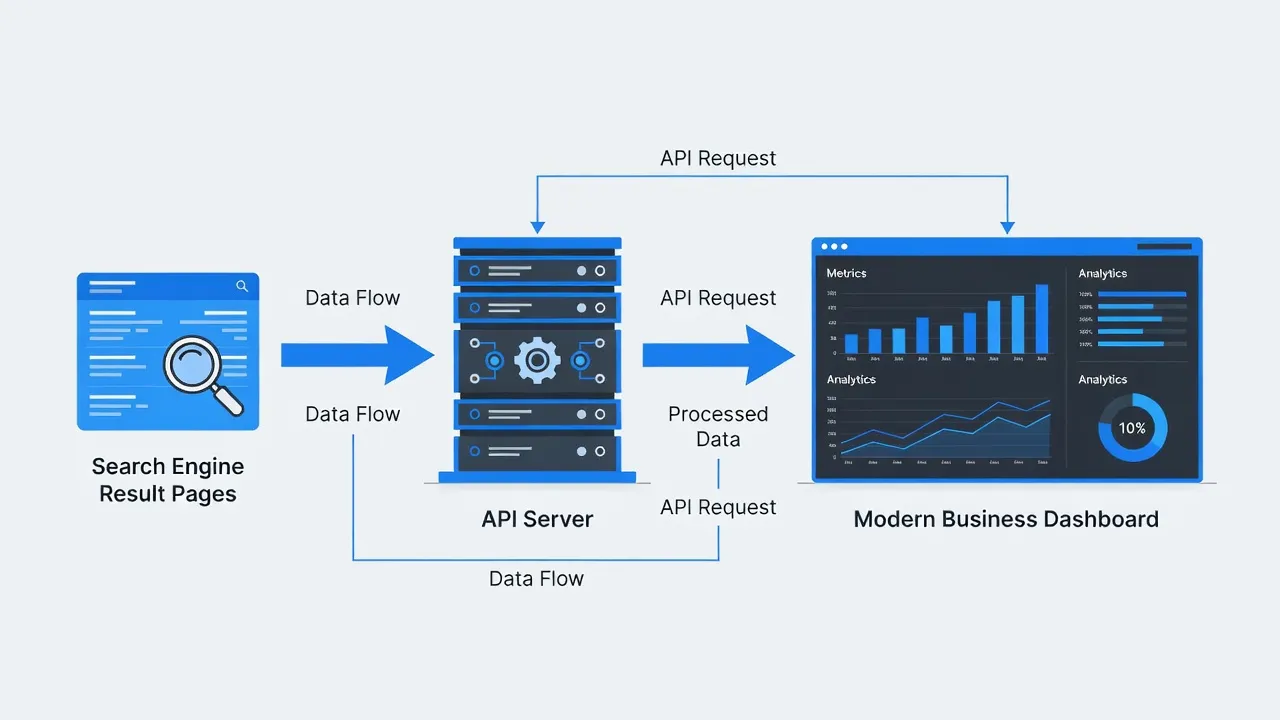
- User App / Dashboard sends HTTP Request containing Keyword, Geo, and Device to Rank Tracking API
- Rank Tracking API scrapes or queries SERP
- SERP returns Ranks, Features, and URLs to Rank Tracking API
- Rank Tracking API returns Structured JSON Data to User App / Dashboard
Businesses rely on a google rank tracking api when off-the-shelf SEO tools no longer fit their operational workflows. Whether you build an in-house performance portal, track millions of localized keywords, or feed machine-learning models, programmatic rank data removes the UI overhead of traditional software.
How a Rank Tracking API Works Behind the Scenes
Every rank tracking API acts as a data pipeline between search engine results pages and your database. When you request keyword positions programmatically, the provider executes several infrastructure-heavy tasks in milliseconds.
First, the API manages IP proxy rotation and headless browser rendering to simulate authentic user searches across thousands of geographic locations. Search engines aggressively block automated scripts through CAPTCHA challenges and rate limits. A dedicated API provider absorbs this infrastructure complexity, making sure your queries execute without blocks.
Second, the system parses unstructured HTML code into organized data models. When Google updates its page layouts - such as shifting local packs, AI Overviews, or shopping units - the API provider updates its parser so your code receives consistent JSON attributes without breaking.
Finally, the API delivers normalized values covering your primary positions, search volumes, URL paths, and SERP feature presence. You can store these data points in your data warehouse to trigger custom alerts, update client reports, or monitor search volatility over time.
Comparing Top Keyword Rank Tracking APIs in 2026
Choosing the right API depends on whether you need raw SERP scraping endpoints, fully managed rank tracking, or an integrated content and reporting platform. The table below outlines leading options based on operational model, data source, and pricing mechanics as checked in August 2026.
| Provider | Primary Delivery Model | Rank Data Sources | Key Differentiator | Pricing Structure |
|---|---|---|---|---|
| DataForSEO | Raw REST API (JSON) | Google, Bing, Yahoo, Baidu | Pay-per-request SERP scraping with ultra-low latency endpoints | Pay-as-you-go per query ($0.0006 - $0.002 per call) |
| SerpApi | Real-time REST API | Google, Bing, DuckDuckGo, Baidu | Automatic proxy management and complete visual SERP parsing | Monthly tiers starting around $50/month for 5,000 searches |
| PulseRank | All-in-One Platform & Search Console Sync | Google Search Console & AI Answer Engines | Direct Search Console rank tracking paired with automated daily article generation and AI citation monitoring | Flat $499/month for complete content and tracking execution |
| Semrush | Enterprise REST API | Google, Baidu | High-volume keyword metrics linked directly to Semrush's backlink and domain database | Enterprise plan required plus API unit balances |
| AccuRanker | REST & GraphQL API | Google, Bing, YouTube | High-refresh velocity with on-demand programmatic SERP updates | Volume-based tiers based on tracked keywords starting around $129/month |
Does DataForSEO offer a Rank Tracking API?
Yes, DataForSEO offers a dedicated Rank Tracker API alongside its general SERP API endpoints. The service allows developers to track keyword rankings across multiple search engines, geographical locations, and device types with structured JSON responses.
DataForSEO structures its rank tracking tools into two main models: live real-time queries and background task-based tracking. The task-based model lets you submit thousands of keyword tracking jobs asynchronously, reducing costs while collecting daily or weekly rank movements.
According to the DataForSEO API documentation, costs are calculated per API request, starting at fractions of a cent per query. This pay-as-you-go model makes it popular among agencies and software teams building custom SEO applications who do not want monthly user seat fees.
Does SerpApi offer a keyword rank tracking API?
Yes, SerpApi provides a keyword rank tracking API through its real-time Google Search Results API and related search endpoints. Instead of maintaining an asynchronous tracking database, SerpApi focuses on scraping live search results directly at the moment of request.
SerpApi executes actual browser searches from selected locations down to the city and zip code level. It parses organic results, paid ads, knowledge graphs, local packs, and rich snippets, returning a clean JSON object containing exact position indexes.
As detailed on the official SerpApi documentation, the platform solves CAPTCHAs, manages residential proxies, and guarantees JSON parsing consistency even when search engines change their underlying HTML. Monthly plans scale based on total search volume rather than fixed keyword lists.

Does SEMrush have a Position Tracking API?
Yes, Semrush features a Position Tracking API designed for enterprise customers and custom dashboard integrations. The endpoint allows developers to programmatically extract visibility scores, position distributions, and keyword rankings from existing Semrush Position Tracking projects.
Unlike raw SERP scraping tools, the Semrush API connects to project data that has already been aggregated within the platform. You can pull daily rank updates, organic vs. paid metrics, and landing page URLs for specific domains.
Access rules detailed in the Semrush API documentation state that the Position Tracking API requires an active Enterprise subscription tier. Usage consumes API units, which scale based on the volume of metric requests your application calls each day.
Does AccuRanker offer an API for rank tracking?
Yes, AccuRanker provides a full-featured REST API and GraphQL API for keyword rank tracking. The API grants direct access to AccuRanker's core tracking engine, allowing developers to retrieve keyword positions, historical ranking trends, and share-of-voice metrics.
AccuRanker built its reputation on fast rank refreshes, and its API maintains those same standards. Developers can trigger on-demand rank updates programmatically or schedule automated data exports into tools like Google Looker Studio, PowerBI, or internal SQL databases.
API access is standard across most AccuRanker subscription plans, though query rate limits expand as your monthly keyword tier grows. This makes it a popular engine for agencies that require frequent rank checks across hundreds of client domains.
Does Ahrefs offer an API for rank tracking keyword positions?
Yes, Ahrefs offers API access that includes rank tracking and keyword metric endpoints via its API v3 interface. However, programmatic access to Rank Tracker data is restricted to higher-tier Enterprise plans and specific API add-on packages.
The Ahrefs API allows organizations to pull organic search positions, traffic estimations, and ranking history for tracked domains. Rather than serving as an open-ended SERP scraper, it extracts data from projects already configured inside the Ahrefs Rank Tracker workspace.
For engineering teams looking to build white-label applications, Ahrefs API usage is governed by workspace units. Consuming detailed daily position histories across large keyword sets can quickly use up monthly unit allocations.
Does SE Ranking offer an API for rank tracking?
Yes, SE Ranking provides an API for rank tracking to automate reporting and data syncs. The SE Ranking REST API allows users to create projects, manage target keyword lists, and pull historical position data without logging into the web interface.
The API exposes metrics including daily ranking positions, search volumes, traffic forecasts, and competitor rankings across Google, Bing, and Yahoo. Developers can filter results by country, region, city, and language parameters.
SE Ranking grants API access on its Agency and Enterprise tiers, capping daily request limits based on overall account size. It serves as a balanced option for mid-sized agencies needing automated data extraction without managing raw proxy infrastructure.
Key Considerations: How to Choose the Right Rank Tracking API
Selecting the best rank tracking API depends on your team's technical capacity, budget model, and overall business objective. If you have active developers, raw scraping APIs like DataForSEO or SerpApi provide total flexibility at lower per-query costs.
However, raw APIs require you to build the database, handle historical storage, design user interfaces, and establish alerting systems yourself. The true cost of an API includes ongoing developer maintenance, data pipeline monitoring, and storage hosting fees.
For businesses and growing agencies, managing raw rank tracking APIs often distracts from actual growth work like content creation and strategy. In many cases, managing raw keyword tracking data turns into a dedicated engineering burden.
+-------------------------------------------------------------------+
|                     RAW SERP API ROUTE                            |
| Scraper API --> Data Pipeline --> Custom DB --> Internal Dashboard |
| (Requires active developer maintenance, storage & parsing logic)  |
+-------------------------------------------------------------------+
                                  VS
+-------------------------------------------------------------------+
|                  INTEGRATED PLATFORM ROUTE                        |
| PulseRank --> Automatic Rank Tracking + Daily Content Execution   |
| (Zero engineering overhead, flat rate, includes Google Console)   |
+-------------------------------------------------------------------+
If your goal is tracking rankings alongside an active search acquisition strategy, an end-to-end management workflow offers a clearer path forward. That is where PulseRank fits into modern organic operations.
Instead of charging you per API endpoint or forcing you to maintain infrastructure, PulseRank handles your entire organic workflow for one flat fee. It syncs directly with Google Search Console to monitor keyword rankings, identifies underperforming pages, and tracks AI answer engine citations across ChatGPT and Perplexity.
What makes PulseRank different is that tracking leads directly into action. Beyond reporting position changes, PulseRank generates and publishes a citation-ready article directly to your site every single day - complete with structured data, formatted tables, sourced facts, and custom visual assets.
If you run an agency managing multiple clients, trying to stitch together raw rank endpoints alongside content creation tools gets expensive fast. Utilizing an integrated workflow simplifies your stack, as explored in our guide on content marketing for agencies.
For enterprise environments requiring dedicated rank data, you can learn more in our deep-dive on enterprise rank tracking. And if you are shifting your focus toward modern generative engines, checking your brand's presence with an aeo geo checker ensures you capture visibility across both traditional search engines and AI assistants.

Frequently Asked Questions
What is the difference between a SERP API and a Rank Tracking API?
A SERP API scrapes raw, real-time search engine result pages for a given query and returns unorganized or freshly parsed HTML/JSON data. A Rank Tracking API stores keyword lists over time, tracks historical position changes, calculates visibility trends, and monitors specific domains across daily updates.
Is Google's Search Console API a free rank tracking API?
Yes, the official Google Search Console API is free to use and provides real-time performance data directly from Google. However, it only provides data for search queries where your verified domain already receives impressions or clicks, and it does not allow you to track competitor keyword rankings.
How much does a rank tracking API cost?
Pricing ranges widely based on infrastructure requirements. Raw pay-per-request SERP APIs cost between $0.0006 and $0.003 per query, while traditional SEO platforms like Semrush or Ahrefs restrict API access to enterprise plans ranging from $400 to over $1,000 per month.
Can a rank tracking API monitor local search rankings?
Yes, most specialized rank tracking APIs allow you to specify geographic location parameters down to exact country, state, city, or zip code levels. They can also simulate mobile or desktop device user agents to capture accurate local map packs and localized SERP layouts.
How often do rank tracking APIs update keyword positions?
Update frequency depends on the provider and plan structure. Real-time scraping APIs return instant data whenever a request is made, while managed rank tracking APIs typically update positions once every 24 hours or on-demand when manually triggered.
Do rank tracking APIs monitor generative AI answer engines?
Standard search APIs focus primarily on traditional Google and Bing web listings. Modern tracking platforms like PulseRank go further by monitoring visibility across both Google Search Console and AI answer engines such as ChatGPT, Claude, and Perplexity to track brand citations.
Will search engines block my IP address if I use a rank tracking API?
No, because the API provider handles all request routing, proxy management, and CAPTCHA solving on their own server infrastructure. Your local servers or applications simply make clean HTTP calls to the API endpoint without making direct automated requests to search engines.