
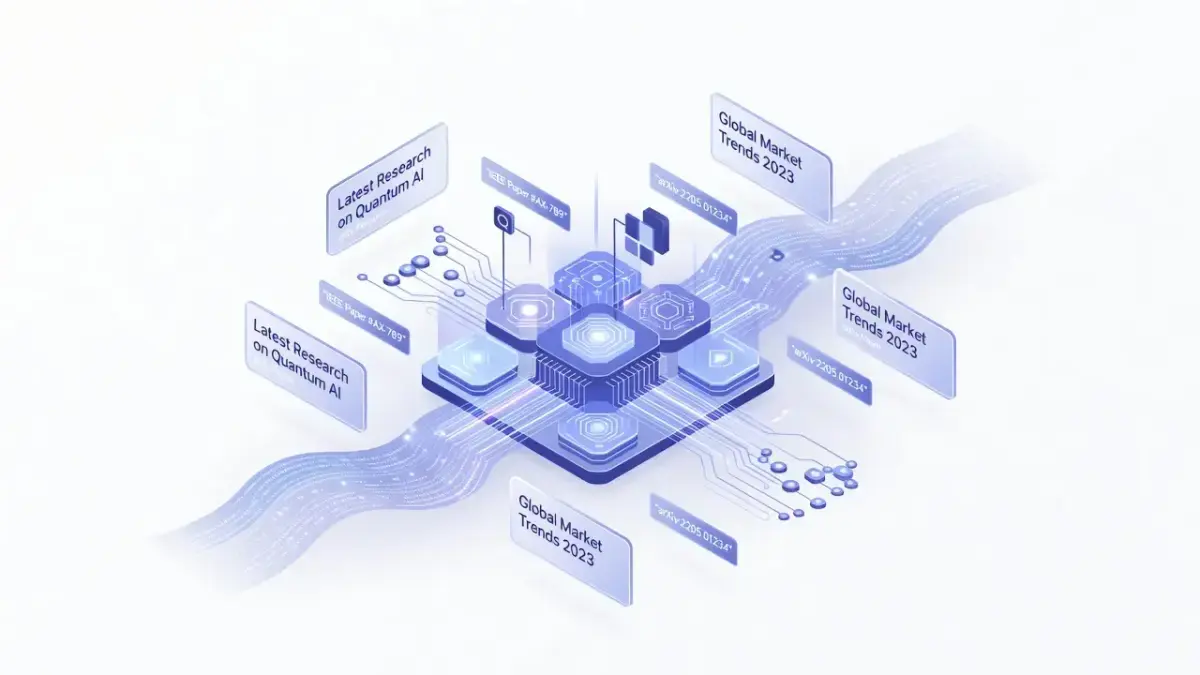
AI answer engines are conversational search systems that synthesize live web data into direct, structured responses rather than returning a list of links. Unlike legacy search engines that require users to click through multiple websites to assemble information, answer engines use retrieval-augmented generation (RAG) to scan top web results, extract key facts, and draft a single unified answer in real time.
For business owners and growth marketers, this shift changes how prospective customers find your brand online. While standard search engine optimization focused on ranking blue links, getting recommended by generative answer engines requires producing structured, highly factual content that AI models can lift and cite. Managing this shift manually across multiple research and writing tools can quickly become overwhelming. To streamline this workflow, PulseRank automates your entire organic strategy by researching search intent, drafting citation-ready articles, and publishing directly to your site.
What are AI answer engines and how do they work?
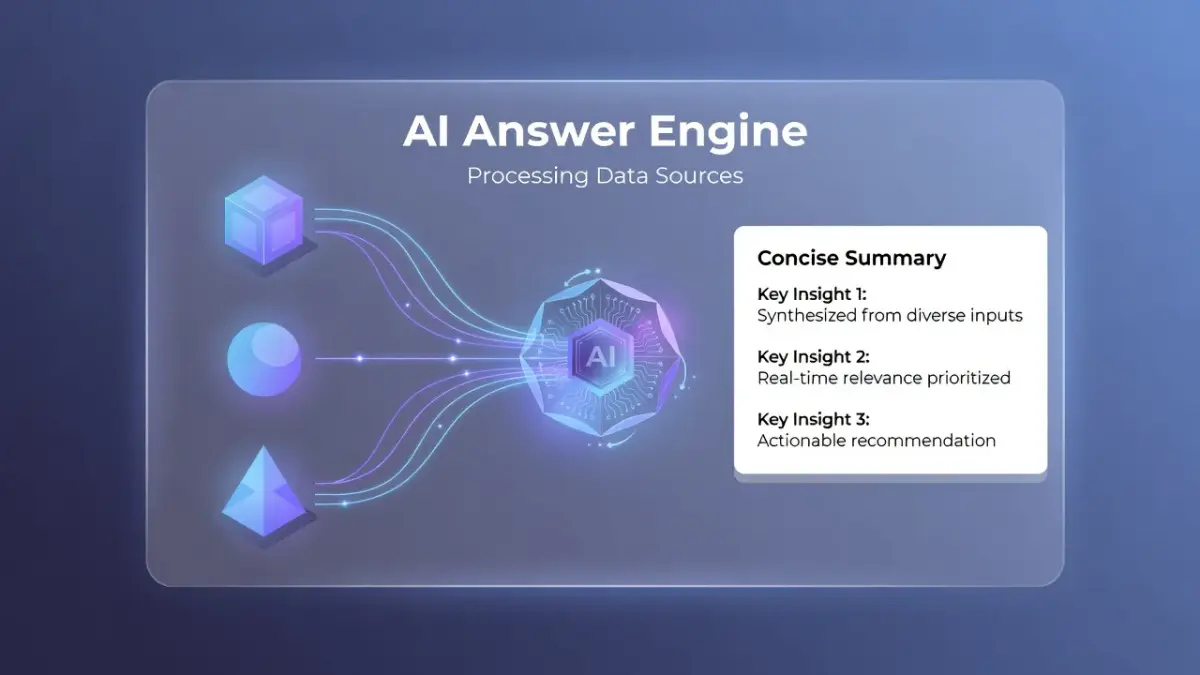
AI answer engines process search queries by combining real-time web search with natural language generation to provide instant, cited answers. Instead of relying solely on pre-trained internal memory, these systems launch background search queries, retrieve active web pages, and digest the information before presenting it to the user.
The technology behind this workflow relies on three main technical components:
- Query Decomposition: The engine breaks down complex user prompts into several smaller, targeted sub-queries.
- Web Retrieval and Parsing: Vector search algorithms retrieve high-authority web pages and extract the specific text passages that directly address those sub-queries.
- Generative Synthesis: Large language models synthesize those extracted passages into a cohesive response while embedding footnotes or inline citations pointing back to the primary sources.
Understanding these mechanics is essential for modern web strategy. If your digital content lacks direct answers, explicit data points, or clear formatting, retrieval algorithms skip over your pages during the parsing phase. To better align your site structure with generative search models, review our guide on answer engine optimization vs generative engine optimization.
How to manage your visibility across AI answer engines
Managing your business visibility across AI answer engines requires a continuous pipeline of structured, fact-dense content engineered for LLM retrieval. Because generative engines update their citations continuously based on web freshness and authority, publishing sporadic blog posts is no longer enough to maintain referral traffic.
To scale this process without building a massive content team, PulseRank provides an all-in-one platform for your organic content operation. For $499 per month, the platform executes your complete search strategy through the following native features:
- Sub-Question Keyword Research: Automatically discovers the exact follow-up questions AI models generate when researching your industry topics.
- Citation-Ready Article Generation: Writes complete, fully formatted articles equipped with data tables, inline image prompts, and verified third-party links.
- Automated Publishing: Connects directly to WordPress, Shopify, Wix, or Git repositories to publish one optimized article per day.
- Unified Reporting: Integrates Google Search Console metrics alongside AI citation tracking in a single dashboard to show exactly where your pages are cited.
Delegating content structure and indexing tasks to dedicated answer engine optimization services ensures your site stays visible across all major generative search interfaces without multiplying your software stack.
What are the best AI chatbots in 2026?
The best AI chatbots in 2026 are ChatGPT, Perplexity AI, Google Gemini, Anthropic Claude, and Microsoft Copilot. Each tool excels at specific business workflows, ranging from real-time web research and coding to long-document analysis and enterprise software integration.
Here is how the top options split by primary business use case:
- Perplexity AI: Best for fast, accurate web research with explicit source attribution and live citations.
- ChatGPT (OpenAI): Best all-around assistant for multimodal interaction, custom GPT workflows, and general task automation.
- Google Gemini: Best for teams deeply integrated into Google Workspace, Google Drive, and live web search.
- Anthropic Claude: Best for complex writing, large document analysis, and precise coding projects.
- Microsoft Copilot: Best for enterprise environments running Microsoft 365 applications like Word, Excel, and Teams.
Choosing the right platform depends on whether your daily focus is real-time research, creative drafting, or deep analytical tasks.
How do ChatGPT, Gemini, Claude, Perplexity and Bing Chat compare as AI answer engines?
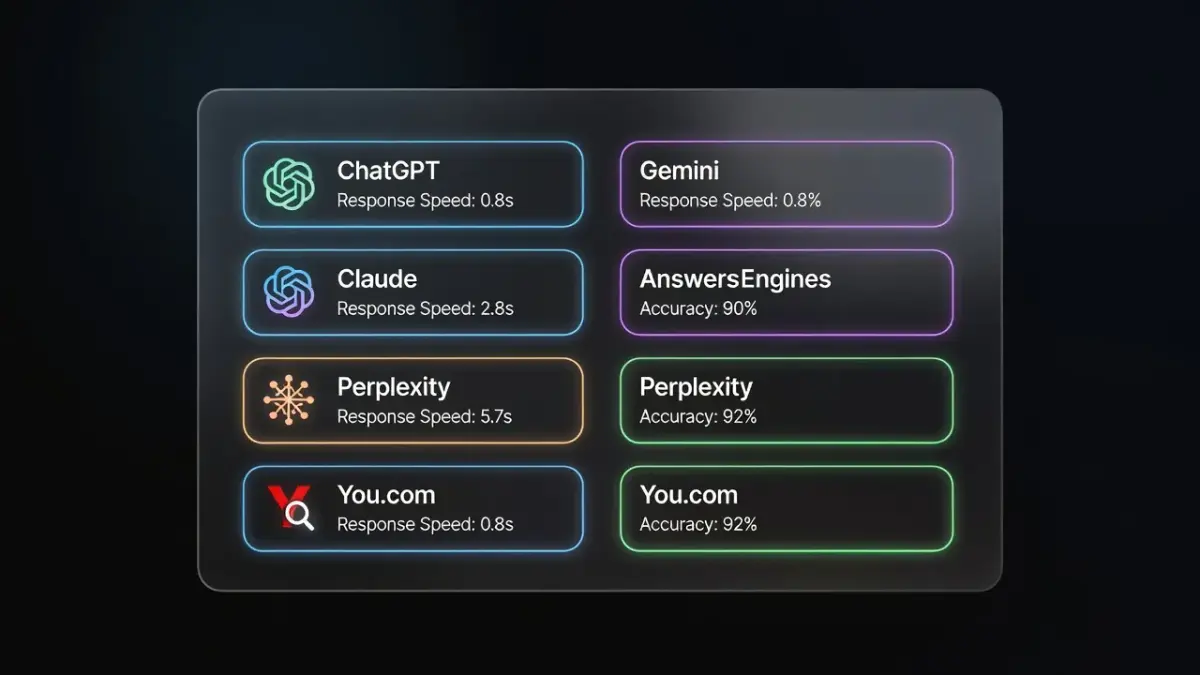
Perplexity and Bing Chat operate primarily as dedicated web answer engines, whereas ChatGPT, Gemini, and Claude balance conversational AI with real-time web retrieval. Selecting the right tool or optimization target depends on retrieval accuracy, context window sizes, and source transparency.
The table below outlines how these generative search platforms and optimization systems compare as of November 2026:
| Platform / Tool | Primary Category | Manual Constraint Removed | Target Strength / Distinction |
|---|---|---|---|
| PulseRank | Organic Content & GEO Platform | Removes manual keyword research, AEO formatting, and multi-tool reporting stacks | Automated daily content strategy, direct publishing, and GSC / AI citation tracking |
| Perplexity AI | Generative Answer Engine | Removes traditional link browsing by synthesizing live search queries | Deep, real-time citation accuracy with direct academic and web source links |
| ChatGPT (OpenAI) | Multimodal AI Assistant | Removes fragmented research and drafting workflows | Flexible plugin ecosystem, custom GPTs, and advanced reasoning via GPT-4o |
| Google Gemini | Workspace & Search AI Engine | Removes manual cross-referencing between web search and Google Docs | Native Google ecosystem integration and multimodal context processing |
| Anthropic Claude | Enterprise Reasoning Engine | Removes context limits when analyzing long reports and code bases | Exceptional technical writing quality and massive context window support |
| Microsoft Copilot (Bing) | Enterprise Productivity Search | Removes context-switching across Microsoft office suite apps | Native integration with Microsoft 365 enterprise data and Bing web index |
While consumer search engines focus on serving answers to end-users, platforms like PulseRank focus on helping businesses structure their web assets so these exact engines index and cite them continuously.
What is Perplexity AI like in 2026?
Perplexity AI in 2026 is the leading dedicated answer engine, processing billions of natural language queries with live source citations. Rather than functioning as a conversational chatbot that occasionally browses the web, Perplexity was built from the ground up as a conversational replacement for standard search engines.
According to official user documentation on Perplexity AI, the platform utilizes a multi-LLM architecture that lets users toggle between underlying models like GPT-4o and Claude 3.5 Sonnet while maintaining its proprietary search retrieval layer. Key features defining Perplexity include:
- Pro Search: Asks clarifying questions to refine complex prompts before running multi-step web searches.
- Collections: Organizes search threads, custom prompts, and uploaded files into shared team knowledge bases.
- Pages: Converts research threads into polished, shareable web articles with a single click.
For businesses looking to capture organic market share, appearing in Perplexity’s cited sources provides some of the highest-intent referral traffic available in modern search. Learn how to optimize your website for AI answer engines to earn those citations.
What is Anthropic Claude like in 2026, and what is its latest version?
Anthropic Claude in 2026 is defined by its Claude 3.5 model family, led by Claude 3.5 Sonnet, which sets industry benchmarks for technical writing, coding, and logical reasoning. Anthropic focuses heavily on steering safety, steerability, and long-form context processing.
As detailed on Anthropic, the platform features a massive 200,000-token context window on standard tiers, allowing users to upload entire books, complex code repositories, or quarterly financial reports in a single prompt.
Major features of the Claude platform include:
- Artifacts: A split-screen interface that displays generated code, interactive UI designs, and long documents side-by-side with the chat window.
- Projects: Custom workspaces where teams can upload shared documentation to ground Claude’s responses in internal company knowledge.
- Computer Use API: Allows the AI model to interpret screen pixels, move cursor coordinates, and operate desktop applications automatically.
Claude’s focus on natural tone and nuanced language makes it particularly effective for drafting complex enterprise communications and analyzing intricate operational data.
What are ChatGPT's latest features, including GPT-4o?
ChatGPT’s latest capabilities center on GPT-4o, OpenAI’s flagship flagship flagship omni-model that processes text, vision, and real-time audio natively within a single architecture. This architecture significantly reduces latency while improving performance across visual reasoning and multilingual tasks.
As highlighted in OpenAI’s official release updates, GPT-4o brings several critical upgrades to the ChatGPT ecosystem:
- Real-Time Voice Mode: Enables conversational audio interactions with realistic inflection, tone adjustments, and natural interruption handling.
- Advanced Desktop Vision: Allows the model to view, analyze, and troubleshoot visual interfaces or live code running on a user's screen.
- Integrated Web Search: Blends real-time web browsing directly into responses, making ChatGPT a formidable answer engine alongside its creation tools.
To explore how AI models generate structured output for business content, read our guide on using an AI prompt for content creation.
What is Google Gemini like in 2026?
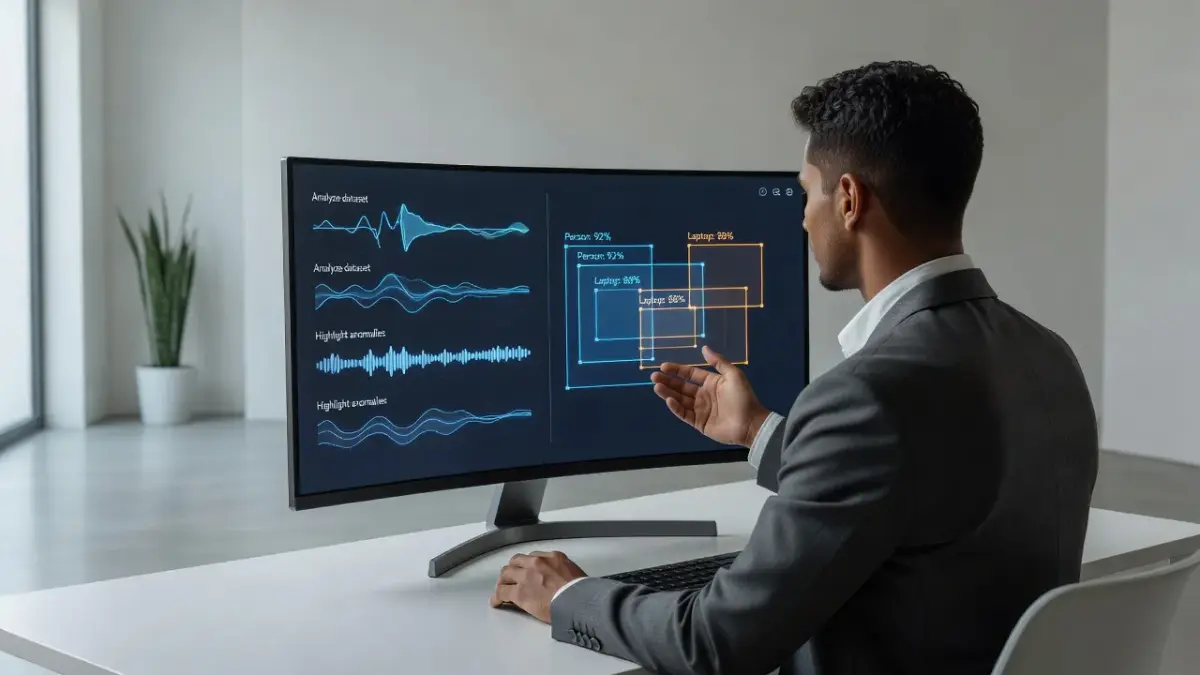
Google Gemini in 2026 represents Google’s deeply integrated multimodal AI ecosystem, power-housing AI Overviews in standard search alongside native workspace tools. Built natively to handle text, audio, image, and video data, Gemini powers both consumer search and enterprise productivity software.
As noted in Google's enterprise documentation on the Gemini platform, its competitive edge stems from direct access to Google's real-time web index and personal context across Google Workspace apps like Gmail, Docs, and Drive.
Key elements of Google Gemini include:
- 1 Million+ Token Context Window: Generates answers based on massive video uploads, large datasets, or lengthy PDF archives.
- AI Overviews: Displays AI-generated summaries at the very top of Google search results pages for broad informational queries.
- Gems: Custom-tuned versions of Gemini designed for specialized tasks like coding instruction or editorial review.
Because Google's standard search engine relies heavily on Gemini to summarize web content, structuring your website for generative readability directly impacts your traditional Google visibility as well.
Key AI answer engine trends for businesses
The dominant ai answer engine trends center on brand citation tracking, zero-click search behavior, and the convergence of organic search with AI optimization. As more consumers rely on generated summaries rather than clicking through link lists, traditional search strategies must evolve.
To maintain digital growth, business owners should track three critical industry shifts:
1. The Rise of Zero-Click Queries
When generative answer engines provide complete summaries directly on the search results page, users rarely click outward unless they require deeper context or transactional tools. Businesses must structure their pages to be the primary source cited within those summaries.
2. Multi-Engine Citation Monitoring
Brand tracking is no longer limited to monitoring rank positions on Google. Marketers must now track whether their products and services are recommended in generated answers across ChatGPT, Perplexity, Claude, and Gemini simultaneously. You can audit your current reach using our dedicated GEO analysis framework.
3. Fact Density over Keyword Volume
AI retrieval algorithms prioritize pages packed with unique data points, explicit numbers, and authoritative source links over pages stuffed with repetitive keyword variations. High factual density increases the probability that an LLM extracts your text as a verified truth snippet.
Frequently Asked Questions
What is the main difference between a traditional search engine and an AI answer engine?
Traditional search engines return a ranked list of website links based on keyword indexing, requiring the user to click through pages to find information. An AI answer engine uses large language models to read web sources in real time and synthesize a single direct, cited response.
Are AI answer engines accurate?
Most modern AI answer engines reduce hallucination risks by using Retrieval-Augmented Generation (RAG) to ground responses in live web sources. However, inaccuracies can still occur if the underlying web sources contain conflicting or outdated information.
How do I get my business cited by Perplexity and ChatGPT?
To get cited, publish structured, highly factual content that directly answers common customer sub-questions. Including clear data tables, schema markup, explicit statistics, and third-party references makes it easier for AI retrieval models to parse and quote your site.
Does AI answer engine optimization replace traditional SEO?
No, answer engine optimization (AEO) builds on top of traditional technical SEO. Search engines still need clean sitemaps, fast load times, and crawlable site structures to index your pages before AI models can synthesize them.
What is the best AI answer engine for business research?
Perplexity AI is widely considered the top choice for business research due to its explicit source links, real-time web retrieval, and dedicated thread organization tools.
Are AI answer engines free to use?
Most major AI answer engines offer robust free tiers with basic web searching, alongside paid subscriptions (typically $20/month) that unlock advanced reasoning models, larger context limits, and file upload capabilities.
How does PulseRank help with generative answer engines?
PulseRankautomates the content strategy needed for AI visibility by researching target sub-questions, generating citation-ready articles with tables and sources, and publishing them directly to your site while tracking Search Console performance and AI citations in one platform.