
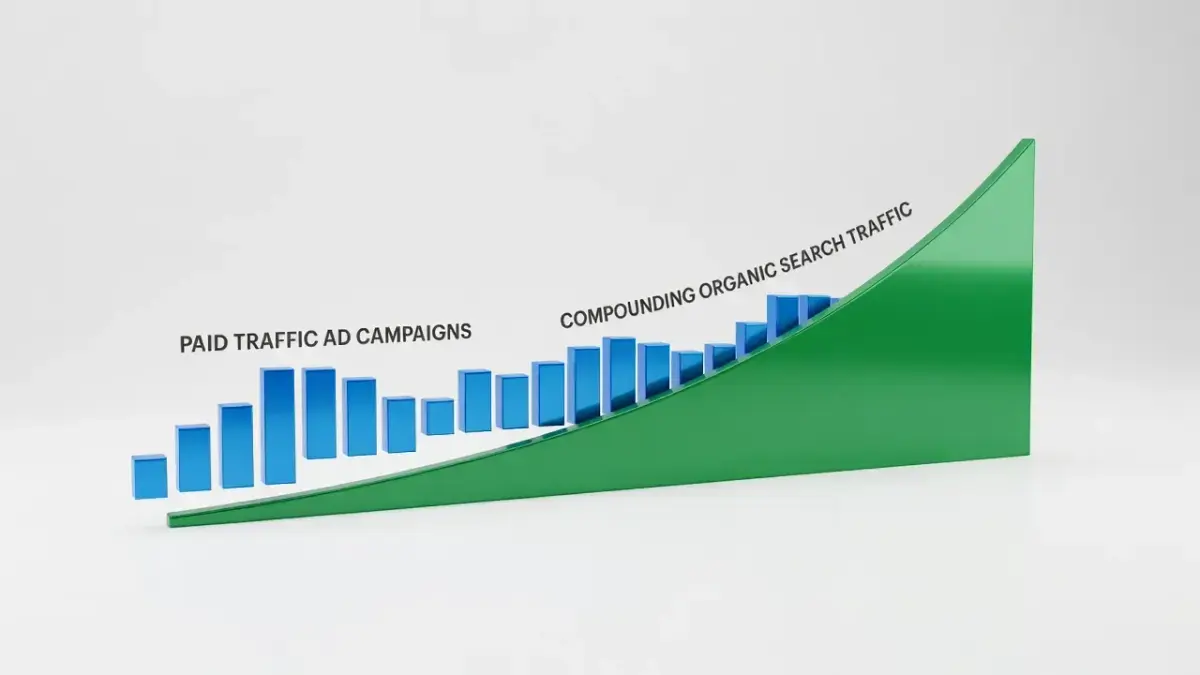
For most growing businesses, paid traffic provides immediate sales leads while organic traffic builds lower-cost, compounding customer growth over time. Choosing between paid traffic (such as Google Ads or Meta Ads) and organic traffic (such as search engine optimization) depends on your runway, cash flow, and target customer acquisition cost.
If you need sales by tomorrow morning, paid channels are your only option. If you want your traffic cost to decrease as your business grows over the next three years, organic search is where your budget belongs.
What is the fundamental difference between paid traffic and organic traffic?
The core difference between paid traffic and organic traffic is that paid traffic stops the moment you stop paying for ads, while organic traffic continues to visit your site long after the content is published. Paid acquisition functions like renting real estate, whereas organic acquisition functions like buying real estate.
Paid traffic includes any visitor who arrives at your website through a sponsored listing, banner ad, or promoted post. Channels like Google Search Ads, YouTube Ads, LinkedIn Sponsored Content, and Meta Ads charge you per click (CPC) or per thousand impressions (CPM). Once your daily advertising budget hits zero, your lead flow cuts off immediately.
Organic traffic consists of visitors who discover your brand naturally through search engine results, social media shares, or direct recommendations. When a searcher types a query into Google or an AI answer engine, organic search listings appear based on relevance and domain authority. To track these audience numbers correctly in your analytics setup, you can review this guide on Organic Traffic Google Analytics: How to Find and Track It.
Are marketers prioritizing paid traffic or organic traffic?
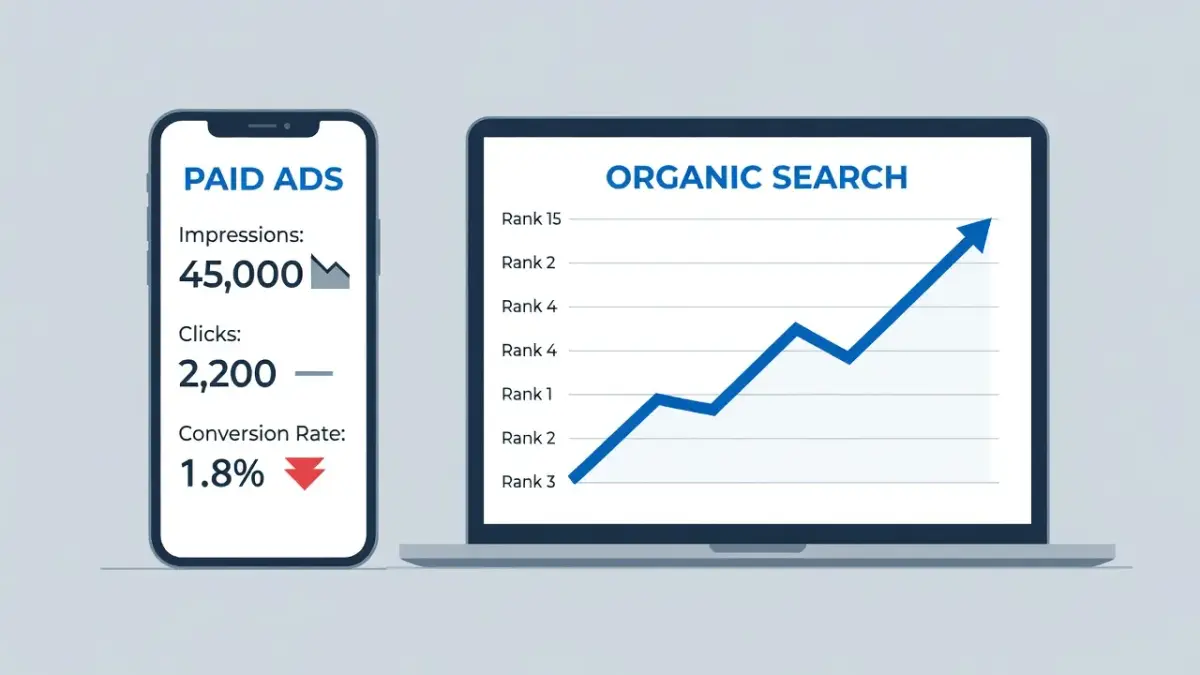
In 2026, most marketing teams prioritize a blended strategy that uses paid traffic for immediate demand generation and organic traffic for long-term margin protection. Neither channel operates effectively in total isolation for a scaling company.
Rising ad prices have forced many brands to re-evaluate their acquisition mix. According to performance data published in Search Engine Land's SEO vs PPC guide, pay-per-click costs across competitive industries have increased steadily over recent budget cycles. This inflation makes relying 100% on paid ads a dangerous strategy for thin-margin businesses.
Conversely, relying purely on organic traffic leaves a brand vulnerable to search engine algorithm updates. Modern growth teams use paid search to capture intent-heavy keywords with high purchase intent today, while simultaneously publishing targeted organic content to capture middle-of-funnel research traffic.
How are digital marketing budgets allocated between paid search and SEO?
Businesses typically allocate 60% to 70% of their search budget to paid ads during initial launch phases, shifting toward a 50/50 or 40/60 split in favor of organic channels as their domain authority matures. The exact split depends on business age and capital availability.
Early-stage companies frequently spend more on paid search because they lack the domain authority required to rank on page one of search engines. As an organic content footprint expands, the customer acquisition cost (CAC) of organic visitors drags down the total average acquisition cost across the entire business.
Industry benchmarks from HubSpot's Marketing Research show that mature B2B companies allocate substantial ongoing resources toward long-form content, technical site maintenance, and generative engine optimization (GEO). The primary objective is building an organic asset that produces leads independent of monthly ad spend.
Paid traffic vs organic traffic: channel comparison matrix
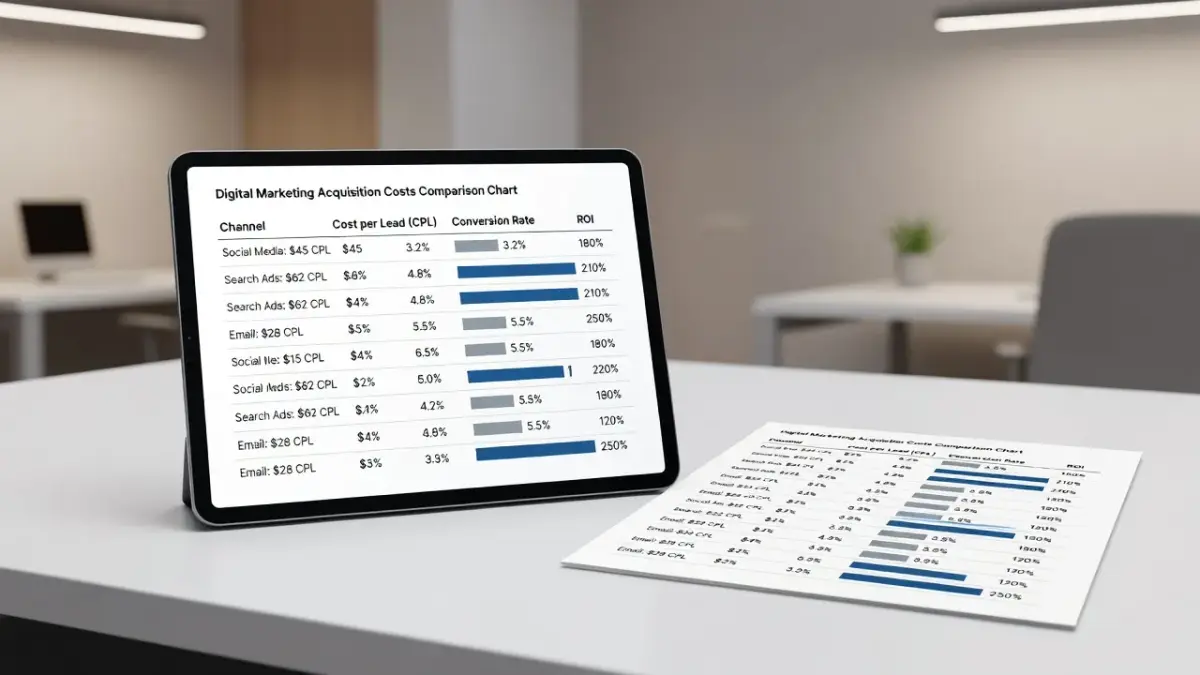
Comparing traffic acquisition channels requires balancing speed, cost sustainability, total effort, and long-term asset value. The table below compares the four primary methods businesses use to drive web traffic in 2026.
| Strategy Channel | Time to First Results | Monthly Cost Range | Scalability & CAC Trend | Primary Limitation / Risk |
|---|---|---|---|---|
| PPC & Paid Search (Google Ads, Bing) | 24 to 48 Hours | $1,000 - $50,000+ | Fast scaling; CAC increases as ad competition grows | Zero traffic residual; costs stop only when funding stops |
| Paid Social Ads (Meta, LinkedIn, TikTok) | 1 to 3 Days | $1,500 - $30,000+ | Moderate scaling; ad fatigue requires weekly creative refreshes | Disruptive intent; lower conversion rate than search ads |
| Automated Content Platforms (PulseRank) | 30 to 90 Days | $499 flat plan | Rapid scaling; CAC drops significantly over 6-12 months | Requires steady indexation window for new domain authority |
| Manual Agency SEO (Custom In-House/Agency) | 6 to 12 Months | $3,000 - $15,000+ | Slow scaling; high fixed labor overhead | Long timeline before seeing measurable revenue return |
This matrix illustrates why single-channel dependence is risky. Paid ads provide fast feedback, but automated organic publishing platforms like PulseRank offer a predictability curve that traditional agency retainers rarely match.
When should a business invest heavily in paid traffic?
You should prioritize paid traffic when you need instant audience testing, rapid product launches, or immediate sales during seasonal spikes. Paid acquisition is unmatched when speed is your primary constraint.
Here are the specific scenarios where paid traffic makes the most financial sense:
- Testing new offer messaging: You can run $500 worth of Google Ads over a weekend to test three headline variations. The click-through data tells you what your audience responds to before you write a line of organic content.
- Promoting time-sensitive events: If you are running a flash sale or hosting a live webinar next Thursday, organic search will not index your landing page fast enough to fill seats.
- Retargeting warm site visitors: People who abandoned a shopping cart or left a contact form half-filled are prime candidates for paid retargeting ads across Meta or display networks.
- Dominating commercial intent keywords: For terms like "emergency plumber near me" or "enterprise payroll software pricing," buying the top ad placement ensures you show up before the organic listings.
As documented in Google Ads Documentation, paid campaigns allow precise targeting by location, device type, user intent, and audience demographics. However, if your business model cannot absorb high cost-per-click rates, paid traffic can eat your profit margins rapidly.
When should a business focus primarily on organic traffic?
Focus on organic traffic when your target customer acquisition costs are rising and you need sustainable, compounding lead generation. Organic search provides a defensible moat against competitors who rely exclusively on paid media budget.
Organic traffic excels in several critical areas:
- Building trust and authority: Searchers frequently skip sponsored ads to click top organic listings because they view organic rankings as an objective endorsement by the search engine.
- Capturing informational search intent: Customers ask dozens of research questions before they are ready to buy. Writing helpful articles for these queries captures potential buyers at the top of the sales funnel.
- Lowering long-term CAC: A comprehensive piece of content written today can bring qualified traffic to your business in three years without costing a single extra ad dollar.
- Winning in generative search engines: AI answer engines pull their citations directly from indexed organic pages rather than sponsored ad units.
To understand how non-paid channels divide into distinct tracking groups inside analytics platforms, review this comparative breakdown of Direct vs Organic Traffic: Differences and GA4 Tracking (2026).
How do automated SEO platforms combine content production and technical management?
Automated SEO platforms streamline organic traffic creation by handling keyword research, content production, publishing, and search reporting in a single unified system. This approach removes the heavy labor bottlenecks that traditionally made organic search slow and expensive.
For years, small and medium businesses faced a tough choice: spend $5,000 per month on an agency or spend 20 hours a week writing articles manually. Automated systems eliminate that trade-off by handling the end-to-end publishing workflow directly.
- Keyword Research
- Content Strategy
- Automated Writing
- CMS Publishing
- Search Console Analytics
This is where PulseRank fits into a modern acquisition strategy. Rather than paying an agency thousands of dollars for sporadic deliverables, PulseRank runs your entire organic content operation for a flat $499 per month.
The platform handles your keyword research, builds a custom 30-day content strategy, and publishes one citation-ready article per day directly to your site (WordPress, Shopify, Wix, or Git repositories). It also includes automated image generation with SEO alt text, structured data tables, sourced third-party links, and internal linking.
By integrating Google Search Console reporting directly into its dashboard, you can track keyword rankings and monitor whether AI search engines are citing your content, all without managing multiple tool subscriptions.
If you are currently refining your long-term organic playbook, you can follow this 5-step roadmap on How to Drive Organic Traffic Generation in 2026: 5 Steps.

How do you calculate the real ROI of paid traffic versus organic traffic?
Calculating paid traffic ROI relies on comparing immediate ad spend against gross revenue, whereas organic traffic ROI factors upfront content production costs against lifetime traffic value. Evaluating these returns requires different formulas.
Paid traffic ROI calculation
Paid search return is straightforward because the spend and revenue occur in close proximity.
$$\text{Paid ROI} = \frac{\text{Revenue generated from ads} - \text{Total ad spend}}{\text{Total ad spend}} \times 100$$
If you spend $5,000 on Google Ads in October 2026 and generate $15,000 in direct product sales, your paid ROI is 200%. However, as soon as November begins, you must spend another $5,000 to maintain that revenue volume.
Organic traffic ROI calculation
Organic traffic return must be evaluated over a multi-month or multi-year horizon.
$$\text{Organic ROI} = \frac{\text{Lifetime revenue from organic leads} - (\text{Production costs} + \text{Tool software costs})}{\text{Production costs} + \text{Tool software costs}} \times 100$$
If an automated platform like PulseRank costs $499 per month ($5,988 annually) and generates 50,000 organic visits over 12 months, your cost per visitor drops to roughly $0.12. If those visitors produce $40,000 in high-margin sales, your organic ROI exceeds 560%, and that content asset continues to drive traffic into subsequent years. To estimate what that traffic would cost on paid channels, check Ahrefs organic traffic value.
Frequently Asked Questions
Which is better for small businesses: paid traffic or organic traffic?
Most small businesses should start with a small, focused paid ad campaign to generate immediate cash flow while simultaneously building an organic content engine. Relying only on paid ads can strain cash flow, while relying only on organic traffic takes time to produce revenue.
How long does it take for organic traffic to outpace paid traffic?
Organic traffic typically takes three to six months to show meaningful momentum. Once an organic content strategy matures, the volume of unpaid search visitors often outpaces paid ad traffic at a far lower per-lead cost.
Does paid ad spend improve organic search rankings directly?
No, running Google Ads or social media ads does not directly boost your organic search engine rankings. Search engines maintain a strict separation between their advertising platforms and organic search algorithms.
Why is customer acquisition cost (CAC) higher on paid traffic?
Paid traffic CAC rises over time because ad space is sold through competitive auctions. As more competitors bid on the same targeted keywords, the cost-per-click increases regardless of your conversion rate.
Can AI answer engines generate organic traffic for my website?
Yes, generative search engines synthesize answers using top-ranked organic content and display inline citations linking back to the source sites. Optimizing content for these sub-questions allows you to capture traffic from AI search queries.
What is the average conversion rate difference between paid and organic traffic?
Paid search traffic often converts slightly higher on immediate transactional landing pages because the ads target high-intent buying terms. However, organic search traffic usually yields higher overall lead quality because buyers consume informative content before converting.