

Affiliate links SEO is the practice of qualifying commercial outbound links with proper link attributes so search engines do not pass page rank or penalize a site for unnatural link patterns. When you place monetization links on your website, search engines like Google expect explicit signals that distinguish paid recommendations from editorial citations. Properly managing these outbound links prevents search engine penalties while preserving your domain authority.
Building an affiliate site requires balancing monetization with high-quality content. Managing outbound links alongside a full publishing schedule often creates operational bottlenecks for growing businesses. Platforms like PulseRank handle organic content strategy by building comprehensive editorial plans and publishing optimized articles directly to your CMS, helping site owners maintain search compliance while scaling traffic.

What do Google's guidelines say about nofollow and sponsored for affiliate links?
Google's official guidelines mandate that all monetization links - including affiliate links, paid recommendations, and sponsored placements - must use specific rel attributes to prevent passing PageRank. According to Google Search Central's documentation on link spam, passing link equity through paid links violates search engine policies and can trigger manual actions or automated ranking demotions.
Search engines expect site owners to classify commercial links using one of two attributes: rel="sponsored" or rel="nofollow". Google introduced the rel="sponsored" attribute specifically to give site owners an explicit tag for paid or commercial agreements. If you do not qualify these links, search crawlers treat them as natural editorial recommendations, which distorts their ranking algorithms.
Failing to mark commercial outbound connections carries real ranking risks:
- Algorithmic demotions: The SpamBrain system actively detects pattern anomalies in outbound link networks and strips value from undisclosed paid links.
- Manual action penalties: Human evaluators at Google can issue sitewide penalties if your site shows widespread unflagged commercial links.
- Lost crawling budget: Excessive un-queried outbound redirects force search spiders to waste crawling budget on third-party destination pages.
To learn more about managing link flow across your entire site, review our detailed guide on outbound links SEO rules and best practices.
Should affiliate links use rel=sponsored, rel=nofollow, or rel=ugc?
Affiliate links should primarily use rel="sponsored", though rel="nofollow" remains a completely valid secondary option accepted by Google. You should reserve rel="ugc" exclusively for links submitted directly by users within forum threads, blog comments, or user reviews.
Google created rel="sponsored" in September 2019 as the precise micro-declaration for monetization. However, if your content management system (CMS) only supports rel="nofollow", you do not need to rewrite your site's codebase. Google explicitly accepts legacy nofollow tags for affiliate links without penalty.
The following table breaks down how to apply these link attributes across different scenario types on your site.
| Link Attribute Tag | Primary Purpose | Applied to Affiliate Links? | Algorithmic Treatment |
|---|---|---|---|
rel="sponsored" | Paid links, affiliate links, and commercial sponsorships | Recommended | Treated as a hint that no link equity should pass |
rel="nofollow" | General untrusted content or legacy monetization links | Acceptable | Legacy directive; hints to crawlers to ignore link weight |
rel="ugc" | User-generated content (comments, user forum posts) | Incorrect | Hints that content was submitted by external visitors |
rel="dofollow" (Default) | Standard editorial recommendations and citations | Never use for affiliate links | Full link equity passes to the destination URL |
You can also combine attributes when appropriate. For example, using rel="sponsored nofollow" works seamlessly across older browsers while explicitly signaling commercial intent to modern search engines.
What has John Mueller said about affiliate links and rel=sponsored?
Google Search Advocate John Mueller has repeatedly confirmed that affiliate links are not inherently harmful to SEO as long as they carry a rel="sponsored" or rel="nofollow" tag. Mueller clarified that search engines fully understand the commercial business models of affiliate websites and do not penalize sites simply for trying to earn revenue.
In multiple Google Search Central office hours sessions, Mueller stated that the presence of affiliate links alone will not cause a site to drop in rankings. Instead, problems arise when site owners fail to add qualifying tags or post low-effort merchant descriptions wrapped around affiliate links.
Key insights from Mueller's statements include:
- Attribute flexibility: Google accepts both
rel="sponsored"andrel="nofollow"interchangeably for affiliate links without favoring one over the other for ranking purposes. - No algorithmic bonus: Switching legacy
rel="nofollow"tags over torel="sponsored"will not produce a sudden ranking boost; both tell Google to ignore the link for PageRank calculations. - Focus on unique content: The primary vector for affiliate site demotion is lack of original value, not the referral links themselves.

How content strategy protects sites from link-related ranking drops
Maintaining search compliance across hundreds of published articles takes consistent effort. Many business owners make the mistake of spending thousands of dollars on expensive manual auditing tools or enterprise SEO software suites to manually update old links.
Instead of juggling multiple disjointed keyword research tools, writer contracts, and compliance plugins, PulseRank offers a unified platform for organic content operations. For $499 per month on a flat subscription, PulseRank plans your keyword strategy, writes citation-ready articles structured for modern AI search engines, and publishes them straight to your site (WordPress, Shopify, Wix, or Git).
Every piece generated through PulseRank includes built-in search engine compliance, data tables, structured external citations, and automatic internal linking. This allows business owners to focus on growing their core offer while their content pipeline remains fully compliant with search guidelines.
How do you use affiliate links without hurting SEO?
You can safely use affiliate links without hurting SEO by placing them within valuable, original content and managing their structure using technical best practices. Adding affiliate links to high-quality pages will not damage your domain performance if you follow standard technical parameters.
To build a durable affiliate site that survives search core updates, adopt these five core practices:
- Implement link cloaking and redirection: Route internal tracking links through a clean subfolder (such as
yourdomain.com/recommend/product-name) using a standard 302 or 307 temporary redirect. This keeps your outbound URLs neat and makes sitewide management simple. - Apply attributes globally: Ensure your redirect plugin or CMS automatically injects
rel="sponsored"orrel="nofollow"onto every commercial URL string. - Block redirect folders via robots.txt: Prevent search engine bots from spending crawl budget on your internal affiliate redirect paths by adding
Disallow: /recommend/to yourrobots.txtfile. - Maintain a healthy link-to-text ratio: Avoid overwhelming a page with affiliate calls-to-action. Aim for contextual placement within long-form paragraphs rather than repeating buttons after every sentence.
- Use standard white hat SEO tactics: Focus on sustainable optimization patterns. To explore these methods further, review our guide on white hat SEO techniques.
# Example robots.txt disallow rule for affiliate link redirects
User-agent: *
Disallow: /recommend/
Disallow: /go/
By keeping outbound commercial pathways organized, you protect your site from unexpected indexation issues while maintaining clean site architecture.
What do FTC guidelines require for affiliate link disclosure?
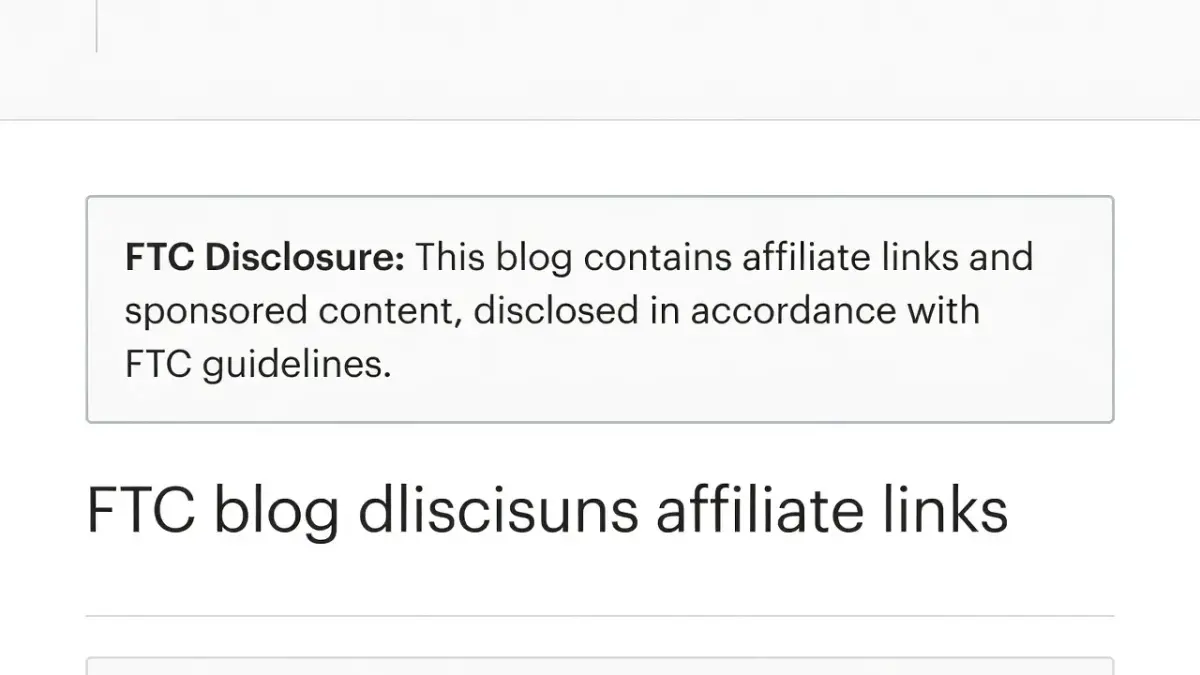
Federal Trade Commission (FTC) guidelines require site owners to provide clear, conspicuous, and unavoidable disclosures on any page containing affiliate links before visitors click those links. According to the FTC's Endorsement Guides, readers must understand your financial relationship with a merchant prior to making a purchasing decision.
Meeting FTC disclosure standards requires adhering to four key rules:
- Placement matters: Place disclosures above the fold, near the top of your article, or directly adjacent to the commercial link. Never relegate disclosures exclusively to a footer link or a generic Privacy Policy page.
- Unambiguous phrasing: Use explicit phrasing such as "As an Amazon Associate, I earn from qualifying purchases" or "I receive a referral commission if you buy through my link." Avoid vague terms like "partner link" or "sponsored affiliate link."
- Visual visibility: Use text colors that contrast sharply with your background so the notice stands out clearly on both desktop and mobile screens.
- Pre-click positioning: Updated FTC guidance enforced throughout 2026 mandates that disclosures must appear before a reader encounters an actionable referral link.
How do you avoid thin content on affiliate sites?
You avoid thin content on affiliate sites by publishing original product testing, comparative analyses, custom media, and expert opinions that cannot be found on the merchant's store page. Search engines actively penalize affiliate pages that simply scrape descriptions, feature lists, and stock photos directly from sites like Amazon or Shopify.
Google's quality evaluator guidelines emphasize E-E-A-T (Experience, Expertise, Authoritativeness, and Trustworthiness). To demonstrate genuine experience, your content must offer unique insights that help buyers make informed decisions.
Consider these proven techniques for elevating content quality:
- Include real product photos and original video: Avoid relying entirely on manufacturer stock images; upload your own media showing the product in practical use.
- Publish comparative performance data: Run hands-on tests and present the outcomes inside custom Markdown tables.
- Highlight product flaws: Genuine reviews discuss both pros and cons. Pages that offer uncritical praise often trigger automated spam filters for commercial bias.
- Map out clear user search intent: Build comprehensive strategies around what your potential customers are searching for. For a deeper look at scaling high-value content, check out our guide on organic traffic generation.
Focusing on substantial value creation ensures that your site maintains high search engine rankings regardless of algorithm changes.
Evaluating the cost of affiliate SEO tools and management
Building an affiliate platform involves real costs, and choosing the wrong stack can drain your budget quickly. Businesses frequently buy separate software tools for every step of their workflow, resulting in expensive monthly subscriptions.
Here is a look at what traditional affiliate content stacks typically cost site owners each month:
- Enterprise keyword research platforms: $119 to $499 per month for access to search volumes and keyword tracking.
- Content optimization suites: $89 to $199 per month for real-time document recommendations.
- Freelance writers and editors: $300 to $1,200 per long-form review article when paying for subject matter experts.
- Compliance and link auditing tools: $49 to $149 per month to detect unflagged outbound links.
When you add these services together, running a consistent publishing schedule can cost upwards of $1,500 to $3,000 every single month.
By contrast, using an all-in-one system like PulseRank brings your keyword research, content planning, article generation, image creation, and automated publishing into a single flat $499 per month workflow. This eliminates high per-article fees and keeps your site covered by complete SEO compliance out of the box.
Frequently Asked Questions
Do affiliate links hurt my website's Google rankings?
No, affiliate links do not hurt your rankings if they use proper attributes like rel="sponsored" or rel="nofollow". Google permits commercial referral links as long as you disclose them properly and embed them within valuable, original content.
Is rel="sponsored" mandatory for all affiliate links?
While rel="sponsored" is Google's preferred attribute for commercial links, using rel="nofollow" is still completely acceptable. Both attributes signal to search engines that link equity should not pass to the destination page.
What happens if I forget to add nofollow or sponsored to affiliate links?
Forgetting to qualify your affiliate links can lead to algorithmic ranking drops or manual spam penalties. Google may view unflagged commercial links as an attempt to manipulate search engine rank through paid link schemes.
Can I use dynamic link cloaking on my affiliate site?
Yes, redirecting affiliate links through internal subfolders like /recommend/ using 302 or 307 temporary redirects is completely safe for SEO. Just ensure your robots.txt file blocks search engines from crawling those redirect paths.
Does the FTC fine websites for missing affiliate disclosures?
Yes, the FTC actively enforces rules against undisclosed endorsement links and can fine non-compliant publishers. You must place clear disclosures above the fold on any page containing commercial referral links.
How many affiliate links can I place on a single page?
There is no rigid link limit, but placing too many affiliate links creates a poor user experience and signals low content quality. Keep links contextual and natural within long-form content rather than clustering affiliate buttons together.
Will changing rel="nofollow" to rel="sponsored" boost my SEO rankings?
No, switching from rel="nofollow" to rel="sponsored" will not produce a direct ranking boost. Both attributes instruct search engine crawlers to ignore the link for PageRank calculations.