

A ranking engine is a software system that scores, filters, and orders vast collections of data to present the most relevant results to a user query. Modern engines do not rely on simple keyword matches anymore. Instead, they combine lexical keyword searching, dense vector retrieval, and machine-learning rerankers to process billions of pages in milliseconds.
If your business relies on web traffic, understanding how these underlying engines work is no longer optional. Search engines like Google and generative answer engines like Perplexity use multi-stage ranking algorithms to evaluate every page you publish. Outdated strategies like basic keyword stuffing fail because modern ranking architectures measure semantic context, query intent, and content structure.
To keep pace with these architectural shifts, platforms like PulseRank handle the technical heavy lifting for business owners. PulseRank structures your organic content strategy around the exact sub-questions AI engines evaluate, delivering turn-key articles published directly to your CMS for a flat $499 per month.
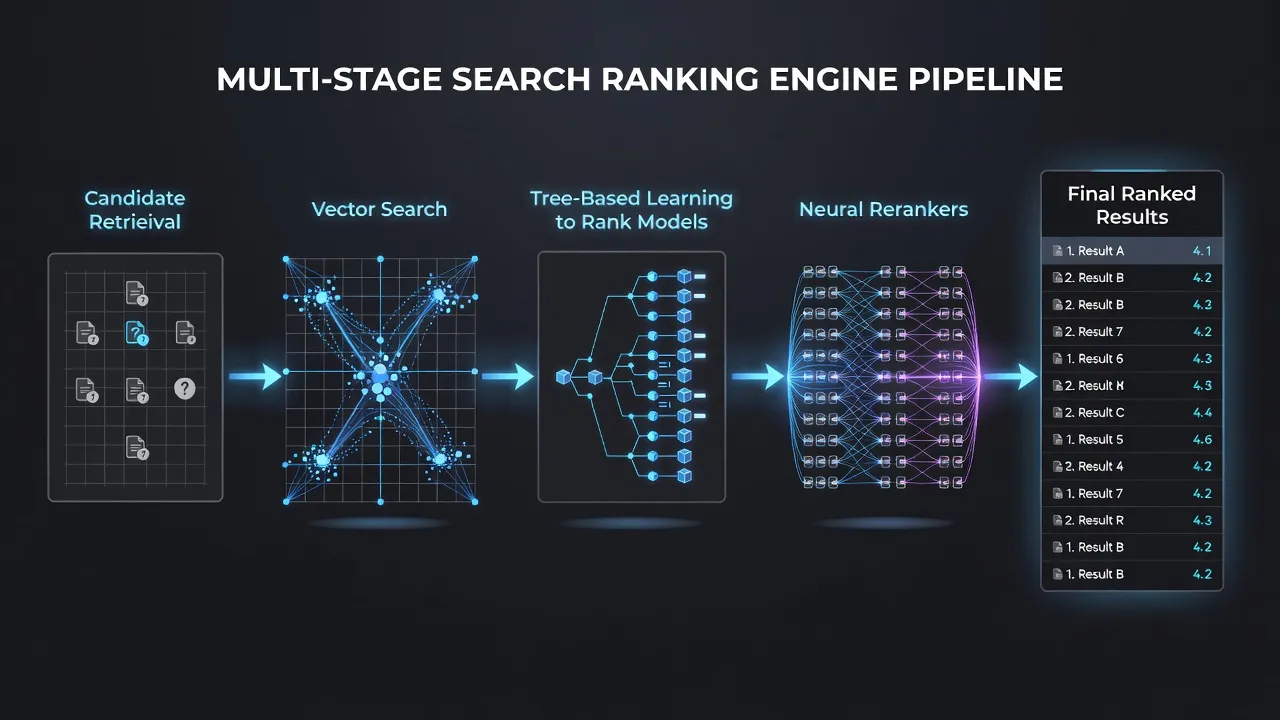
What has changed in modern ranking engine design?
Traditional ranking engines relied strictly on exact keyword matching, but modern production systems use multi-stage neural architectures. As of August 2026, old single-pass lexical search systems are largely obsolete for commercial web engines.
Historically, engines used algorithms like TF-IDF or early BM25 implementations to count terms in a document. Today, computing at scale requires a tiered approach:
- Candidate Retrieval (Stage 1): Fast algorithms pull thousands of potentially relevant documents from millions of candidates in less than 20 milliseconds.
- Feature Scoring & LTR (Stage 2): Machine learning models score candidate documents using hundreds of user, query, and document signals.
- Neural Reranking (Stage 3): Large deep-learning models evaluate the top 50 to 100 results for deep semantic understanding before final output.
Because this multi-stage pipeline is expensive to run, ranking engines balance speed with accuracy. To earn top rankings, your content must satisfy both the fast first-stage filters and the deep semantic cross-encoders used in final scoring. You can explore how AI-driven platforms manage this in our guide to generative engine optimization tools.
Is LambdaMART used as a production ranking algorithm?
Yes, LambdaMART remains one of the most widely deployed Learning to Rank (LTR) algorithms in production search systems, particularly within tree-based ensembles. It combines Gradient Boosted Decision Trees (GBDT) with LambdaRank to optimize listwise ranking metrics directly.
In a traditional regression model, the system tries to predict an absolute score for a document. LambdaMART changes this by evaluating document pairs and clusters. It optimizes directly for metrics like Normalized Discounted Cumulative Gain (NDCG), which heavily rewards getting the top three search results right.
LambdaMART scales efficiently because decision trees evaluate numerical features in microsecond bursts. Major e-commerce platforms and search engines rely on LambdaMART variants during second-stage candidate scoring because deep neural networks are often too slow to evaluate thousands of documents per query.
Are XGBoost, LightGBM, and CatBoost used for learning to rank in production?
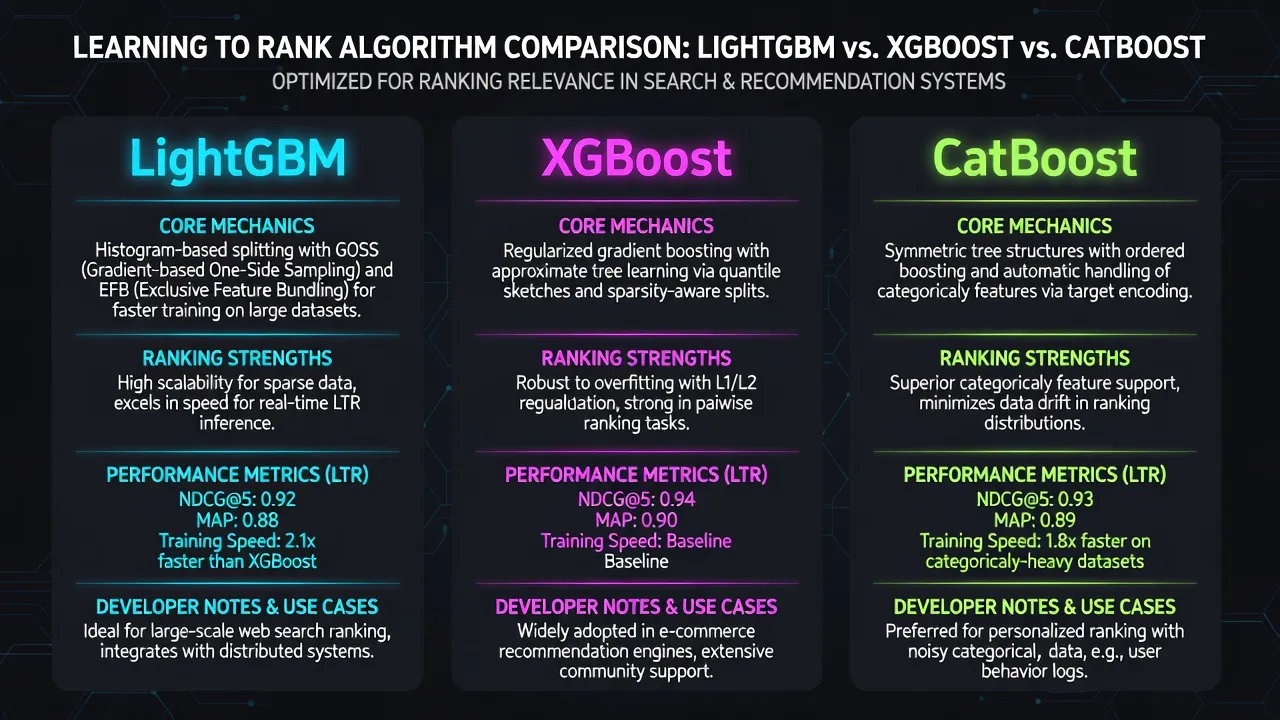
Yes, gradient boosted decision tree (GBDT) libraries like XGBoost, LightGBM, and CatBoost are industry-standard tools for production Learning to Rank tasks. These open-source frameworks provide fast implementations of pairwise and listwise ranking objectives tailored for high-throughput environments.
Engineers choose among these three tools based on specific production constraints:
- LightGBM: Known for extreme speed and low memory footprint. Microsoft's official LightGBM documentation details built-in support for
lambdarankobjectives, making it popular for real-time web engines. - XGBoost: Highly stable and widely supported across cloud data pipelines, offering robust pairwise ranking methods (
rank:pairwise). - CatBoost: Superior at processing categorical features (like user region, brand category, or device type) without needing extensive manual feature engineering.
Most web-scale ranking engines run tree-based models on CPUs to handle high request volumes cheaply. They process features like document age, historical click-through rates, author authority, and term frequency in parallel.
How is BM25 combined with a BERT reranker in a production pipeline?
In a modern multi-stage ranking pipeline, BM25 acts as an efficient first-stage retriever to pull candidate documents, while a BERT-based model acts as a second-stage cross-encoder to re-score top candidates. This hybrid setup balances speed and deep semantic comprehension.
Running a Transformer model like BERT over millions of web documents for every incoming query would crush server infrastructure. The computation is far too heavy.
- User Query enters Stage 1: BM25 / Vector, which performs fast filtering to produce 1,000 candidates
- The 1,000 candidates from Stage 1 enter Stage 2: BERT Cross-Encoder, which performs deep scoring on the top 50-100 items
- Stage 2 produces Final Ranked Search Results
To solve this, the engine runs Okapi BM25 on inverted indexes to quickly reduce millions of web pages down to roughly 1,000 candidates. Then, a fine-tuned BERT cross-encoder processes those top 1,000 items.
BERT analyzes word relationships bi-directionally, recognizing subtle context, synonyms, and search intent that simple term matching misses entirely. Combining BM25 candidate generation with BERT reranking forms the backbone of modern web search platforms.
How are neural ranking models (BERT, dense retrieval) adopted in production?
Production systems adopt neural ranking models primarily through a decoupled, multi-stage architecture where dense retrieval bi-encoders handle candidate generation and cross-encoders perform heavy semantic reranking. This split prevents latency spikes during live search.
Dense retrieval replaces standard word indexes with mathematical vector embeddings. A neural model converts the user's query into a dense vector (a sequence of floating-point numbers) and compares it against pre-computed document vectors in a database.
The adoption curve in production environments follows two key patterns:
- Bi-Encoders (Dense Passage Retrieval): The query and documents are encoded into vectors separately. This allows vector calculations to execute in milliseconds, ideal for initial search retrieval.
- Cross-Encoders: The query and document are fed into the neural network together. As described in Google's original BERT research paper, cross-encoders capture rich interactions between words but require far more computing power, limiting their use to the final stage of ranking.
Businesses seeking consistent search visibility must produce content structured for both retrieval types. Working with specialized answer engine optimization services ensures your articles contain clear entity definitions for bi-encoders and direct answers for cross-encoders.
How is FAISS (or vector search like HNSW/Annoy) used in production?
Production engines use FAISS and vector search algorithms like HNSW to execute sub-millisecond approximate nearest neighbor (ANN) lookups over high-dimensional vector embeddings. These libraries locate semantically similar documents without scanning every record in the database.
Searching through millions of 768-dimensional vectors line-by-line causes severe performance bottlenecks. Vector indexing algorithms overcome this limitation:
- HNSW (Hierarchical Navigable Small World): Builds multi-layer graphs that guide the search query rapidly toward nearby vector clusters. It provides exceptional search speed and recall accuracy.
- FAISS (Facebook AI Similarity Search): Developed by Meta AI, this framework optimizes GPU and CPU memory management to run vector lookups at massive scale.
- Annoy (Approximate Nearest Neighbors Oh Yeah): Uses random projection trees to optimize memory usage, making it ideal for static, read-only indexes.
In a live ranking engine, FAISS retrieves the top semantic candidate matches alongside lexical BM25 results. The system merges these candidate lists before handing them off to tree-based LTR models or cross-encoder models for final sorting.
Which companies (Netflix, Google, Amazon) use learning to rank in production?
Tech giants including Google, Netflix, Amazon, Airbnb, and Spotify rely heavily on Learning to Rank (LTR) pipelines to personalize search, recommendations, and product listings. These algorithms adapt continuously based on user engagement metrics.
Each company tailors its ranking engine to specific business objectives:
- Google: Uses multi-tier LTR systems alongside RankBrain and MUM to evaluate hundreds of web ranking factors simultaneously.
- Amazon: Employs LTR models to balance keyword relevance against conversion probability, fulfillment speed, and seller ratings.
- Netflix: Uses LTR algorithms to order movie thumbnails, personalized rows, and genre lists based on past watch history and time of day.
- Airbnb: Combines deep learning embeddings with LambdaMART to rank property listings using query filters, guest preferences, and host acceptance rates.
Understanding how these platforms organize data highlights a key truth: ranking engines care about clear patterns, relevance signals, and accurate structured data.
How do ranking engine components compare across pipeline stages?
Modern ranking engines split workload across distinct architectural stages, balancing computational costs against retrieval accuracy. The table below contrasts how different technologies function within a production ranking engine.
| Pipeline Stage | Primary Technologies | Main Purpose | Typical Latency | Key Output |
|---|---|---|---|---|
| PulseRank Content Pipeline | Auto-KW Research, GEO Optimization, Direct CMS Publishing | Creates citation-ready articles structured for modern AI ranking engines | Automated (30-day workflow) | Structured, fully-indexed organic articles |
| First-Stage Lexical Retrieval | Okapi BM25, Elasticsearch, Lucene | Quickly filters millions of documents down to relevant keyword matches | 5 - 15 ms | Top 1,000 - 5,000 raw candidate IDs |
| First-Stage Dense Retrieval | FAISS, HNSW, Annoy, Bi-Encoder Embeddings | Retrieves semantically related candidates without exact keyword overlap | 10 - 30 ms | Top 1,000 semantic candidate IDs |
| Second-Stage Feature Scoring | LightGBM, XGBoost, CatBoost (LambdaMART) | Ranks candidates using broad user signals, CTR, document age, and quality metrics | 20 - 50 ms | Re-ordered list of top 100 - 200 items |
| Final Neural Reranking | BERT, MonoBERT, Cross-Encoders | Applies deep contextual comprehension to determine final top-10 positions | 50 - 150 ms | Final sorted search result list |
How can business owners optimize for modern ranking engines?
To rank on modern search engines, businesses must shift from simple keyword targeting to intent-based context building. AI answer engines and traditional search platforms prioritize pages that give direct, structured answers to specific sub-questions.
If you want your website to capture high-intent traffic, build content using these core principles:
- Answer Questions Immediately: Place direct summary answers right below every heading so first-pass neural parsers extract your content easily.
- Use Clear Schema and Data Tables: Present factual data, terms, and comparisons in clean Markdown or HTML tables that algorithms can lift cleanly.
- Cover Topic Clusters Fully: Provide deep context on sub-topics so dense retrieval models associate your brand domain with the broader concept.
- Anchor Claims with Real Sources: Citation systems favor articles that cite verifiable sources across independent domains.
Executing this process manually across dozens of topics requires significant time and engineering overhead. Many organizations streamline this workflow by using PulseRank.
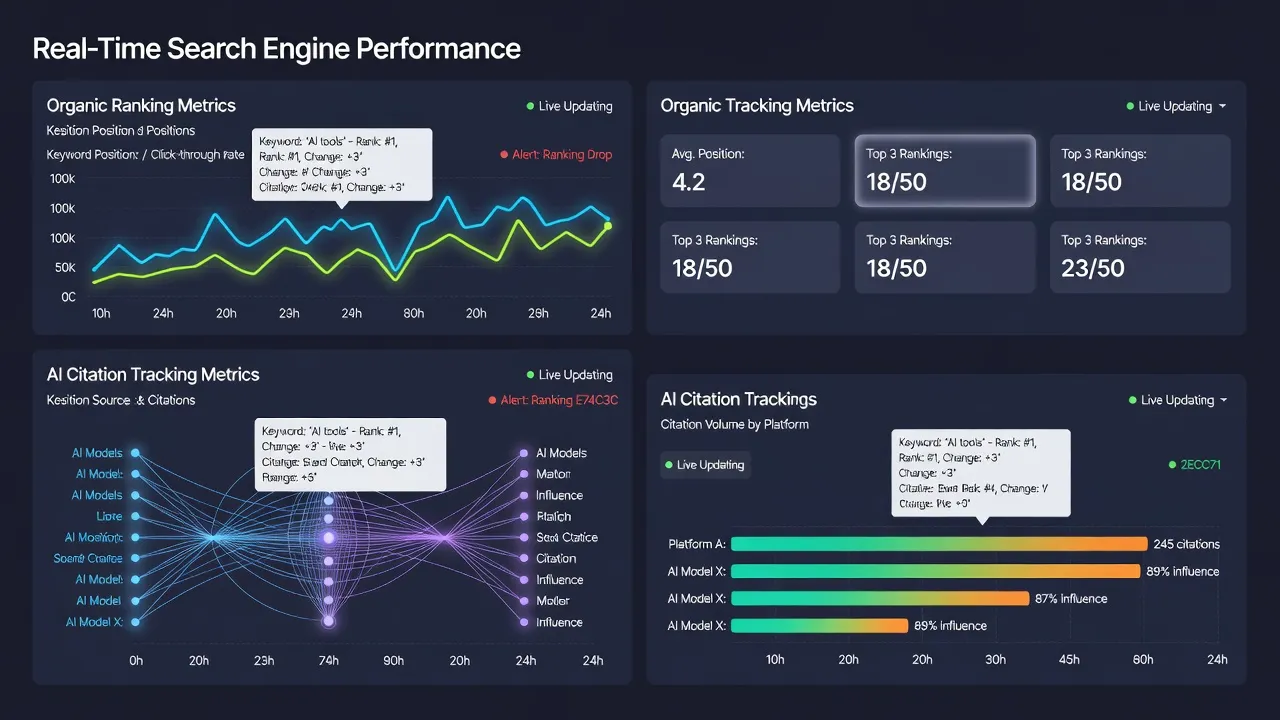
PulseRank automates keyword research, builds structured 30-day content strategies, writes comprehensive articles tuned for AI answer engines, and publishes them straight to your site. Combined with built-in Google Search Console analytics and AI citation tracking, it gives growing businesses an end-to-end strategy for scalable organic traffic generation.
Frequently Asked Questions
What is the difference between search engine optimization and ranking engine optimization?
Search engine optimization focuses traditional tactics on engines like Google, whereas ranking engine optimization considers modern multi-stage AI retrieval, vector search indexing, and answer engine citation pipelines.
Why do ranking engines use multi-stage pipelines instead of one model?
Single deep learning models are too compute-heavy to scan millions of documents in real time. Multi-stage pipelines use fast, cheap filters early on and save heavy neural models for the top candidate documents.
How does dense vector retrieval differ from traditional BM25 search?
BM25 looks for exact term matches in an inverted index. Dense vector retrieval converts text into mathematical embeddings, enabling the system to match documents based on meaning even if they share zero keywords.
What metric does LambdaMART optimize for in search engines?
LambdaMART primarily optimizes listwise metrics like Normalized Discounted Cumulative Gain, which places the heaviest mathematical weight on placing correct results in the top search positions.
Can a business rank in AI search engines without using structured data?
While possible, missing structured data makes it harder for vector indexes and cross-encoder rerankers to extract factual answers cleanly, lowering your overall citation rate.
How often do modern ranking engines update their scoring models?
Large platforms adjust algorithmic features and retraining models continuously, often running automated daily or weekly LTR model updates based on user engagement logs.